I can't help wondering lately, what a public reading of Lepanto might stir up.
And then I wonder, what would a public reading of The Ballad of the White Horse stir up? Would all of the Sons of Viking Raiders come out of the woodwork, and claim that they were not being depicted fairly? Would heirs of the Norsemen cry out for vengeance? Would there be any violence? Would King Alfred be re-written in the history books as a war-mongering interfering dictator?
Saturday, September 30, 2006


Friday, September 29, 2006
We Begin the Battle Today
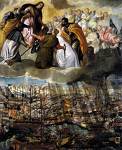
Er, I mean the novena. Today is the Feast of St. Michael the Archangel, and in nine days (isn't the Church clever?) is the Feast of the Victory of the Battle of Lepanto, aka, Our Lady of Victory.
Here's the plan, via Dr. Thursday:
Pray everyday for Peace, for the Pope, for the Muslims. If you pray the rosary (a significant factor in the Victory at Lepanto), pray the sorrowful mysteries each day. If you are Catholic, try to get to mass each day.
That's it. Please join us in prayer.
Thursday, September 28, 2006
Rebuilding the bridge
One of the most amazing lines written by GKC, which might almost be my own motto these days, was a line I first read in a book about GKC:
1. "Interpreter of Science"
2. "Antagonist of Scientism"
3. "Critic of Evolutionism"
4. "Champion of the Universe"
People have been trying to deny, refute, or otherwise despise GKC's very technical background, but Jaki provides all the rebuttals with full references to the relevant literature - meaning GKC's books. (That book is available through the ACS. And if you want to know Jaki's other books on science, religion, and history, visit Real View Books.
I have to laugh when I read the Luddites saying "I am not a Luddite" on TV or in magazines or bloggs - those who try to abolish technology with technology - indeed, I have to laugh, because for them GKC had a great reply:
But there are some who wouldn't believe, even if they saw GKC sitting in front of a microphone...
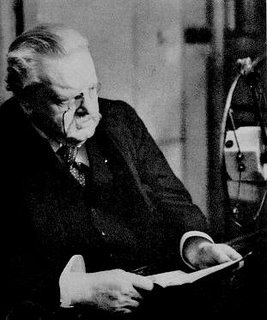
[GKC at the BBC microphone, sometime in the 1930s; from Maisie Ward's biography]
Here's some more of GKC on this very important topic:
Please don't be mechanical. As GKC said, "I have often thanked God for the telephone." [WWWTW CW4:112] So let us thank God for the INTERNET, and blogging, and computers, and refrigerators, and cars, and electricity...
The rebuilding of this bridge between science and human nature is one of the greatest needs of mankind.If you are interested in science, mathematics, engineering, and technology - or if you are a "lit'ry" scholar, or a historian - or even if you are a "tech-muggle" and try to ignore these fields while continuously relying on them - well, then I would strongly urge you to read this book. It is relatively small, only four chapters long - but contains GKC quotes from dozens and dozens of his books. The four chapters are called:
[S. L. Jaki, Chesterton a Seer of Science quoting GKC, The Defendant]
1. "Interpreter of Science"
2. "Antagonist of Scientism"
3. "Critic of Evolutionism"
4. "Champion of the Universe"
People have been trying to deny, refute, or otherwise despise GKC's very technical background, but Jaki provides all the rebuttals with full references to the relevant literature - meaning GKC's books. (That book is available through the ACS. And if you want to know Jaki's other books on science, religion, and history, visit Real View Books.
I have to laugh when I read the Luddites saying "I am not a Luddite" on TV or in magazines or bloggs - those who try to abolish technology with technology - indeed, I have to laugh, because for them GKC had a great reply:
A cosmos one day being rebuked by a pessimist replied, "How can you who revile me consent to speak by my machinery? Permit me to reduce you to nothingness and then we will discuss the matter."
Moral. You should not look a gift universe in the mouth.
[quoted in Ward, Gilbert Keith Chesterton]
But there are some who wouldn't believe, even if they saw GKC sitting in front of a microphone...
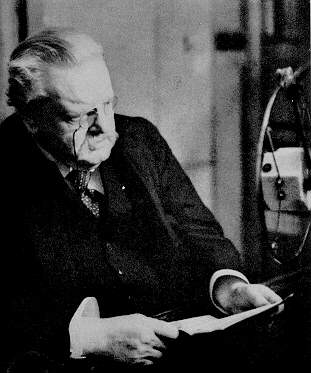
[GKC at the BBC microphone, sometime in the 1930s; from Maisie Ward's biography]
Here's some more of GKC on this very important topic:
The child is, indeed, in these, and many other matters, the best guide. And in nothing is the child so righteously childlike, in nothing does he exhibit more accurately the sounder order of simplicity, than in the fact that he sees everything with a simple pleasure, even the complex things. The false type of naturalness harps always on the distinction between the natural and the artificial. The higher kind of naturalness ignores that distinction. To the child the tree and the lamp-post are as natural and as artificial as each other; or rather, neither of them are natural but both supernatural. For both are splendid and unexplained. The flower with which God crowns the one, and the flame with which Sam the lamplighter crowns the other, are equally of the gold of fairy-tales. In the middle of the wildest fields the most rustic child is, ten to one, playing at steam-engines. And the only spiritual or philosophical objection to steam-engines is not that men pay for them or work at them, or make them very ugly, or even that men are killed by them; but merely that men do not play at them. The evil is that the childish poetry of clockwork does not remain. The wrong is not that engines are too much admired, but that they are not admired enough. The sin is not that engines are mechanical, but that men are mechanical.
[GKC, Heretics CW1:112-3, emphasis added]
Please don't be mechanical. As GKC said, "I have often thanked God for the telephone." [WWWTW CW4:112] So let us thank God for the INTERNET, and blogging, and computers, and refrigerators, and cars, and electricity...
Wednesday, September 27, 2006
Gilbert got tagged

The Geography Guy started an interesting game, and Gilbert thought it was so interesting, that he sent his responses to me, via Dr. Thursday.
1. A Place You've Visited and Your Favorite Thing there
(Poland)
When I visited Poland, I was honoured by an invitation from the Government; but all the hospitality I received was far too much alive to remind me of anything official. There is a sort of underground tavern in Warsaw, where men drink Tokay, which would cure any official of officialism; and there they sang the marching songs of the Poles. Cracow is now even more the national city because it is not the capital... I was driving with a Polish lady, who was very witty and well-aquainted with the whole character of Europe, and also of England (as is the barbarous habit of the Slavs); and I only noticed that her tone changed, if anything to a sort of coolness, as we stopped outside an archway leading to a side-street, and she said, "We can't drive in here." I wondered; for the gateway was wide and the street apparently open. As we walked under the arch she said in the same colourless tone; "You take off your hat here." And then I saw the open street. It was filled with a vast crowd, all facing me; and all on their knees on the ground. It was as if someone were walking behind me; or some strange bird were hovering over my head. I faced around, and saw in the centre of the arch great windows standing open, unsealing a chamber full of gold and colours; there was a picture behind; but parts of the whole picture were moving like a puppet-show, stirring strange double memories like a dream of the bridge in the puppet-show of my childhood; and then I realised that from those shifting groups there shone and sounded the ancient magnificence of the Mass.
[Autobiography CW16:306-7]
2. A Country You'd Like to Visit and Why
(Europe)
There is one good test and one only of whether a man has travelled to any profit in Europe. An Englishman is, as such, a European, and as he approaches the central splendours of Europe he ought to feel that he is coming home. If he does not feel at home he had much better have stopped at home. England is a real home; London is a real home; and all the essential feelings of adventure or the picturesque can easily be gained by going out at night upon the flats of Essex or the cloven hills of Surrey. Your visit to Europe is useless unless it gives you the sense of an exile returning. Your first sight of Rome is futile unless you feel that you have seen it before.
[Appreciations and Criticisms of the Works of Charles Dickens CW15:372-3]
3. A Place From History You'd Like to Visit and Why
(the Dark Ages; England under the Plantagenets)
The whole object of history is to enlarge experience by imagination. And this sort of history would enlarge neither imagination nor experience. The whole object of history is to make us realize that humanity could be great and glorious, under conditions quite different and even contrary to our own. It is to teach us that men could achieve most profitable labour without our own division of labour. It is to teach us that men could be industrious without being industrial. It is to make us understand that there might be a world in which there was far less improvement in the transport for visiting various places, and there might still be a very great improvement in the places visited. The professor is perfectly right in saying that a history of the Plantagenet period ought not merely to record the presence of kings and armies. But what ought it to record? Is it to record only the absence of motors and electric lights? Should we say nothing of the Plantagenet period except that it did not have motor-bikes? I venture to suggest that we might record the presence of some things which the whole people had then and have not got now, such as the guilds, the great popular universities, the use of the common lands, the fraternity of the common creed. I fear the professor will not follow me into matters so disturbing to his perfect picture of progress. But, in conclusion, there is one little question I should like to ask him, and it is this. If you cannot see Man, divine and democratic, under the disguises of all the centuries, why on earth should you suppose you will be able to see him under the disguises of all the nations and tribes? If the Dark Ages most be as dark as they look, why are the black men not so black as they are painted? If I may feel supercilious towards a Chaldean, why not towards a Chinaman? If I may despise a Roman for not having a steam-plough, why not a Russian for not wanting a steam-plough? If scientific industry is the supreme historical test, it divides us as much from backward peoples as from bygone peoples. It divides even European peoples from each other.
["Much Too Modern History" in Fancies Versus Fads]
4. A Place You Know a Lot About
(England)
...the strangest country I ever visited was England; but I visited it at a very early age, and so became a little queer myself. England is extremely subtle; and about the best of it there is something almost secretive; it is amateur even more than aristocratic in tradition; it is never official. Among its very valuable and hardly visible oddities is this. There is one type of Englishman I have very frequently met in travel and never met in books of travel. He is the expiation for the English tripper; he may be called the English exile. He is a man of good English culture quite warmly and unaffectedly devoted to some particular foreign culture. ... Maurice Baring had exactly that attitude towards Russia and Professor Eccles towards France. But I have met a particularly charming Anglo-Irish academic gentleman doing exactly the same work of penetrating with sympathy the soul of Poland; I have met another searching out the secrets of Spanish music in Madrid; and everywhere they are dotted about on the map, doing not only something for Europe but very decidedly something for England; proving to Lithuanian antiquaries or Portuguese geographers that we are not all bounders and boosters; but come of the people that could interpret Plutarch and translate Rabelais. They are a microscopically small minority; like nearly every English group that really knows what is going on; but they are a seed and therefore a secret.
[Autobiography CW16:302-3]
5. A Place You'd Like to Learn More About
(my own home)
We have read of some celebrated philosopher who was so absent-minded that he paid a call at his own house. My own absentmindedness is extreme, and my philosophy, of course, is the marvel of men and angels. But I never quite managed to be so absent-minded as that. Some yards at least from my own door, something vaguely familiar has always caught my eye; and thus the joke has been spoiled. Of course I have quite constantly walked into another man's house, thinking it was my own house; my visits became almost monotonous. But walking into my own house and thinking it was another man's house is a flight of poetic detachment still beyond me. Something of the sensations that such an absent-minded man must feel I really felt the other day; and very pleasant sensations they were. The best parts of every proper romance are the first chapter and the last chapter; and to knock at a strange door and find a nice wife would be to concentrate the beginning and end of all romance.
["The Hypothetical Householder" in A Miscellany of Men]
6. A Fictional Place You'd Like to Visit
(the home of the Princess in George MacDonald's The Princess and the Goblin)
I am speaking of what may emphatically be called the presence of household gods - and household goblins. And the picture of life in this parable is not only truer than the image of a journey like that of the Pilgrim's Progress, it is even truer than the mere image of a siege like that of The Holy War. There is - something not only imaginative but intimately true about the idea of the goblins being below the house and capable of besieging it from the cellars. When the evil things besieging us do appear, they do not appear outside but inside. Anyhow, that simple image of a house that is our home, that is rightly loved as our home, but of which we hardly know the best or the worst, and must always wait for the one and watch against the other, has always remained in my mind as something singularly solid and unanswerable; and was more corroborated than corrected when I came to give a more definite name to the lady watching over us from the turret, and perhaps to take a more practical view of the goblins under the floor. Since I first read that story some five alternative philosophies of the universe have come to our colleges out of Germany, blowing through the world like the east wind. But for me that castle is still standing in the mountains and the light in its tower is not put out.
[GKC's introduction to George MacDonald and His Wife, by Greville M. MacDonald, collected in GKC as MC]
Tuesday, September 26, 2006
Chestertoniana for Christmas
I know it's early, but I was shopping at Kohl's yesterday and noticed they had some Christmas decorations up and out already, and that the Halloween stuff was already on sale. I think, correct me if I'm wrong, that Halloween isn't for another month. So why the stuff is on sale now, I don't know. Maybe to make room for the Christmas stuff.
Anyway, it got me thinking that now would be a good time to do some Christmas shopping at the American Chesterton Society, where you can get everything from books to beer to bumper stickers.
Another great gift idea is a Gilbert magazine subscription for either yourself, your Uncle, your neighbor, your library, and if you already give to all those people, you can even donate a subscription to someone who is in prison, longing for the mental freedom that Chesterton offers.
So, take advantage of these early offers. You'll be done shopping before everyone else, and will be able to take advantage of all the early bird shopping deals. They are the same as the late shopping deals, except that you'll have the peace of mind of knowing you are done. ;-)
Anyway, it got me thinking that now would be a good time to do some Christmas shopping at the American Chesterton Society, where you can get everything from books to beer to bumper stickers.
Another great gift idea is a Gilbert magazine subscription for either yourself, your Uncle, your neighbor, your library, and if you already give to all those people, you can even donate a subscription to someone who is in prison, longing for the mental freedom that Chesterton offers.
So, take advantage of these early offers. You'll be done shopping before everyone else, and will be able to take advantage of all the early bird shopping deals. They are the same as the late shopping deals, except that you'll have the peace of mind of knowing you are done. ;-)
Monday, September 25, 2006
Quotemeisters Request
I have a group of teens coming over this afternoon for a philosophical discussion. The topic: What is Love?
Is there a succinct and appropriate Chestertonian quote that applies?
I have a vague memory of something GKC said about faith isn't faith unless....hope isn't hope unless....charity isn't charity unless....
Is there a succinct and appropriate Chestertonian quote that applies?
I have a vague memory of something GKC said about faith isn't faith unless....hope isn't hope unless....charity isn't charity unless....
Saturday, September 23, 2006
The Scouring of the White Horse
G.K.Chesterton was fascinated by the idea of the White Horse on Britian's hillside, and the fact that people must continuously free it of weeds and work on it to keep it the visible landmark that it is.
He also spoke of a white fence post, that must continuously be scraped and repainted, if it is to remain white.
In this way, he reminds us that when things look right and are going ok, we must still work to keep them that way, they won't just "stay fixed."
That reminds me of the movie "The Incredibles" where, in the opening interview with Mr. Incredible, he says something like, "You know, sometimes I wish the world would just stay fixed, ya know? I mean, it's like, sometimes I feel like the maid: I just cleaned up in here! Could you just keep it clean for just a little while?"
But the world just doesn't stay fixed, does it?
He also spoke of a white fence post, that must continuously be scraped and repainted, if it is to remain white.
In this way, he reminds us that when things look right and are going ok, we must still work to keep them that way, they won't just "stay fixed."
That reminds me of the movie "The Incredibles" where, in the opening interview with Mr. Incredible, he says something like, "You know, sometimes I wish the world would just stay fixed, ya know? I mean, it's like, sometimes I feel like the maid: I just cleaned up in here! Could you just keep it clean for just a little while?"
But the world just doesn't stay fixed, does it?
Friday, September 22, 2006
More Common Sense
I think thinking has gone out of style.
It seems to be the fashion not to think. Although in order to get some thoughts (and thus be an interesting person) people do pick up the thoughts of others, and then spout them as if they were their own, whether or not they make sense.
And some of the people are so far gone, they don't even know that they aren't thinking. They think --so to speak--that by getting all emotional and angry over things, that that really shows they've put a lot of thought into what they believe.
What do you think?
It seems to be the fashion not to think. Although in order to get some thoughts (and thus be an interesting person) people do pick up the thoughts of others, and then spout them as if they were their own, whether or not they make sense.
And some of the people are so far gone, they don't even know that they aren't thinking. They think --so to speak--that by getting all emotional and angry over things, that that really shows they've put a lot of thought into what they believe.
What do you think?
Thursday, September 21, 2006
A Boy is not a Ford
Nancy Brown, always taking the motherly, which is to say Chestertonian, view of things, even on her walks, or her ponderings of Potter... you do not believe me? See her blogg for more.
--Dr. Thursday
...the folly of merely driving all women from the family to the factory. It is in the cold economic sense a waste; it is uneconomic in the full sense of being thriftless. For, obviously, such a neglect of family feeling is the neglect of a natural force, which must be replaced by an artificial and, therefore, an expensive force. If the mother must not take an interest in her children, somebody else must be paid to do what she alone could have a particular pleasure in doing. Examples of silliness on a gigantic scale are recorded of some of the mad Roman emperors, and even of some of the old mad English squires...
[GKC ILN May 3, 1919 CW31:467]
I am concerned with pointing out that the passage from private life to public life, while it may be right or wrong, or necessary or unnecessary, or desirable or undesirable, is always of necessity a passage from a greater work to a smaller one, and from a harder work to an easier one. And that is why most of the moderns do wish to pass from the great domestic task to the smallest and easier commercial one. They would rather provide the liveries of a hundred footmen than be bothered with the love-affairs of one. They would rather take the salutes of a hundred soldiers than try to save the soul of one. They would rather serve out income-tax papers or telegraph forms to a hundred men than meals, conversation, and moral support to one. They would rather arrange the educational course in history or geography, or correct the examination papers in algebra or trigonometry, for a hundred children, than struggle with the whole human character of one. For anyone who makes himself responsible for one small baby, as a whole, will soon find that he is wrestling with gigantic angels and demons.
[GKC ILN Aug 12, 1922 CW32:427]
I have never understood myself how this superstition arose: the notion that a woman plays a lowly part in the home and a loftier part outside the home. There may be all sorts of excellent reasons for individuals doing or not doing either; but I cannot understand how the domestic thing can be considered inferior in the nature of the thing done. Most work done in the outer world is pretty mechanical work; some of it is decidedly dirty work. There seems no possible sense in which it is intrinsically superior to domestic work. Nine times out of ten, the only difference is that the one person is drudging for people she does care for and the other drudging for people she does not care for. But, allowing for the element of drudgery in both cases, there is rather more element of distinction, and even dictatorship, in the domestic case. The most fully trusted official must very largely go by rules and regulations established by superiors. The mother of a family makes her own rules and regulations; and they are not merely mechanical rules, but often very fundamental moral rules. Nor are they merely monotonous in their application. Mr. Ford is reported, rightly or wrongly, as saying that the woman should not be in the business of the outer world, because business people have to make decisions. I should say that mothers have to make many more decisions. A great part of a big business goes by routine; and all the technical part of Mr. Ford's business goes, quite literally, on oiled wheels. It is the very boast of such a system that its products are made rapidly because rigidly, upon a regular pattern, and can be trusted ninety-nine times out of a hundred to turn out according to plan. But a little boy does not, by any means, always turn out according to plan. The little boy will present a series of problems in the course of twenty-four hours which would correspond to a Ford car bursting like a bomb or flying out of the window like an aeroplane. The little boy is individual; he cannot be mended with spare parts from another little boy. The mother cannot order another little boy at the same works, and make the experiment work. The domestic woman really is called upon to make decisions, real or moral decisions, and she jolly well does. Some have even complained that her decisions were too decisive.
[GKC, ILN Nov 16, 1929 CW35:201-2]
Wednesday, September 20, 2006
Chesterton's Use of Time of Day
Have you ever noticed that when Chesterton is writing a story, quite often it is either dawn or dusk, the sky is usually flaming with color?
Here is a bit of greatness, taken from "The Sins of Prince Saradine."
Tomorrow, I'll post the dangerous part of this quote.
Here is a bit of greatness, taken from "The Sins of Prince Saradine."
"...they awoke before it was light. To speak more strictly, they awoke before it was daylight; for a large lemon moon was only just setting in the forest of high grass above their heads, and the sky was of a vivid violet-blue, nocturnal but bright. Both men had simultaneously a reminiscence of childhood, of the elfin and adventurous time when tall weeds close over us like woods. Standing up thus against the large low moon, the daisies really seemed to be giant daises, the dandelions to be giant dandelions. Somehow, it reminded them of the dado of a nursery wallpaper. The drop of the river-bed sufficed to sink them under the roots of all shrubs and flowers and make them gaze upwards at the grass.
'By Jove,' said Flambeau, 'it's like being in fairyland.'"
Tomorrow, I'll post the dangerous part of this quote.
Tuesday, September 19, 2006
The Woman Who Was Tuesday
I've always like Tuesday, I was born on a Tuesday, and growing up, my guitar lessons (classical) were always on a Tuesday. I have often thought of sevens as yellow and Tuesdays, this abberation of the mind, I've recently discovered, is called synesthesia, I also think of 4s as blue, etc. My daughter has this as well, but she has more, she thinks six and eight don't get along, one number is kind, another patient (I can't remember which), and many of the numbers have not only colors, but personalities.
Anyway, about being born on a Tuesday. Let's see. I was born in a car, in a parking lot of a hospital, at about 7 in the morning, on the seventh of the month, when the weather was cold, my dad grabbed a night shift nurse who was leaving for the day (punched out, too, no less) who had worked all night and wasn't a labor and delivery nurse, who told my mom she would make it into the hospital, and the immediately announced, "It's a boy!"
Well, she was a little flustered by her sudden off-duty employment.
After correcting herself and assuring my dad that I was, after all, another girl, they declared the whole scene unsanitary and put my mother and me in solitary confinement....ah, isolation.
Oh. The car was a 1959 Ford Custom. Green.
Anyway, about being born on a Tuesday. Let's see. I was born in a car, in a parking lot of a hospital, at about 7 in the morning, on the seventh of the month, when the weather was cold, my dad grabbed a night shift nurse who was leaving for the day (punched out, too, no less) who had worked all night and wasn't a labor and delivery nurse, who told my mom she would make it into the hospital, and the immediately announced, "It's a boy!"
Well, she was a little flustered by her sudden off-duty employment.
After correcting herself and assuring my dad that I was, after all, another girl, they declared the whole scene unsanitary and put my mother and me in solitary confinement....ah, isolation.
Oh. The car was a 1959 Ford Custom. Green.
Monday, September 18, 2006
Thanks Due to Dr. Thursday
Thank you Dr. Thursday for so beautifully handling this blog and stimulating such great conversations while I was taking a break.
To those of you who prayed for me, thank you. God is good, and I am fine.
To those of you who love Dr. Thurday's posts, he will be posting still on Thursdays (naturally), and you can also read his own blog.
Meanwhile, as I contemplate fairy stories, I will leave you with this thought:
"I find that there really are human beings who think fairy tales bad for
children. I do not speak of the man in the green tie, for him I can
never count truly human. But a lady has written me an earnest letter
saying that fairy tales ought not to be taught to children even if they
are true. She says that it is cruel to tell children fairy tales, because it
frightens them. You might just as well say that it is cruel to give girls
sentimental novels because it makes them cry. This kind of talk is
based on that complete forgetting of what a child is like which has
been the firm foundation of so many educational schemes. If you kept
bogies and goblins away from children they would make them up for
themselves. One small child in the dark can invent more hells than
Swedenborg. One small child can imagine monsters too big and black
to get into any picture, and give them names too unearthly and
cacophonous to have occurred in the cries of any lunatic. The child,
to begin with, commonly likes horrors, and he continues to indulge in
them even when he does not like them. There is just as much
difficulty in saying exactly where pure pain begins in his case, as
there is in ours when we walk of our own free will into the
torture-chamber of a great tragedy. The fear does not come from fairy
tales; the fear comes from the universe of the soul."
G.K.Chesterton in Tremendous Trifles, as essay called The Red Angel
To those of you who prayed for me, thank you. God is good, and I am fine.
To those of you who love Dr. Thurday's posts, he will be posting still on Thursdays (naturally), and you can also read his own blog.
Meanwhile, as I contemplate fairy stories, I will leave you with this thought:
"I find that there really are human beings who think fairy tales bad for
children. I do not speak of the man in the green tie, for him I can
never count truly human. But a lady has written me an earnest letter
saying that fairy tales ought not to be taught to children even if they
are true. She says that it is cruel to tell children fairy tales, because it
frightens them. You might just as well say that it is cruel to give girls
sentimental novels because it makes them cry. This kind of talk is
based on that complete forgetting of what a child is like which has
been the firm foundation of so many educational schemes. If you kept
bogies and goblins away from children they would make them up for
themselves. One small child in the dark can invent more hells than
Swedenborg. One small child can imagine monsters too big and black
to get into any picture, and give them names too unearthly and
cacophonous to have occurred in the cries of any lunatic. The child,
to begin with, commonly likes horrors, and he continues to indulge in
them even when he does not like them. There is just as much
difficulty in saying exactly where pure pain begins in his case, as
there is in ours when we walk of our own free will into the
torture-chamber of a great tragedy. The fear does not come from fairy
tales; the fear comes from the universe of the soul."
G.K.Chesterton in Tremendous Trifles, as essay called The Red Angel
Saturday, September 16, 2006
Neither GREP nor GOOGLE: Chestertonians search upside down.
Tomorrow, of course, is Sunday.
And I have a piece of news! This is my last posting standing in for Nancy Brown, who shall resume her excellent work on Monday.
Yes, I have sailed quite close to the edge of the envelope in mentioning technology along with GKC - so I will complete my discussion, which (as it turns out) is quite fittingly related to Nancy's recent column "Finding Clairity" which was also about a kind of search. This posting will complete my little discussion on words, and finding certain things with a computer, and provide a little surprise.
If you play on the INTERNET, you know about "GOOGLE" and its rivals, which are tools for doing "searches" - they seek for words among web pages. Or, if you work with computers, you know about the famous search tool called GREP which seeks for words among files in the disks of the computer. Such tools could be said to work on the biblical principle of "seek and you shall find": like the man with a ring of keys, the computer takes the word being sought, and tries it against every part of the file, step by step, announcing each "successful match", until the end is reached. (We humans usually stop once we find a key that works. Computers do as they are told, no matter how boring their work.)
This wonderful mechanism works fine for basic kinds of searches like the GREP and GOOGLE kind. But for things like rRNA sequences, which have their own challenges, or for upside-down searches, like "Calculatus Eliminatus" - well, a different kind of trick is needed.
Some biologist-friends needed to find sequences in RNA from bacteria - sequences which were in one species but weren't in any other. So I looked into ways of using the computer to help them. The technical details I defer for now - but it is an interesting challenge to express the question in - er - "lit'ry" terms:
There are ways of solving such things, but I won't go into details here. The important thing about one technique is that it provides you with both the singular words, and also repeated words.
So, with a bit of trickery, I managed to make my software process some English text instead of RNA sequences. And I found that among the over 100,000 words of The Everlasting Man, there were around 4000 words which appear only once... For example, of the "many thousand things" I did not want, I learned that "Anselm" only appears on CW2:386 and "yesterday" on CW2:373. But I had already found out these singular words by a much easier route. So I asked the harder question:
What phrases repeat, and what is the longest repeated phrase?
I was shocked when I read the answer. The following 13 words appear in this order three times:
""Heaven and earth shall pass away, but my words shall not pass away."[quoting Luke 21:33; see CW2:327,392,393]
If you want to try finding them yourself, go ahead - you may have to stand on your head to get anywhere. But if you want to save yourself the effort, as I did, just use your mouse to highlight the above gap, and the answer will appear.
Those particular words seem quite fitting, considering the subject and title of GKC's book. And they are strangely related to the quote I mentioned previously about "the smallest part of a letter".
Well, that concludes the discussion for today. I am quite grateful to Nancy for the opportunity to "splash around" here - and I am happy to say this is not farewell. She has asked, and I have agreed, to make a weekly appearance here, with bits of Chestertonian wit and technology. Can you guess what weekday it will be?
"The fact is," said Syme serenely, "the truth is I am a Sabbatarian. I have been specially sent here to see that you show a due observance of Sunday." [The Man Who Was Thursday CW6:496]It is ACS blogg policy to "show a due observance of Sunday" - hence, no postings will be made tomorrow. (You may, however, read and comment at your pleasure.)
And I have a piece of news! This is my last posting standing in for Nancy Brown, who shall resume her excellent work on Monday.
Yes, I have sailed quite close to the edge of the envelope in mentioning technology along with GKC - so I will complete my discussion, which (as it turns out) is quite fittingly related to Nancy's recent column "Finding Clairity" which was also about a kind of search. This posting will complete my little discussion on words, and finding certain things with a computer, and provide a little surprise.
...it is the test of a good encyclopaedia that it does two rather different things at once. The man consulting it finds the thing he wants; he also finds how many thousand things there are that he does not want.Some time ago there was a cartoon version of "The Cat in the Hat" which I ought to have used in writing my doctoral dissertation. I cannot recall what happens in the story, but the two children are trying to find something, and the Cat attempts to assist them in finding the whatever-it-is. Anyway, the Cat introduces them to a method called "Calculatus Eliminatus" which (if I remember correctly) is the method by which one finds something by finding out where it isn't. Lots of good fun for human and feline.
[GKC The Common Man 240]
If you play on the INTERNET, you know about "GOOGLE" and its rivals, which are tools for doing "searches" - they seek for words among web pages. Or, if you work with computers, you know about the famous search tool called GREP which seeks for words among files in the disks of the computer. Such tools could be said to work on the biblical principle of "seek and you shall find": like the man with a ring of keys, the computer takes the word being sought, and tries it against every part of the file, step by step, announcing each "successful match", until the end is reached. (We humans usually stop once we find a key that works. Computers do as they are told, no matter how boring their work.)
This wonderful mechanism works fine for basic kinds of searches like the GREP and GOOGLE kind. But for things like rRNA sequences, which have their own challenges, or for upside-down searches, like "Calculatus Eliminatus" - well, a different kind of trick is needed.
Some biologist-friends needed to find sequences in RNA from bacteria - sequences which were in one species but weren't in any other. So I looked into ways of using the computer to help them. The technical details I defer for now - but it is an interesting challenge to express the question in - er - "lit'ry" terms:
We are given a certain edition of a certain book of some decent size, such as GKC's The Everlasting Man. As a kind of puzzle, we wish to find a "key" word for each page, which acts just like the page number does. That is, a word which appears only once in the whole book. So if one were to mention that word (like maybe in a kind of cryptogram) one would know what page number was being referred to.So we want to find a word which isn't anywhere else.
There are ways of solving such things, but I won't go into details here. The important thing about one technique is that it provides you with both the singular words, and also repeated words.
So, with a bit of trickery, I managed to make my software process some English text instead of RNA sequences. And I found that among the over 100,000 words of The Everlasting Man, there were around 4000 words which appear only once... For example, of the "many thousand things" I did not want, I learned that "Anselm" only appears on CW2:386 and "yesterday" on CW2:373. But I had already found out these singular words by a much easier route. So I asked the harder question:
What phrases repeat, and what is the longest repeated phrase?
I was shocked when I read the answer. The following 13 words appear in this order three times:
""Heaven and earth shall pass away, but my words shall not pass away."[quoting Luke 21:33; see CW2:327,392,393]
If you want to try finding them yourself, go ahead - you may have to stand on your head to get anywhere. But if you want to save yourself the effort, as I did, just use your mouse to highlight the above gap, and the answer will appear.
Those particular words seem quite fitting, considering the subject and title of GKC's book. And they are strangely related to the quote I mentioned previously about "the smallest part of a letter".
Well, that concludes the discussion for today. I am quite grateful to Nancy for the opportunity to "splash around" here - and I am happy to say this is not farewell. She has asked, and I have agreed, to make a weekly appearance here, with bits of Chestertonian wit and technology. Can you guess what weekday it will be?
Friday, September 15, 2006
Stabat Mater Dolorosa
Alleluia, Alleluia.
Holy Mary, Queen of heaven, and Lady of the Kosmos,
stood by the sorrowful Cross of our Lord Jesus Christ.
-- "Alleluia" for Our Lady of Seven Sorrows [See John 19:25]
"To A Lady"
-- G. K. Chesterton
Light of the young, before you have grown old
The world will have grown weary of its youth,
All its cheap charity and loose-lipped truth,
And passion that goes naked - and grows cold.
Tire of a pity so akin to hate,
Turn on a truth that is so near to treason,
When Time, the god of traitors, in their season
Marks down for dated all the up-to-date.
Then shall men know by the great grace you are,
How something better than blind fear or blunder
Bade us stand back, where we could watch with wonder,
Ladies like landscapes, very fair and far.
A crowd shall call your high estrangéd face,
A mask of blind reaction and resistance,
Because you have made large the world with distance,
As God made large the universe with space.
Yet beautiful your feet upon the mountains,
Moving in soundless music shall return,
And they that look into your eyes shall learn -
Having forced up the secret sea in fountains.
And having vulgarised infinity,
And splashed their brains against the starry steeps,
In what unfathomable inward deeps
Dwells the last mystery men call Liberty.
When they shall say we scorned and held in thrall
Spirits like yours; the mother of the tribe
Slandered, a slave, a butt for slur and gibe,
You shall confound the one great slur of all.
The one great slander answered long ago
By Her that hid all things within her heart,
One speaking when the veil was rent apart,
"Women alone can keep a secret so."
Holy Mary, Queen of heaven, and Lady of the Kosmos,
stood by the sorrowful Cross of our Lord Jesus Christ.
-- "Alleluia" for Our Lady of Seven Sorrows [See John 19:25]
...I have seen, where a strange country
Opened its secret plains about me,
One great golden dome stand lonely with its golden image, one
Seen afar, in strange fulfillment,
Through the sunlit Indian summer
That Apocalyptic portent that has clothed her with the Sun.
She too looks on the Arena,
Sees the gladiators in grapple,
She whose names are Seven Sorrows
and the Cause of All Our Joy,
Sees the pit that stank with slaughter
Scoured to make the courts of morning
For the cheers of jesting kindred
and the scampering of a boy.
"Queen of Death and deadly weeping
Those about to live salute thee,
Youth untroubled; youth untortured;
hateless war and harmless mirth
And the New Lord's larger largesse
Holier bread and happier circus,
Since the Queen of Sevenfold Sorrow
has brought joy upon the earth."
-- GKC, "The Arena"
"To A Lady"
-- G. K. Chesterton
Light of the young, before you have grown old
The world will have grown weary of its youth,
All its cheap charity and loose-lipped truth,
And passion that goes naked - and grows cold.
Tire of a pity so akin to hate,
Turn on a truth that is so near to treason,
When Time, the god of traitors, in their season
Marks down for dated all the up-to-date.
Then shall men know by the great grace you are,
How something better than blind fear or blunder
Bade us stand back, where we could watch with wonder,
Ladies like landscapes, very fair and far.
A crowd shall call your high estrangéd face,
A mask of blind reaction and resistance,
Because you have made large the world with distance,
As God made large the universe with space.
Yet beautiful your feet upon the mountains,
Moving in soundless music shall return,
And they that look into your eyes shall learn -
Having forced up the secret sea in fountains.
And having vulgarised infinity,
And splashed their brains against the starry steeps,
In what unfathomable inward deeps
Dwells the last mystery men call Liberty.
When they shall say we scorned and held in thrall
Spirits like yours; the mother of the tribe
Slandered, a slave, a butt for slur and gibe,
You shall confound the one great slur of all.
The one great slander answered long ago
By Her that hid all things within her heart,
One speaking when the veil was rent apart,
"Women alone can keep a secret so."
The "Mooreeffoc"
So, you say you've read Chesterton, and Tolkien, and Dickens, and Rowling, and you know all the strange names for their characters and creatures... I ask you, on your honour as a knight, a defender of Notting Hill, a true seneschal of the High Court of Beacon, a card-carrying member of the Last Crusade:
Do you know the Mooreeffoc?
Oh, you missed that? No, it's not the real name of the Ghost of Christmas Past, nor a member of the Order of the Phoenix, nor a crime (or criminal) thwarted by Father Brown, nor one of the Dwarves of the Lonely Mountain. But it was seen by Dickens, mentioned by Chesterton, and commented on by Tolkien, and now you too will learn about it Wands out, then, and use that great magic (an entrance requirement even for Hogwarts) which you learned so very long ago: read on!
Do you know the Mooreeffoc?
Oh, you missed that? No, it's not the real name of the Ghost of Christmas Past, nor a member of the Order of the Phoenix, nor a crime (or criminal) thwarted by Father Brown, nor one of the Dwarves of the Lonely Mountain. But it was seen by Dickens, mentioned by Chesterton, and commented on by Tolkien, and now you too will learn about it Wands out, then, and use that great magic (an entrance requirement even for Hogwarts) which you learned so very long ago: read on!
Herein is the whole secret of that eerie realism with which Dickens could always vitalize some dark or dull corner of London. There are details in the Dickens descriptions - a window, or a railing, or the keyhole of a door - which he endows with demoniac life. The things seem more actual than things really are. Indeed, that degree of realism does not exist in reality: it is the unbearable realism of a dream. And this kind of realism can only be gained by walking dreamily in a place; it cannot be gained by walking observantly. Dickens himself has given a perfect instance of how these nightmare minutiae grew upon him in his trance of abstraction. He mentions among the coffee-shops into which he crept in those wretched days one in St. Martin's Lane, "of which I only recollect that it stood near the church, and that in the door there was an oval glass plate with 'COFFEE ROOM' painted on it, addressed towards the street. If I ever find myself in a very different kind of coffee-room now, but where there is such an inscription on glass, and read it backwards on the wrong side, MOOR EEFFOC (as I often used to do then in a dismal reverie), a shock goes through my blood." That wild word, "Moor Eeffoc," is the motto of all effective realism; it is the masterpiece of the good realistic principle - the principle that the most fantastic thing of all is often the precise fact. And that elvish kind of realism Dickens adopted everywhere. His world was alive with inanimate objects.
[GKC, Charles Dickens CW15:65]
...fairy-stories are not the only means of recovery, or prophylactic against loss. Humility is enough. And there is (especially for the humble) Mooreeffoc, or Chestertonian Fantasy. Mooreeffoc is a fantastic word, but it could be seen written up in every town in this land. It is Coffee-room, viewed from the inside through a glass door, as it was seen by Dickens on a dark London day; and it was used by Chesterton to denote the queerness of things that have become trite, when they are seen suddenly from a new angle. That kind of "fantasy" most people would allow to be wholesome enough; and it can never lack for material. But it has, I think, only a limited power; for the reason that recovery of freshness of vision is its only virtue. The word Mooreeffoc may cause you suddenly to realize that England is an utterly alien land, lost either in some remote past age glimpsed by history, or in some strange dim future to be reached only by a time-machine; to see the amazing oddity and interest of its inhabitants and their customs and feeding-habits; but it cannot do more than that: act as a time-telescope focused on one spot. Creative fantasy, because it is mainly trying to do something else (make something new), may open your hoard and let all the locked things fly away like cage-birds. The gems all turn into flowers or flames, and you will be warned that all you had (or knew) was dangerous and potent, not really effectively chained, free and wild; no more yours than they were you. The "fantastic" elements in verse and prose of other kinds, even when only decorative or occasional, help in this release. But not so thoroughly as a fairy-story, a thing built on or about Fantasy, of which Fantasy is the core. Fantasy is made out of the Primary World, but a good craftsman loves his material, and has a knowledge and feeling for clay, stone and wood which only the art of making can give.
[J. R. R. Tolkien, "On Fairy Stories" in Tree and Leaf 77-78]
Thursday, September 14, 2006
The Triumph of the Cross
"Behold the wood of the cross on which hung the Saviour of the world."
It is written, "Thou shalt not tempt the Lord thy God." [Mt 4:7 quoting Dt. 6:16] No; but the Lord thy God may tempt Himself; and it seems as if this was what happened in Gethsemane. In a garden Satan tempted man: and in a garden God tempted God. He passed in some superhuman manner through our human horror of pessimism. When the world shook and the sun was wiped out of heaven, it was not at the crucifixion, but at the cry from the cross: the cry which confessed that God was forsaken of God. [Mt 27:46 quoting Ps 22:1] And now let the revolutionists choose a creed from all the creeds and a god from all the gods of the world, carefully weighing all the gods of inevitable recurrence and of unalterable power. They will not find another god who has himself been in revolt. Nay (the matter grows too difficult for human speech), but let the atheists themselves choose a god. They will find only one divinity who ever uttered their isolation; only one religion in which God seemed for an instant to be an atheist.
[GKC, Orthodoxy CW1:343]
...there was present in this ancient population an evil more peculiar to the ancient world. We have noted it already as the neglect of the individual, even of the individual voting the condemnation and still more of the individual condemned. It was the the soul of the hive; a heathen thing. The cry of this spirit also was heard in that hour, "It is well that one man die for the people." [Jn 11:50-51] Yet this spirit in antiquity of devotion to the city and to the state had also been in itself and in its time a noble spirit. It had its poets and its martyrs; men still to be honoured for ever. It was failing through its weakness in not seeing the separate soul of a man, the shrine of all mysticism; but it was only failing as everything else was failing. The mob went along with the Sadducees and the Pharisees, the philosophers and the moralists. It went along with the imperial magistrates and the sacred priests, the scribes and the soldiers, that the one universal human spirit might suffer a universal condemnation; that there might be one deep, unanimous chorus of approval and harmony when Man was rejected of men. [cf. Is 53:3]
[GKC The Everlasting Man CW2:343-4]
In every century, in this century, in the next century, the Passion is what it was in the first century, when it occurred; a thing stared at by a crowd. It remains a tragedy of the people; a crime of the people; a consolation of the people; but never merely a thing of the period. And its vitality comes from the very things that its foes find a scandal and a stumbling-block; from its dogmatism and from its dreadfulness. It lives, because it involves the staggering story of the Creator truly groaning and travailing with his Creation; and the highest thing thinkable passing through some nadir of the lowest curve of the cosmos. And it lives, because the very blast from this black cloud of death comes upon the world as a wind of everlasting life; by which all things wake and are alive.
[CW3:549]
It is written, "Thou shalt not tempt the Lord thy God." [Mt 4:7 quoting Dt. 6:16] No; but the Lord thy God may tempt Himself; and it seems as if this was what happened in Gethsemane. In a garden Satan tempted man: and in a garden God tempted God. He passed in some superhuman manner through our human horror of pessimism. When the world shook and the sun was wiped out of heaven, it was not at the crucifixion, but at the cry from the cross: the cry which confessed that God was forsaken of God. [Mt 27:46 quoting Ps 22:1] And now let the revolutionists choose a creed from all the creeds and a god from all the gods of the world, carefully weighing all the gods of inevitable recurrence and of unalterable power. They will not find another god who has himself been in revolt. Nay (the matter grows too difficult for human speech), but let the atheists themselves choose a god. They will find only one divinity who ever uttered their isolation; only one religion in which God seemed for an instant to be an atheist.
[GKC, Orthodoxy CW1:343]
...there was present in this ancient population an evil more peculiar to the ancient world. We have noted it already as the neglect of the individual, even of the individual voting the condemnation and still more of the individual condemned. It was the the soul of the hive; a heathen thing. The cry of this spirit also was heard in that hour, "It is well that one man die for the people." [Jn 11:50-51] Yet this spirit in antiquity of devotion to the city and to the state had also been in itself and in its time a noble spirit. It had its poets and its martyrs; men still to be honoured for ever. It was failing through its weakness in not seeing the separate soul of a man, the shrine of all mysticism; but it was only failing as everything else was failing. The mob went along with the Sadducees and the Pharisees, the philosophers and the moralists. It went along with the imperial magistrates and the sacred priests, the scribes and the soldiers, that the one universal human spirit might suffer a universal condemnation; that there might be one deep, unanimous chorus of approval and harmony when Man was rejected of men. [cf. Is 53:3]
[GKC The Everlasting Man CW2:343-4]
In every century, in this century, in the next century, the Passion is what it was in the first century, when it occurred; a thing stared at by a crowd. It remains a tragedy of the people; a crime of the people; a consolation of the people; but never merely a thing of the period. And its vitality comes from the very things that its foes find a scandal and a stumbling-block; from its dogmatism and from its dreadfulness. It lives, because it involves the staggering story of the Creator truly groaning and travailing with his Creation; and the highest thing thinkable passing through some nadir of the lowest curve of the cosmos. And it lives, because the very blast from this black cloud of death comes upon the world as a wind of everlasting life; by which all things wake and are alive.
[CW3:549]
September issue in process!
From one who knows:
"The September issue of Gilbert Magazine was sent to press today and should be in the mail within the next two weeks. This is the conference issue, with complete coverage of the '06 Chesterton conference, including a lengthy review of 'The Surprise'..."
by our once-and-future blogg-mistress, Nancy Brown!
"The September issue of Gilbert Magazine was sent to press today and should be in the mail within the next two weeks. This is the conference issue, with complete coverage of the '06 Chesterton conference, including a lengthy review of 'The Surprise'..."
by our once-and-future blogg-mistress, Nancy Brown!
Wednesday, September 13, 2006
A Vision of Obedience
[Maria says:] "Obedience. The most thrilling word in the world; a very thunderclap of a word. Why do all these fools fancy that the soul is only free when it disagrees with the common command? Even the mobs who rise to burn and destroy owe all their grandeur and terror, and a sort of authority, not to their anger but to their agreement. Why should mere disagreement make us feel free? I know you are fond of dancing; do you want to dance to a different tune from your partner's? You are a fine horsewoman; do you want to think of walking northward all by yourself, when you and your horse are going southward together? You have called me a nun; I am not a nun, I am not good enough to be a nun. ... But do you suppose that nuns are unhappy? I never see them pass, silent and hooded, through their quiet cloisters but I have a vision: a vast vision of Amazons, wilder than any heathen Valkyrs, riders rushing into battle; a charge of chivalry going all one way, and every rider as free as Joan of Arc; galloping, galloping to God. That is the real vision of Obedience."
[GKC, "The Surprise" CW11:313-4]
(Wow. May God strengthen each of us in our vocations! --Dr. T.)
[GKC, "The Surprise" CW11:313-4]
(Wow. May God strengthen each of us in our vocations! --Dr. T.)
A quarrel about words
"Now, let us put the matter very plainly, and without any romantic nonsense about honour or anything of that sort. Is not bloodshed a great sin?"Did you ever realize that every time you "connect" (or whatever it is one does) by entering a password, you attest to a precision embodied in a "word" which is not only literary but mathematical?
"No," said MacIan, speaking for the first time.
"Well, really, really!" said the peacemaker.
"Murder is a sin," said the immovable Highlander. "There is no sin of bloodshed."
"Well, we won't quarrel about a word," said the other, pleasantly.
"Why on earth not?" said MacIan, with a sudden asperity. "Why shouldn't we quarrel about a word? What is the good of words if they aren't important enough to quarrel over? Why do we choose one word more than another if there isn't any difference between them? If you called a woman a chimpanzee instead of an angel, wouldn't there be a quarrel about a word? If you're not going to argue about words, what are you going to argue about? Are you going to convey your meaning to me by moving your ears? The Church and the heresies always used to fight about words, because they are the only things worth fighting about. I say that murder is a sin, and bloodshed is not, and that there is as much difference between those words as there is between the word 'yes' and the word 'no'; or rather more difference, for 'yes' and 'no', at least, belong to the same category. Murder is a spiritual incident. Bloodshed is a physical incident. A surgeon commits bloodshed."
[GKC, The Ball and the Cross]
(You may even have to be concerned with typographical niceties like apostrophes or upper and lower case - and the fact that "four" is not the same as "two-plus-two"!)
Yes - your password "word" is the key which gives you access to the E-cosmos - and a strange thing, too, as GKC pointed out:
...the shape of a key is in itself a rather fantastic shape. A savage who did not know it was a key would have the greatest difficulty in guessing what it could possibly be. And it is fantastic because it is in a sense arbitrary. A key is not a matter of abstractions; in that sense a key is not a matter of argument. It either fits the lock or it does not. It is useless for men to stand disputing over it, considered by itself; or reconstructing it on pure principles of geometry or decorative art. It is senseless for a man to say he would like a simpler key; it would be far more sensible to do his best with a crowbar.I think of this every time I have to type in one of those "word verification" roadbumps. As you might expect there is a hidden pun: the part of the key which enters a lock and acts upon the tumblers is called the "bit" - which in the computer is literally "the smallest part of a letter" (one eighth, to be precise).
[GKC, The Everlasting Man CW2:347]
Somehow this sounds strangely familiar, doesn't it?
(Yes, I am building up to an amazing revelation. Keep reading...)
Tuesday, September 12, 2006
How Chestertonian of Belloc!
(Caution! this post has some funny stuff in it, or at least our test subject laughed when reading it. Please put down any drinks. You have been warned.)
How much did Hilaire Belloc like to read GKC? Well, he wrote a poem to explain:
You will be even more amused to learn that Belloc misquoted GKC in his small but excellent book written after GKC's death:
I looked into this, and was able to find the phrase "It is as though" only two times in my current collection of GKC - whereas, the similar but not identical "It is as if" appears over 250 times. How very Chestertonian of Belloc!
It is as if two duellists had to fight with sharp swords, but one was allowed to wear a shirt and not the other. [like they do in pick-up basketball?]
It is as if we heard a man accused of being short of one leg, and then only discovered long afterwards that the accuser was a centipede.
It is as if I (being entirely ignorant of botany and chemistry) said that the beanstalk grew to the sky because nitrogen and argon got into the subsidiary ducts of the corolla. [A Toyota?]
It is as if one read, "Great excitement has been caused in Rotten Row, in the west of London, by the fact that the centaur, previously seen by several colonels and young ladies, has at last been stopped in his lawless gallop." Or it is as if one saw in a newspaper: "Slight perturbation has been caused at the west end of Margate by the capture of a mermaid," or "A daring fowler, climbing the crags of the Black Mountains for a nest of eagles, found, somewhat unexpectedly, that it was a nest of angels." [Wow, was he reading Rowling, perhaps?]
It is as if you were to say, "The magic of a baby to its mother is that it contradicts the idea of a decrease in population," or "The magic of a lady's portrait treasured by a lover is that it will assist him to identify her body at an inquest. " [Hmmm - "magic" - I guess so.]
It is as if the correspondence between two paralytics should entirely consist of threats of horsewhipping.
It is as if a man said, "The only Macintosh I wear is 'The Pirates of Penzance'"; "The only toothpick I carry is 'Paradise Lost'."
(If you're still wide awake, I'll dredge up some more; just let me know.)
How much did Hilaire Belloc like to read GKC? Well, he wrote a poem to explain:
I like to read myself to sleep in Bed,No matter how much we like reading Chesterton, it is all too easy to misquote him. Which is good, because he so often misquoted so many authors! But we must remember how he wrote his articles - as he walked up or down a staircase, or standing at the door while the messenger waited for him to finish - without books, or computers, or anything else but his wonderful memory. So when a famous Chesterton scholar tells us "angels fly because they take themselves lightly" we smile, and murmur, "how like GKC he is!"
A thing that every honest man has done
At one time or another, it is said,
But not as something in the usual run;
Now I from ten years old to forty one
Have never missed a night: and what I need
To buck me up is Gilbert Chesterton,
(The only man I regularly read).
The 'Illustrated London News' is wed
To letter press as stodgy as a bun,
The 'Daily News' might just as well be dead,
The 'Idler' has a tawdry kind of fun,
The 'Speaker' is a sort of Sally Lunn,
The 'World' is like a small unpleasant weed;
I take them all because of Chesterton,
(The only man I regularly read).
The memories of the Duke of Beachy Head,
The memoirs of Lord Hildebrand (his son)
Are things I could have written on my head,
So are the memories of the Comte de Mun,
And as for novels written by the ton,
I'd burn the bloody lot! I know the Breed!
And get me back to be with Chesterton
(The only man I regularly read).
ENVOI
Prince, have you read a book called "Thoughts upon
The Ethos of the Athanasian Creed"?
No matter - it is not by Chesterton
(The only man I regularly read).
[by Hilaire Belloc, quoted in Ward's Return to Chesterton]
You will be even more amused to learn that Belloc misquoted GKC in his small but excellent book written after GKC's death:
Whenever Chesterton begins a sentence with, "It is as though," (in exploding a false bit of reasoning,) you may expect a stroke of parallelism as vivid as a lightning flash. Thus if some ass propounds that a difference of application destroys the validity of a doctrine, or that particulars are the enemies of universals, Chesterton will answer: "It is as though you were to say I cannot be an Englishman because I am a Londoner," or "It is as though you were to say that I cannot be an Englishman because I travel," or "As though you were to say Brown and Smith cannot both be Englishmen because one of them talks West Country and the other North Country."However!
[HB On the Place of Gilbert Chesterton in English Letters 37-38]
I looked into this, and was able to find the phrase "It is as though" only two times in my current collection of GKC - whereas, the similar but not identical "It is as if" appears over 250 times. How very Chestertonian of Belloc!
An aside: if you are not happy with my making a picky distinction between these two phrases, you are neither a tech (who use them for passwords) nor a lit'ry scholar (who write dissertations on such things) - I will deal with this in a future post.So if you are like Belloc and "regularly read" GKC, and want to laugh yourself to sleep sometime, go over the list of these appearances. Here's just a handful, just from the ILN for 1908:
It is as if two duellists had to fight with sharp swords, but one was allowed to wear a shirt and not the other. [like they do in pick-up basketball?]
It is as if we heard a man accused of being short of one leg, and then only discovered long afterwards that the accuser was a centipede.
It is as if I (being entirely ignorant of botany and chemistry) said that the beanstalk grew to the sky because nitrogen and argon got into the subsidiary ducts of the corolla. [A Toyota?]
It is as if one read, "Great excitement has been caused in Rotten Row, in the west of London, by the fact that the centaur, previously seen by several colonels and young ladies, has at last been stopped in his lawless gallop." Or it is as if one saw in a newspaper: "Slight perturbation has been caused at the west end of Margate by the capture of a mermaid," or "A daring fowler, climbing the crags of the Black Mountains for a nest of eagles, found, somewhat unexpectedly, that it was a nest of angels." [Wow, was he reading Rowling, perhaps?]
It is as if you were to say, "The magic of a baby to its mother is that it contradicts the idea of a decrease in population," or "The magic of a lady's portrait treasured by a lover is that it will assist him to identify her body at an inquest. " [Hmmm - "magic" - I guess so.]
It is as if the correspondence between two paralytics should entirely consist of threats of horsewhipping.
It is as if a man said, "The only Macintosh I wear is 'The Pirates of Penzance'"; "The only toothpick I carry is 'Paradise Lost'."
(If you're still wide awake, I'll dredge up some more; just let me know.)
Colours in the Gospel
There is but a faint shade which turns grey into purple. There is but one nameless tint that is between the poorest of colours and the richest of colours. That grey turning purple is the nearest simile we can find for the poverty and pleasure of the Franciscans. But the thing is very fresh and delicate, like the dawning observation of infancy. The Franciscan monk is only conscious of his unworthiness. He is not conscious of his hilarity. This paradox of a humiliation which is named creating an exultation which is not named is the whole poetry of this grey and silver daybreak of the medieval civilization; and it is the root of all the irony and fantasy which a modern feels in reading these tales. For example, there is one tale of how Brother Juniper "played see-saw to abase himself". The reader has a kind of subconscious conviction that he really played see-saw to amuse himself. But the real truth is somewhere between the two, and is a matter of more subtle psychology. The man did sincerely feel that in joining a grotesque game of children he was in some way breaking the back of his own natural pride. But there also entered into the operation involuntarily and invisibly a breath from the paradise of children. And, indeed, see-saw (besides being an excellent game) is a very good symbol of the principle that he that abaseth himself shall be exalted. [See Matthew 23:12]
--GKC, "The Paradox of Humility" in Lunacy and Letters
--GKC, "The Paradox of Humility" in Lunacy and Letters
Monday, September 11, 2006
Five years ago
Five years ago my boss and I were standing in the lab where dozens of monitors showed the cable TV networks we used for testing... suddenly we saw something strange happen.
Soon we and most of the company were in the Control Room, where we watched a news network piped up onto one of the four big screen displays. On the others, the machinery reported that network after network was "going live" and ceased sending cues to trigger commercials - even the music-video networks were affected.
Somebody on TV said something about it being a surprise.
I shook my head and quoted Father Brown:
"I am never surprised at any work of hell."
[GKC, "The God of the Gongs" in The Wisdom of Father Brown]
As we pause for a moment of solemn silence, let us not be "surprised" about that work of hell. Let us erect a monument by resorting to prayer and to work - thus furthering the work of heaven, which is always surprising.
Soon we and most of the company were in the Control Room, where we watched a news network piped up onto one of the four big screen displays. On the others, the machinery reported that network after network was "going live" and ceased sending cues to trigger commercials - even the music-video networks were affected.
Somebody on TV said something about it being a surprise.
I shook my head and quoted Father Brown:
"I am never surprised at any work of hell."
[GKC, "The God of the Gongs" in The Wisdom of Father Brown]
As we pause for a moment of solemn silence, let us not be "surprised" about that work of hell. Let us erect a monument by resorting to prayer and to work - thus furthering the work of heaven, which is always surprising.
Saturday, September 09, 2006
Fostering a Chestertonian love of Tolkien
If Bilbo Baggins had read GKC, he would have been a bit more well-prepared to face Smaug. Chesterton was practically a dragonologist (if that is how it should be spelt) teaching us important details of dragonhood like
And thanks to Mike Foster, I have just discovered a similar omission in my own reading! Somehow or other, despite having read The Lord of the Rings almost every year since 1978, I have somehow missed reading JRRT's Smith of Wootton Major.
In the current issue of Gilbert!, Mike Foster reviews a new edition of this short fantasy - "Tolkien's last complete work".
Have you read it yet? What did you think? (Don't go telling the ending, please!)
Thanks, Mike!
"The Dragon is the most cosmopolitan of impossibilities."and
"If there was a dragon, he had a grandmother."and this important detail on their dining habits in an explanation about a toy theatre:
The trick is to so arrange the tale that the mere appearance of a person tells the important truth about him. Thus, supposing the drama to be about St. George let us say, the mere abrupt appearance of the dragon's head (if of a proper ferocity) will be enough to explain that he intends to eat people; and it will not be necessary for the dragon to explain at length, with animated gestures and playful conversation, that his nature is carnivorous and that he has not merely dropped in to tea.and, in his pre-conversion argument for conversion in which he founded a 2000-year-old religion:
I felt in my bones; first, that this world does not explain itself. It may be a miracle with a supernatural explanation; it may be a conjuring trick, with a natural explanation. But the explanation of the conjuring trick, if it is to satisfy me, will have to be better than the natural explanations I have heard. The thing is magic, true or false. Second, I came to feel as if magic must have aWell, alas, no one ever delivered the Illustrated London News to Bag End, little buddy.
meaning, and meaning must have some one to mean it. There was something personal in the world, as in a work of art; whatever it meant it meant violently. Third, I thought this purpose beautiful in its old design, in spite of its defects, such as dragons. ...
And thanks to Mike Foster, I have just discovered a similar omission in my own reading! Somehow or other, despite having read The Lord of the Rings almost every year since 1978, I have somehow missed reading JRRT's Smith of Wootton Major.
In the current issue of Gilbert!, Mike Foster reviews a new edition of this short fantasy - "Tolkien's last complete work".
Have you read it yet? What did you think? (Don't go telling the ending, please!)
Thanks, Mike!
The plumber found nothing wrong with my piano...
Just what is the relation between science and religion?
Here's Uncle Gilbert on an aspect of the topic.
--Dr. Thursday
Those who detest the harmless writer of this column are generally reduced (in their final ecstasy of anger) to calling him "brilliant"; which has long ago in our Journalism become a mere expression of contempt. But I am afraid that even this disdainful phrase does me too much honour. I am more and more convinced that I suffer, not from a shiny or showy impertinence, but from a simplicity that verges upon imbecility. I think more and more that I must be very dull, and that everybody else in the modern world must be very clever. I have just been reading this important compilation, sent to me in the name of a number of men for whom I have a high respect, and called "New Theology and Applied Religion." And it is literally true that I have read through whole columns of the things without knowing what the people were talking about. Either they must be talking about some black and bestial religion in which they were brought up, and of which I never even heard, or else they must be talking about some blazing and blinding vision of God which they have found, which I have never found, and which by its very splendour confuses their logic and confounds their speech. But the best instance I can quote of the thing is in connection with this matter of the business of physical science on the earth, of which I have just spoken. The following words are written over the signature of a man whose intelligence I respect, and I cannot make head or tail of them -
When modern science declared that the cosmic process knew nothing of a historical event corresponding to a Fall, but told, on the contrary, the story of an incessant rise in the scale of being, it was quite plain that the Pauline scheme - I mean the argumentative process of Paul's scheme of salvation - had lost its very foundation; for was not that foundation the total depravity of the human race inherited from their first parents? ... But now there was no Fall; there was no total depravity, or imminent danger of endless doom; and, the basis gone, the superstructure followed.It is written with earnestness and in excellent English; it must mean something. But what can it mean? How could physical science prove that man is not depraved? You do not cut a man open to find his sins. You do not boil him until he gives forth the unmistakable green fumes of depravity. How could physical science find any traces of a moral fall? What traces did the writer expect to find? Did he expect to find a fossil Eve with a fossil apple inside her? Did he suppose that the ages would have spared for him a complete skeleton of Adam attached to a slightly faded fig-leaf? The whole paragraph which I have quoted is simply a series of inconsequent sentences, all quite untrue in themselves and all quite irrelevant to each other. Science never said that there could have been no Fall. There might have been ten Falls, one on top of the other, and the thing would have been quite consistent with everything that we know from physical science. Humanity might have grown morally worse for millions of centuries, and the thing would in no way have contradicted the principle of Evolution. Men of science (not being raving lunatics) never said that there had been "an incessant rise in the scale of being"; for an incessant rise would mean a rise without any relapse or failure; and physical evolution is full of relapse and failure. There were certainly some physical Falls; there may have been any number of moral Falls. So that, as I have said, I am honestly bewildered as to the meaning of such passages as this, in which the advanced person writes that because geologists know nothing about the Fall, therefore any doctrine of depravity is untrue. Because science has not found something which obviously it could not find, therefore something entirely different - the psychological sense of evil - is untrue. You might sum up this writer's argument abruptly, but accurately, in some way like this - "We have not dug up the bones of the Archangel Gabriel, who presumably had none, therefore little boys, left to themselves, will not be selfish. " To me it is all wild and whirling; as if a man said - "The plumber can find nothing wrong with our piano; so I suppose that my wife does love me."
I am not going to enter here into the real doctrine of original sin, or into that probably false version of it which the New Theology writer calls the doctrine of depravity. But whatever else the worst doctrine of depravity may have been it was a product of spiritual conviction; it had nothing to do with remote physical origins. Men thought mankind wicked because they felt wicked themselves. If a man feels wicked, I cannot see why he should suddenly feel good because somebody tells him that his ancestors once had tails. Man's primary purity and innocence may have dropped off with his tail, for all anybody knows. The only thing we all know about that primary purity and innocence is that we have not got it. Nothing can be, in the strictest sense of the word, more comic than to set so shadowy a thing as the conjectures made by the vaguer anthropologists about primitive man against so solid a thing as the human sense of sin. By its nature the evidence of Eden is something that one cannot find. By its nature the evidence of sin is something that one cannot help finding.
[GKC, ILN Sept 28, 1907 CW27:559-61]
Friday, September 08, 2006
The Search for English-speaking Terrestrial Intelligence
Therese asks about alien languages. It is one of the amazing facts that we have all learned an alien tongue, both written and spoken, and spent so much time and energy on it we have all forgotten how hard it was while we were learning it as little children - for there is no human tongue which is natural to any human being. The best we can ever do in tasting that difficulty is to try to learn another tongue... We can delight, as GKC did when he found Greek: "To me the ancient capital letters of the Greek alphabet, the great Theta, a sphere barred across the midst like Saturn, or the great Upsilon, standing up like a tall curved chalice, have still a quite unaccountable charm and mystery, as if they were the characters traced in wide welcome over Eden of the dawn." [Autobiography CW16:60] Or, we might probe into the hieroglyphs of ancient Egypt, or the wedges of Babylon, or the pictographs of China - all curious to view, and so much easier to handle in ASCII, I mean in the Roman characters. Or we may encounter something far more startling, as when I learned that the Vietnamese title for the Fourth Station translates as "Her Majesty the Mother Mary meets His Majesty the Lord Jesus carrying the Holy Cross" - or "Holy Price" (there is an untranslatable pun here). And who among the theologians of the Early Church would have ever expected to find the chimes in English between "good" and "God", or "devil" and "evil"?
But until we find some authentic off-planet aliens, and try to start up a friendly conversation (Hi, I'm from Earth, have you ever heard of G. K. Chesterton?), I think we'll be plenty busy trying to find out what our fellow humans are talking about - even the ones who write and speak the language we grew up with!
Meanwhile, I found a couple of interesting quotes which suggest GKC was conducting his own SETI (that is, a Search for English-speaking Terrestrial Intelligence):
I like Americans very much. I like their sense of equality and their fighting simplicity and many other things rather wanting in my own civilization. But that is exactly the point - that even their virtues were strange virtues. If I went to the moon, I might like the Man in the Moon very much. He also might have simplicity, though he might have few opportunities of encouraging social equality. I might enjoy being in the moon more than being in some places on the earth - as in a den of robbers, a committee of financial experts, a millionaire's freak dinner, a scientific congress on eugenics, a temperance meeting, or any other horrible plague-spot on our own planet; but I should still feel it strange to be on another planet; and I really did feel as if I were on another planet when I was in the United States.
[GKC, ILN Feb 2, 1924 CW33:265-6]
the most extraordinary of all the experiences of a traveller and a sightseer in that town at that time. I mean the quite indescribable and unique character of the popular decoration, of what may be called the purely domestic decoration, in the very poorest quarters of the city. It is here that we find the presence of something almost without parallel on earth; and certainly quite without parallel in England. We may call it comic; we may call it creative; we may call it crazy or impudent; we may call it an outburst of barbaric fancy and imagery; we may call it all sorts of things, according to our particular taste of culture. But it is something in the most emphatic sense worth seeing; as the people on another planet would be worth seeing.
[GKC, Christendom in Dublin]
But until we find some authentic off-planet aliens, and try to start up a friendly conversation (Hi, I'm from Earth, have you ever heard of G. K. Chesterton?), I think we'll be plenty busy trying to find out what our fellow humans are talking about - even the ones who write and speak the language we grew up with!
Meanwhile, I found a couple of interesting quotes which suggest GKC was conducting his own SETI (that is, a Search for English-speaking Terrestrial Intelligence):
I like Americans very much. I like their sense of equality and their fighting simplicity and many other things rather wanting in my own civilization. But that is exactly the point - that even their virtues were strange virtues. If I went to the moon, I might like the Man in the Moon very much. He also might have simplicity, though he might have few opportunities of encouraging social equality. I might enjoy being in the moon more than being in some places on the earth - as in a den of robbers, a committee of financial experts, a millionaire's freak dinner, a scientific congress on eugenics, a temperance meeting, or any other horrible plague-spot on our own planet; but I should still feel it strange to be on another planet; and I really did feel as if I were on another planet when I was in the United States.
[GKC, ILN Feb 2, 1924 CW33:265-6]
the most extraordinary of all the experiences of a traveller and a sightseer in that town at that time. I mean the quite indescribable and unique character of the popular decoration, of what may be called the purely domestic decoration, in the very poorest quarters of the city. It is here that we find the presence of something almost without parallel on earth; and certainly quite without parallel in England. We may call it comic; we may call it creative; we may call it crazy or impudent; we may call it an outburst of barbaric fancy and imagery; we may call it all sorts of things, according to our particular taste of culture. But it is something in the most emphatic sense worth seeing; as the people on another planet would be worth seeing.
[GKC, Christendom in Dublin]
Variation on a Theme in Brown
In the new issue of Gilbert!:
John Peterson, the master of Brownian motion, presents us with a very interesting and clever story: "The Bathrobe".
I found myself hearing chords out of "The Dagger With Wings"... as Father Brown would comment in his solution to that silvery puzzle, both are based on "the one really good disguise I've ever known".
A side note! Out of respect for those who may not yet have read either story, I've used a tricky little HTML "charm" to hide a word here - strangely but truly related to the "white magic" in the above story. (What a great tech pun!) So if you've already read these stories and want the clue, use your mouse to "highlight" the above paragraph as if you were going to do a "cut-and-paste" - and the hidden word will appear.
A personal note: John, a tireless Chestertonian writer, began a wonderful newspaper some years back - it was called The Midwest Chesterton News. It gave me much pleasure to read, and began my on-going linkage into the Family of Uncle Gilbert and Aunt Frances. The MCN, phoenix-like, lives on in our favourite magazine, and John's mysteries and other writings are still a delight.
John Peterson, the master of Brownian motion, presents us with a very interesting and clever story: "The Bathrobe".
I found myself hearing chords out of "The Dagger With Wings"... as Father Brown would comment in his solution to that silvery puzzle, both are based on "the one really good disguise I've ever known".
A side note! Out of respect for those who may not yet have read either story, I've used a tricky little HTML "charm" to hide a word here - strangely but truly related to the "white magic" in the above story. (What a great tech pun!) So if you've already read these stories and want the clue, use your mouse to "highlight" the above paragraph as if you were going to do a "cut-and-paste" - and the hidden word will appear.
A personal note: John, a tireless Chestertonian writer, began a wonderful newspaper some years back - it was called The Midwest Chesterton News. It gave me much pleasure to read, and began my on-going linkage into the Family of Uncle Gilbert and Aunt Frances. The MCN, phoenix-like, lives on in our favourite magazine, and John's mysteries and other writings are still a delight.
"Miss Jones, take a letter..."
Christopher Morley has noted how "[GKC's] play upon words often led to a genuine play upon thoughts.... One of Chesterton's best pleasantries was his remark on the so-called Emancipation of Women. 'Twenty million young women rose to their feet with the cry We will not be dictated to: and proceeded to become stenographers'."
[quoted in Maisie War's Gilbert Keith Chesterton 205]
[quoted in Maisie War's Gilbert Keith Chesterton 205]
Connecting gravitation with a kitten
Today, September 8, being exactly nine months after the Immaculate Conception, we celebrate the birthday of the Blessed Virgin Mary, the Mother of Jesus. So let us see just a bit of what GKC had to say about her:
...we do not admit sentiment as a substitute for statement; still less as a contradiction of something that we state. There may be devotional expressions that are emotional, and even extravagantly emotional; but they do not actually distort any definition that is purely intellectual. But in the case of our critics, the confusion is in the intellect. We do not claim that all our pictorial or poetical expressions are adequate; but the fault is in the execution not in the conception. And there is a conception which is not a confusion. We do not say that every pink and blue doll from an Art Repository is a satisfactory symbol of the Mother of God. But we do say that it is less of a contradiction than exists in a person who says there is no Original Sin in anybody, and then calls it Mariolatry to say there was no Original Sin in Mary.
[GKC, The Thing CW3:248-9]
"A Little Litany"
When God turned back eternity and was young,
Ancient of Days, grown little for your mirth
(As under the low arch the land is bright)
Peered through you, gate of heaven - and saw the earth.
Or shutting out his shining skies awhile
Built you about him for a house of gold
To see in pictured walls his storied world
Return upon him as a tale is told.
Or found his mirror there; the only glass
That would not break with that unbearable light
Till in a corner of the high dark house
God looked on God, as ghosts meet in the night.
Star of his morning; that unfallen star
In the strange starry overturn of space
When earth and sky changed places for an hour
And heaven looked upwards in a human face.
Or young on your strong knees and lifted up
Wisdom cried out, whose voice is in the street,
And more than twilight of twiformed cherubim
Made of his throne indeed a mercy-seat.
Or risen from play at your pale raiment's hem
God, grown adventurous from all time's repose,
Of your tall body climbed the ivory tower
And kissed upon your mouth the mystic rose.
[CW10:356-7]
Any agnostic or atheist whose childhood has known a real Christmas has ever afterwards, whether he likes it or not, an association in his mind between two ideas that most of mankind must regard as remote from each other; the idea of a baby and the idea of unknown strength that sustains the stars. His instincts and imagination can still connect them, when his reason can no longer see the need of the connection; for him there will always be some savour of religion about the mere picture of a mother and a baby; some hint of mercy and softening about the mere mention of the dreadful name of God. But the two ideas are not naturally or necessarily combined. They would not be necessarily combined for an ancient Greek or a Chinaman, even for Aristotle or Confucius. It is no more inevitable to connect God with an infant than to connect gravitation with a kitten. It has been created in our minds by Christmas because we are Christians; because we are psychological Christians even when we are not theological ones. ... Omnipotence and impotence, or divinity and infancy, do definitely make a sort of epigram which a million repetitions cannot turn into a platitude. It is not unreasonable to call it unique. Bethlehem is emphatically a place where extremes meet. Here begins, it is needless to say, another mighty influence for the humanisation of Christendom. If the world wanted what is called a non-controversial aspect of Christianity, it would probably select Christmas. Yet it is obviously bound up with what is supposed to be a controversial aspect (I could never at any stage of my opinions imagine why); the respect paid to the Blessed Virgin.
[GKC, The Everlasting Man CW2:302-3, emphasis added]
...we do not admit sentiment as a substitute for statement; still less as a contradiction of something that we state. There may be devotional expressions that are emotional, and even extravagantly emotional; but they do not actually distort any definition that is purely intellectual. But in the case of our critics, the confusion is in the intellect. We do not claim that all our pictorial or poetical expressions are adequate; but the fault is in the execution not in the conception. And there is a conception which is not a confusion. We do not say that every pink and blue doll from an Art Repository is a satisfactory symbol of the Mother of God. But we do say that it is less of a contradiction than exists in a person who says there is no Original Sin in anybody, and then calls it Mariolatry to say there was no Original Sin in Mary.
[GKC, The Thing CW3:248-9]
"A Little Litany"
When God turned back eternity and was young,
Ancient of Days, grown little for your mirth
(As under the low arch the land is bright)
Peered through you, gate of heaven - and saw the earth.
Or shutting out his shining skies awhile
Built you about him for a house of gold
To see in pictured walls his storied world
Return upon him as a tale is told.
Or found his mirror there; the only glass
That would not break with that unbearable light
Till in a corner of the high dark house
God looked on God, as ghosts meet in the night.
Star of his morning; that unfallen star
In the strange starry overturn of space
When earth and sky changed places for an hour
And heaven looked upwards in a human face.
Or young on your strong knees and lifted up
Wisdom cried out, whose voice is in the street,
And more than twilight of twiformed cherubim
Made of his throne indeed a mercy-seat.
Or risen from play at your pale raiment's hem
God, grown adventurous from all time's repose,
Of your tall body climbed the ivory tower
And kissed upon your mouth the mystic rose.
[CW10:356-7]
Any agnostic or atheist whose childhood has known a real Christmas has ever afterwards, whether he likes it or not, an association in his mind between two ideas that most of mankind must regard as remote from each other; the idea of a baby and the idea of unknown strength that sustains the stars. His instincts and imagination can still connect them, when his reason can no longer see the need of the connection; for him there will always be some savour of religion about the mere picture of a mother and a baby; some hint of mercy and softening about the mere mention of the dreadful name of God. But the two ideas are not naturally or necessarily combined. They would not be necessarily combined for an ancient Greek or a Chinaman, even for Aristotle or Confucius. It is no more inevitable to connect God with an infant than to connect gravitation with a kitten. It has been created in our minds by Christmas because we are Christians; because we are psychological Christians even when we are not theological ones. ... Omnipotence and impotence, or divinity and infancy, do definitely make a sort of epigram which a million repetitions cannot turn into a platitude. It is not unreasonable to call it unique. Bethlehem is emphatically a place where extremes meet. Here begins, it is needless to say, another mighty influence for the humanisation of Christendom. If the world wanted what is called a non-controversial aspect of Christianity, it would probably select Christmas. Yet it is obviously bound up with what is supposed to be a controversial aspect (I could never at any stage of my opinions imagine why); the respect paid to the Blessed Virgin.
[GKC, The Everlasting Man CW2:302-3, emphasis added]
A footnote: Strange to say, some of our recent discussions (e.g. "repetition" and "the logic of language") are quite well-answered here too. Chesterton is like that.
Thursday, September 07, 2006
Do it again - a repeated string
A child kicks his legs rhythmically through excess, not absence, of life. Because children have abounding vitality, because they are in spirit fierce and free, therefore they want things repeated and unchanged. They always say, "Do it again"; and the grown-up person does it again until he is nearly dead.It was suggested that I start a discussion. Oddly enough, I thought I had - anyone notice the dissonance between a computer scientist posting on the ACS blogg and an article in the latest issue of the ACS magazine? Hee hee hee!
[GKC Orthodoxy CW1:263]
But "Chestertonian" asked about my reference to a "repeated string" in The Everlasting Man so I will explain that now. Actually it is a very simple idea, which even children understand, though they don't use such technical terms. Let's take a simple example:
"Angels can fly because they can take themselves lightly." [Orthodoxy CW1:325]
In this sentence, the word "can" appears twice. However, speaking in terms of characters (which we read):
"I can't take the cant of Kant."
does NOT repeat the word "cant" - not precisely, anyway - imagine it was your password! - though the sound of the word (depending on one's accent) repeats three times.
And yet! There IS a triple repeat there, but it is harder to see. One must look at this strange sentence as if it were written in Russian or Sanskrit, and look at the symbols representing the sentence, not at the words. I will show you, with some color to assist me:
"I can't take the cant of Kant."
Ah. The "string" of characters, which is a little "a" followed by a little "n", is repeated three times in our example sentence.
The child says "Do it again" and again... It is a teaching technique to repeat; I am told that Hebrew uses repetition as an intensifier (e.g. Holy, Holy, Holy in Isaiah). And Chesterton revealed some even more unusual effects of repetition:
Whew! Have I said it enough times yet?
Holbrook Jackson: Familiarity breeds not contempt, but indifference.
GKC: But it can breed surprise. Try saying "Boots" ninety times.
[Platitudes Undone 15]
Now, there is a law written in the darkest of the Books of Life, and it is this: If you look at a thing nine hundred and ninety-nine times, you are perfectly safe; if you look at it the thousandth time, you are in frightful danger of seeing it for the first time.
[The Napoleon of Notting Hill]
Have you ever tried the experiment of saying some plain word, such as "dog," thirty times? By the thirtieth time it has become a word like "snark" or "pobble." It does not become tame, it becomes wild, by repetition.
["The Telegraph Poles" in Alarms and Discursions]
When the mind has grown used to its monotony, a curious change takes place which I have never seen noted or explained by the students of mental science. It may sound strange to say that monotony of its nature becomes novelty. But if any one will try the common experiment of saying some ordinary word such as "moon" or "man" about fifty times, he will find that the expression has become extraordinary by sheer repetition.
[The New Jerusalem]
So! The question to be asked - and answered - is: What is the longest repeated string in GKC's The Everlasting Man? Please don't struggle too much; unlike most grown-ups, the computer does not get tired. I will reveal the answer soon, but will defer discussion of the solution to an appropriate place.
A bit about hunting a pun
In my work I deal with bits, bytes, and words, so I have to know about puns, and love to hunt for them:
...there seems to be serious indication that the whole high human art of scripture or writing began with a joke. There are some who will learn with regret that it seems to have begun with a pun.Chesterton knew about hunting them too:
[GKC, The Everlasting Man CW2:198]
The quality of what can only be called buffoonery which is under discussion is indeed one of the many things in which Browning was more of an Elizabethan than a Victorian. He was like the Elizabethans in their belief in the normal man, in their gorgeous and over-loaded language, above all in their feeling for learning as an enjoyment and almost a frivolity. But there was nothing in which he was so thoroughly Elizabethan, and even Shakespearian, as in this fact, that when he felt inclined to write a page of quite uninteresting nonsense, he immediately did so. Many great writers have contrived to be tedious, and apparently aimless, while expounding some thought which they believed to be grave and profitable; but this frivolous stupidity had not been found in any great writer since the time of Rabelais and the time of the Elizabethans. In many of the comic scenes of Shakespeare we have precisely this elephantine ingenuity, this hunting of a pun to death through three pages. In the Elizabethan dramatists and in Browning it is no doubt to a certain extent the mark of a real hilarity. People must be very happy to be so easily amused.Are you amused yet? At least a little bit?
GKC, Robert Browning, 154, emphasis added
Chesterton at prayer
To begin this Thursday, thinking of Nancy and all the many who need our assistance and that of God, let us consider some few words by GKC on the subject of prayer:
That external vigilance which has always been the mark of Christianity (the command that we should watch and pray [See Mt 26;41, Mk 14:38, Lk 21:36]) has expressed itself both in typical western orthodoxy and in typical western politics: but both depend on the idea of a divinity transcendent, different from ourselves, a deity that disappears. Certainly the most sagacious creeds may suggest that we should pursue God into deeper and deeper rings of the labyrinth of our own ego. But only we of Christendom have said that we should hunt God like an eagle upon the mountains: and we have killed all monsters in the chase.
Orthodoxy CW1:339
You say grace before meals
All right.
But I say grace before the play and the opera,
And grace before the concert and pantomime,
And grace before I open a book,
And grace before sketching, painting,
Swimming, fencing, boxing, walking, playing, dancing;
And grace before I dip the pen in the ink.
-- "The Notebook" quoted in Maisie Ward's Gilbert Keith Chesterton
We should thank God for beer and burgundy by not drinking too much of them.
-- Orthodoxy CW1:268
"The cross of Christ be between me and harm," said Father Brown.
-- "The Purple Wig" in The Wisdom of Father Brown
"If I want any miracles, I know where to get them."
-- "The Miracle of Moon Crescent" in The Incredulity of Father Brown
One more, perhaps one of the most amazing snapshots of all, revealing the secret of all conversions:
After the lecture on the umbrella two priests saw [GKC] at the railway bookstall and asked him if the rumour was true that he was thinking of joining the Church. He answered, "It's a matter that is giving me a great deal of agony of mind, and I'd be very grateful if you would pray for me."
... St. Theresa said the hardest penance was easier than mental prayer: was not much of Gilbert's thought a contemplation?
-- quoted in Maisie Ward's Gilbert Keith Chesterton
That external vigilance which has always been the mark of Christianity (the command that we should watch and pray [See Mt 26;41, Mk 14:38, Lk 21:36]) has expressed itself both in typical western orthodoxy and in typical western politics: but both depend on the idea of a divinity transcendent, different from ourselves, a deity that disappears. Certainly the most sagacious creeds may suggest that we should pursue God into deeper and deeper rings of the labyrinth of our own ego. But only we of Christendom have said that we should hunt God like an eagle upon the mountains: and we have killed all monsters in the chase.
Orthodoxy CW1:339
You say grace before meals
All right.
But I say grace before the play and the opera,
And grace before the concert and pantomime,
And grace before I open a book,
And grace before sketching, painting,
Swimming, fencing, boxing, walking, playing, dancing;
And grace before I dip the pen in the ink.
-- "The Notebook" quoted in Maisie Ward's Gilbert Keith Chesterton
We should thank God for beer and burgundy by not drinking too much of them.
-- Orthodoxy CW1:268
"The cross of Christ be between me and harm," said Father Brown.
-- "The Purple Wig" in The Wisdom of Father Brown
"If I want any miracles, I know where to get them."
-- "The Miracle of Moon Crescent" in The Incredulity of Father Brown
One more, perhaps one of the most amazing snapshots of all, revealing the secret of all conversions:
After the lecture on the umbrella two priests saw [GKC] at the railway bookstall and asked him if the rumour was true that he was thinking of joining the Church. He answered, "It's a matter that is giving me a great deal of agony of mind, and I'd be very grateful if you would pray for me."
... St. Theresa said the hardest penance was easier than mental prayer: was not much of Gilbert's thought a contemplation?
-- quoted in Maisie Ward's Gilbert Keith Chesterton
Wednesday, September 06, 2006
The Pope discovers the North Pole!
Well, no - but Chesterton actually wrote that. Are you surprised? Good. After all, you are waking up to a surprise: me, a computer scientist, on the other side of the screen - instead of our intrepid and wonderful Nancy Brown. Therefore, I thought it good to give you a little surprise. After all, "The world will never starve for want of wonders; but only for want of wonder." [TT 7]
Perhaps you are wondering: how does a computer scientist get interested in Chesterton?
Well, about 50-odd years ago, a young woman walked into a small bookstore, a young man behind the counter waited on her... and that's how my parents met. I grew up with a love of reading - and when I was maybe 4 or 5, I heard my father recite those stunning, powerful, words, burned so deeply into my memory there are few things more ancient:
This interest was not diminished by my subsequent work on fraternity history, on DNA sequence analysis, or even on applying subsidiarity to the needs of cable television spot transport! In fact, it was intensified. I've even applied the machinery of my doctoral work, previously used to explore patterns in prokaryotic rRNA, to see what the longest repeated string in The Everlasting Man might be. (I will tell you in a future posting.)
But enough about me. I would wish to learn more about each of you, at least to the same level of detail, in order to begin acquiring a bit more of GKC's own character: "I wonder whether there will ever come a time when I shall be tired of any one person." This is part of the reason of the delight in the ever-growing ChesterCon, as Nancy, Chestertonian, and many others have indicated here - and the main reason for having a blogg where we can prolong the delight through the rest of the year!
So: let us proceed, since I know you will want to hear the context of GKC's strange words about a polar pope. You know, "polar":
x=r cos q
y=r sin q
... oops, sorry! I'm not supposed to get technical here. Hee hee. OK, here's the quote:
I found this so amazing because this is also how quite a bit of software gets written... "random compromises, barely averted catastrophes"... yeah!
Er - excuse me, I've got all kinds of errors showing up here - hope it wasn't something I typed.
Perhaps you are wondering: how does a computer scientist get interested in Chesterton?
Well, about 50-odd years ago, a young woman walked into a small bookstore, a young man behind the counter waited on her... and that's how my parents met. I grew up with a love of reading - and when I was maybe 4 or 5, I heard my father recite those stunning, powerful, words, burned so deeply into my memory there are few things more ancient:
Dim drums throbbing, in the hills half heard,Many years later, while working on my MS (in computer science) curiosity about this poem called "Lepanto" led to a exponentially growing interest in GKC.
Where only on a nameless throne a crownless prince has stirred,
Where, risen from a doubtful seat and half-attainted stall,
The last knight of Europe takes weapons from the wall,
The last and lingering troubadour to whom the bird has sung,
That once went singing southward when all the world was young,
In that enormous silence, tiny and unafraid,
Comes up along a winding road the noise of the Crusade.
Strong gongs groaning as the guns boom far,
Don John of Austria is going to the war...
This interest was not diminished by my subsequent work on fraternity history, on DNA sequence analysis, or even on applying subsidiarity to the needs of cable television spot transport! In fact, it was intensified. I've even applied the machinery of my doctoral work, previously used to explore patterns in prokaryotic rRNA, to see what the longest repeated string in The Everlasting Man might be. (I will tell you in a future posting.)
But enough about me. I would wish to learn more about each of you, at least to the same level of detail, in order to begin acquiring a bit more of GKC's own character: "I wonder whether there will ever come a time when I shall be tired of any one person." This is part of the reason of the delight in the ever-growing ChesterCon, as Nancy, Chestertonian, and many others have indicated here - and the main reason for having a blogg where we can prolong the delight through the rest of the year!
So: let us proceed, since I know you will want to hear the context of GKC's strange words about a polar pope. You know, "polar":
x=r cos q
y=r sin q
... oops, sorry! I'm not supposed to get technical here. Hee hee. OK, here's the quote:
Our age which has boasted of realism will fail chiefly through lack of reality. Never, I fancy, has there been so grave and startling a divorce between the real way a thing is done and the look of it when it is done. I take the nearest and most topical instance to hand - a newspaper. Nothing looks more neat and regular than a newspaper, with its parallel columns, its mechanical printing, its detailed facts and figures, its responsible, polysyllabic leading articles. Nothing, as a matter of fact, goes every night through more agonies of adventure, more hairbreadth escapes, desperate expedients, crucial councils, random compromises, or barely averted catastrophes. Seen from the outside, it seems to come round as automatically as the clock and as silently as the dawn. Seen from the inside, it gives all its organisers a gasp of relief every morning to see that it has come out at all; that it has come out without the leading article upside down or the Pope congratulated on discovering the North Pole.
[GKC, "The Real Journalist" in A Miscellany of Men, emphasis added]
I found this so amazing because this is also how quite a bit of software gets written... "random compromises, barely averted catastrophes"... yeah!
Er - excuse me, I've got all kinds of errors showing up here - hope it wasn't something I typed.
Tuesday, September 05, 2006
Introducing: Dr. Thursday
Dear Readers of the ACS Blog,
Due to some circumstances, one bad one which is health related, and if you send any prayers up for me, I would appreciate them; and one good one, which is that I am in the process of trying to write a book, I am going to temporarily put Dr. Thursday in charge here.
Dr. Thursday is a great friend of mine, an avid and intelligent, if not brilliant, Chestertonian; who has been involved in the ACS for longer than I have and who has helped me tremendously with every Chestertonian project I've ever attempted; he will be a sure guide, probably taking this blog to new depths and with other spins and interests, should keep things here quite interesting.
I may still post if something is important. Or you may find me in the comment box.
And since Dr. Thursday has already received his Summer Movie Issue (and I haven't), he might have things to say about that even now.
So, please give a warm welcome to.............Dr. Thursday! (clap, clap, clap....)
Due to some circumstances, one bad one which is health related, and if you send any prayers up for me, I would appreciate them; and one good one, which is that I am in the process of trying to write a book, I am going to temporarily put Dr. Thursday in charge here.
Dr. Thursday is a great friend of mine, an avid and intelligent, if not brilliant, Chestertonian; who has been involved in the ACS for longer than I have and who has helped me tremendously with every Chestertonian project I've ever attempted; he will be a sure guide, probably taking this blog to new depths and with other spins and interests, should keep things here quite interesting.
I may still post if something is important. Or you may find me in the comment box.
And since Dr. Thursday has already received his Summer Movie Issue (and I haven't), he might have things to say about that even now.
So, please give a warm welcome to.............Dr. Thursday! (clap, clap, clap....)
Some people have the Summer Gilbert
A Hidden Gem on the ACS Site: The Quotemeister
If you haven't already been there, I suggest looking on the page in the ACS Site called Challenge the Quotemeister. Not only can you have your questions answered, but you can look at a list of frequently asked questions, and discover some questions you haven't asked yet.
Saturday, September 02, 2006
Chesterton University

My oldest niece has just gone off the her first year of college. The first of the grandchildren. This is a momentous occasion.
If you've got young people in your life going off to college, consider giving them the Chesterton University Student Handbook.
From the intro:
"At Chesterton University all subjects are taught and all things considered. This is essential not only at the university, but elsewhere. There is no such thing as an uninteresting subject. In order to avoid the pitfalls of specialization, that is, knowing more and more about less and less, we advocate generalization, that is, knowing at least a little about a lot. In order to achieve academic excellence, the University directs students (and their parents, and everyone else) to study the Great Books. Conveniently, all of the Great Books were written by G.K. Chesterton, after whom the University is named."
Chesterton University is a great concept, yet to be realized physically at a campus, but one that gets people's attention. Whenever I wear my CU sweatshirt, I invariably get asked, "Chesterton University, where's that?"
And the answer is, in his books. Read the books. Oh, and at www.chesterton.org
Subscribe to:
Posts (Atom)


 Posts
Posts