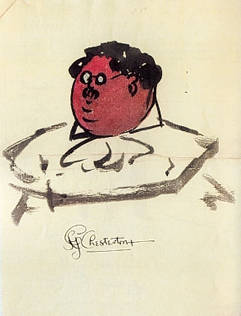
He doesn't look too happy with his portrait, does he?
Saturday, March 31, 2007


Friday, March 30, 2007
Library Thing
There are more than 1800 users on the list with over 4100 books by Chesterton and there are 51 ongoing conversations about the guy on the site. Only if you like books.
Thursday, March 29, 2007
Thursday's Dr. Thursday Post
The Fifth Sorrowful Mystery: the Crucifixion.
...in that scene were symbolically gathered all the human forces that have been vaguely sketched in this story. As kings and philosophers and the popular element had been symbolically present at his birth, so they were more practically concerned in his death; and with that we come face to face with the essential fact to be realised. All the great groups that stood about the Cross represent in one way or another the great historical truth of the time; that the world could not save itself. Man could do no more. Rome and Jerusalem and Athens and everything else were going down like a sea turned into a slow cataract. Externally indeed the ancient world was still at its strongest; it is always at that moment that the inmost weakness begins. But in order to understand that weakness we must repeat what has been said more than once; that it was not the weakness of a thing originally weak. It was emphatically the strength of the world that was turned to weakness, and the wisdom of the world that was turned to folly.
In this story of Good Friday it is the best things in the world that are at their worst. That is what really shows us the world at its worst. It was, for instance, the priests of a true monotheism and the soldiers of an international civilisation. Rome, the legend, founded upon fallen Troy and triumphant over fallen Carthage, had stood for a heroism which was the nearest that any pagan ever came to chivalry. Rome had defended the household gods and the human decencies against the ogres of Africa [that is, Carthage] and the hermaphrodite monstrosities of Greece. But in the lightning flash of this incident, we see great Rome, the imperial republic, going downward under her Lucretian doom. Scepticism has eaten away even the confident sanity of the conquerors of the world. He who is enthroned to say what is justice can only ask, “What is truth?” [”He” is Pontius Pilate. Jn 18:38] So in that drama which decided the whole fate of antiquity, one of the central figures is fixed in what seems the reverse of his true rôle. Rome was almost another name for responsibility. Yet he stands for ever as a sort of rocking statue of the irresponsible. Man could do no more. Even the practical had become the impracticable. Standing between the pillars of his own judgment-seat, a Roman had washed his hands of the world. [Mt 27:24]
There too were the priests of that pure and original truth that was behind all the mythologies like the sky behind the clouds. It was the most important truth in the world; and even that could not save the world. Perhaps there is something overpowering in pure personal theism; like seeing the sun and moon and sky come together to form one staring face. [Cf. “A few clouds in heaven do come together into the staring shape of one human eye.” FB “The Blue Cross” in The Innocence of Father Brown] Perhaps the truth is too tremendous when not broken by some intermediaries, divine or human; perhaps it is merely too pure and far away. Anyhow it could not save the world; it could not even convert the world. There were philosophers who held it in its highest and noblest form; but they not only could not convert the world, but they never tried. You could no more fight the jungle of popular mythology with a private opinion than you could clear away a forest with a pocket-knife. [Cf. Cardinal Newman: “Quarry the granite rock with razors, or moor the vessel with a thread of silk; then may you hope with such keen and delicate instruments as human knowledge and human reason to contend against those giants, the passion and the pride of man.” The Idea of a University] The Jewish priests had guarded it jealously in the good and the bad sense. They had kept it as a gigantic secret. As savage heroes might have kept the sun in a box, they kept the Everlasting in the tabernacle. They were proud that they alone could look upon the blinding sun of a single deity; and they did not know that they had themselves gone blind. Since that day their representatives have been like blind men in broad daylight, striking to right and left with their staffs, and cursing the darkness. [cf. Jn 12:35 ???] But there has been that in their monumental monotheism that it has at least remained like a monument, the last thing of its kind, and in a sense motionless in the more restless world which it cannot satisfy. For it is certain that for some reason it cannot satisfy. Since that day it has never been quite enough to say that God is in his heaven and all is right with the world; [From Browning's Pippa Passes, line 227; GKC comments in ILN Nov 22, 1930 CW35:415] since the rumour that God had left his heavens to set it right.
And as it was with these powers that were good, or at least had once been good, so it was with the element which was perhaps the best, or which Christ himself seems certainly to have felt as the best. The poor to whom he preached the good news, [cf. Lk 4:18 and 7:22] the common people who heard him gladly, [cf. Mk 12:37] the populace that had made so many popular heroes and demigods in the old pagan world, showed also the weaknesses that were dissolving the world. They suffered the evils often seen in the mob of the city, and especially the mob of the capital, during the decline of a society. The same thing that makes the rural population live on tradition makes the urban population live on rumour. Just as its myths at the best had been irrational, so its likes and dislikes are easily changed by baseless assertion that is arbitrary without being authoritative. Some brigand or other was artificially turned into a picturesque and popular figure and run as a kind of candidate against Christ. [Jn 18:39-40] In all this we recognise the urban population that we know, with its newspaper scares and scoops. But there was present in this ancient population an evil more peculiar to the ancient world. We have noted it already as the neglect of the individual, even of the individual voting the condemnation and still more of the individual condemned. It was the soul of the hive; a heathen thing. The cry of this spirit also was heard in that hour, “It is well that one man die for the people.” [Jn 11:50-51] Yet this spirit in antiquity of devotion to the city and to the state had also been in itself and in its time a noble spirit. It had its poets and its martyrs; men still to be honoured for ever. It was failing through its weakness in not seeing the separate soul of a man, the shrine of all mysticism; but it was only failing as everything else was failing. The mob went along with the Sadducees and the Pharisees, the philosophers and the moralists. It went along with the imperial magistrates and the sacred priests, the scribes and the soldiers, that the one universal human spirit might suffer a universal condemnation; that there might be one deep, unanimous chorus of approval and harmony when Man was rejected of men. [cf. Is 53:3]
There were solitudes beyond where none shall follow. There were secrets in the inmost and invisible part of that drama that have no symbol in speech; or in any severance of a man from men. Nor is it easy for any words less stark and single-minded than those of the naked narrative even to hint at the horror of exaltation that lifted itself above the hill. Endless expositions have not come to the end of it, or even to the beginning. And if there be any sound that can produce a silence, we may surely be silent about the end and the extremity; when a cry was driven out of that darkness in words dreadfully distinct and dreadfully unintelligible, which man shall never understand in all the eternity they have purchased for him; and for one annihilating instant an abyss that is not for our thoughts had opened even in the unity of the absolute; and God had been forsaken of God. [Mt 27:46, quoting Ps 21:2]
[GKC, The Everlasting Man CW2:341-4]
Last week, when I had a spare moment, I had planned to give another cheat sheet and tell you where the "Seven Last Words" are to be found, so I will.Read more.Is there any need to repeat and spin out the story of how the tragedy trailed up the Via Dolorosa and how they threw him in haphazard with two thieves in one of the ordinary batches of execution; and how in all that horror and howling wilderness of desertion one voice spoke in homage, a startling voice from the very last place where it was looked for, the gibbet of the criminal; and he said to that nameless ruffian, “This night shalt thou be with me in Paradise”? [cf. Lk 23:43] Is there anything to put after that but a full-stop? Or is any one prepared to answer adequately that farewell gesture to all flesh which created for his Mother a new Son? [cf. Jn 19:26]
1. And Jesus said: Father, forgive them, for they know not what they do. But they, dividing his garments, cast lots. [Lk 23:34]
2. And [the thief] said to Jesus: Lord, remember me when thou shalt come into thy kingdom. And Jesus said to him: Amen I say to thee: This day thou shalt be with me in paradise. [Lk 23:42-43]
3. When Jesus therefore had seen his mother and the disciple standing whom he loved, he saith to his mother: Woman, behold thy son. After that, he saith to the disciple: Behold thy mother. And from that hour, the disciple took her to his own. [John 19:26-27]
4. Afterwards, Jesus knowing that all things were now accomplished, that the scripture might be fulfilled, said: I thirst. [John 19:28]
5. And about the ninth hour, Jesus cried with a loud voice, saying: Eli, Eli, lamma sabacthani? That is, My God,My God, why hast thou forsaken me? [Mt 27:46, Mk 15:34]
6. Jesus therefore, when he had taken the vinegar, said: It is consummated. And bowing his head, he gave up the ghost. [Jn 19:30]
7. And Jesus crying with a loud voice, said: Father, into thy hands I commend my spirit. And saying this, he gave up the ghost. [Lk 23:46]
And I had thought to write more - but I cannot. No one can.
Rather, we ought to read the Gospels - or, take advantage of some high-technology and use the "Hand-Held Gospels" called the Rosary - meanwhile, meditating carefully about what happened. (But see my comments last week about that very crucial word.)
But at least we ought to read what Chesterton said, in some of the most powerful words ever written about this scene.
--Dr. Thursday
...in that scene were symbolically gathered all the human forces that have been vaguely sketched in this story. As kings and philosophers and the popular element had been symbolically present at his birth, so they were more practically concerned in his death; and with that we come face to face with the essential fact to be realised. All the great groups that stood about the Cross represent in one way or another the great historical truth of the time; that the world could not save itself. Man could do no more. Rome and Jerusalem and Athens and everything else were going down like a sea turned into a slow cataract. Externally indeed the ancient world was still at its strongest; it is always at that moment that the inmost weakness begins. But in order to understand that weakness we must repeat what has been said more than once; that it was not the weakness of a thing originally weak. It was emphatically the strength of the world that was turned to weakness, and the wisdom of the world that was turned to folly.
In this story of Good Friday it is the best things in the world that are at their worst. That is what really shows us the world at its worst. It was, for instance, the priests of a true monotheism and the soldiers of an international civilisation. Rome, the legend, founded upon fallen Troy and triumphant over fallen Carthage, had stood for a heroism which was the nearest that any pagan ever came to chivalry. Rome had defended the household gods and the human decencies against the ogres of Africa [that is, Carthage] and the hermaphrodite monstrosities of Greece. But in the lightning flash of this incident, we see great Rome, the imperial republic, going downward under her Lucretian doom. Scepticism has eaten away even the confident sanity of the conquerors of the world. He who is enthroned to say what is justice can only ask, “What is truth?” [”He” is Pontius Pilate. Jn 18:38] So in that drama which decided the whole fate of antiquity, one of the central figures is fixed in what seems the reverse of his true rôle. Rome was almost another name for responsibility. Yet he stands for ever as a sort of rocking statue of the irresponsible. Man could do no more. Even the practical had become the impracticable. Standing between the pillars of his own judgment-seat, a Roman had washed his hands of the world. [Mt 27:24]
There too were the priests of that pure and original truth that was behind all the mythologies like the sky behind the clouds. It was the most important truth in the world; and even that could not save the world. Perhaps there is something overpowering in pure personal theism; like seeing the sun and moon and sky come together to form one staring face. [Cf. “A few clouds in heaven do come together into the staring shape of one human eye.” FB “The Blue Cross” in The Innocence of Father Brown] Perhaps the truth is too tremendous when not broken by some intermediaries, divine or human; perhaps it is merely too pure and far away. Anyhow it could not save the world; it could not even convert the world. There were philosophers who held it in its highest and noblest form; but they not only could not convert the world, but they never tried. You could no more fight the jungle of popular mythology with a private opinion than you could clear away a forest with a pocket-knife. [Cf. Cardinal Newman: “Quarry the granite rock with razors, or moor the vessel with a thread of silk; then may you hope with such keen and delicate instruments as human knowledge and human reason to contend against those giants, the passion and the pride of man.” The Idea of a University] The Jewish priests had guarded it jealously in the good and the bad sense. They had kept it as a gigantic secret. As savage heroes might have kept the sun in a box, they kept the Everlasting in the tabernacle. They were proud that they alone could look upon the blinding sun of a single deity; and they did not know that they had themselves gone blind. Since that day their representatives have been like blind men in broad daylight, striking to right and left with their staffs, and cursing the darkness. [cf. Jn 12:35 ???] But there has been that in their monumental monotheism that it has at least remained like a monument, the last thing of its kind, and in a sense motionless in the more restless world which it cannot satisfy. For it is certain that for some reason it cannot satisfy. Since that day it has never been quite enough to say that God is in his heaven and all is right with the world; [From Browning's Pippa Passes, line 227; GKC comments in ILN Nov 22, 1930 CW35:415] since the rumour that God had left his heavens to set it right.
And as it was with these powers that were good, or at least had once been good, so it was with the element which was perhaps the best, or which Christ himself seems certainly to have felt as the best. The poor to whom he preached the good news, [cf. Lk 4:18 and 7:22] the common people who heard him gladly, [cf. Mk 12:37] the populace that had made so many popular heroes and demigods in the old pagan world, showed also the weaknesses that were dissolving the world. They suffered the evils often seen in the mob of the city, and especially the mob of the capital, during the decline of a society. The same thing that makes the rural population live on tradition makes the urban population live on rumour. Just as its myths at the best had been irrational, so its likes and dislikes are easily changed by baseless assertion that is arbitrary without being authoritative. Some brigand or other was artificially turned into a picturesque and popular figure and run as a kind of candidate against Christ. [Jn 18:39-40] In all this we recognise the urban population that we know, with its newspaper scares and scoops. But there was present in this ancient population an evil more peculiar to the ancient world. We have noted it already as the neglect of the individual, even of the individual voting the condemnation and still more of the individual condemned. It was the soul of the hive; a heathen thing. The cry of this spirit also was heard in that hour, “It is well that one man die for the people.” [Jn 11:50-51] Yet this spirit in antiquity of devotion to the city and to the state had also been in itself and in its time a noble spirit. It had its poets and its martyrs; men still to be honoured for ever. It was failing through its weakness in not seeing the separate soul of a man, the shrine of all mysticism; but it was only failing as everything else was failing. The mob went along with the Sadducees and the Pharisees, the philosophers and the moralists. It went along with the imperial magistrates and the sacred priests, the scribes and the soldiers, that the one universal human spirit might suffer a universal condemnation; that there might be one deep, unanimous chorus of approval and harmony when Man was rejected of men. [cf. Is 53:3]
There were solitudes beyond where none shall follow. There were secrets in the inmost and invisible part of that drama that have no symbol in speech; or in any severance of a man from men. Nor is it easy for any words less stark and single-minded than those of the naked narrative even to hint at the horror of exaltation that lifted itself above the hill. Endless expositions have not come to the end of it, or even to the beginning. And if there be any sound that can produce a silence, we may surely be silent about the end and the extremity; when a cry was driven out of that darkness in words dreadfully distinct and dreadfully unintelligible, which man shall never understand in all the eternity they have purchased for him; and for one annihilating instant an abyss that is not for our thoughts had opened even in the unity of the absolute; and God had been forsaken of God. [Mt 27:46, quoting Ps 21:2]
[GKC, The Everlasting Man CW2:341-4]
Wednesday, March 28, 2007
Tuesday, March 27, 2007
George MacDonald had a blog-E-i-E-i-o
There's even a George MacDonald Society. Cool. Link to blog on post title.
Monday, March 26, 2007
Chesterton grants a post-humous interview
Although very un-Chestertonianly, you must register to read the remaining part of the article.
Saturday, March 24, 2007
Dappled Things graduates to paper
It is with great delight that I write to inform you that subscriptions to the print edition of Dappled Things are now available on our website! (The crowd goes wild!) This is an important milestone in the magazine's history and represents the efforts of our contributing writers, artists, donors, friends, and staff. Dale Ahlquist has been an instrumental supporter of our magazine thus far so we thought you and your readers might be interested to hear this news.
There is simply no other magazine like Dappled Things (or Gilbert for that matter). The work of our talented writers and artists -- always inspired by the Catholic tradition -- not only nurtures the mind but also the soul and the imagination. We would greatly appreciate it if you could let your readers know about this great opportunity to discover the wonder of Catholic literature, art, and thought.
Beautifully designed printed issues of Dappled Things will appear four times a year. You may subscribe online now for only $19.99 and enjoy our content in a whole new way. Keep a copy on your nightstand. Share it with your friends. Discover some of the best emerging Catholic writers and artists of today.
Sincerely in Christ,
Bernardo Aparicio
President, Dappled Things
P.S.: We are currently accepting submissions for our first printed issue. The deadline is April 16. Perhaps some of your reader/writers might want to know about that as well.
TMWWT-Chapter Twelve
The Earth in Anarchy
This is a long chapter. And I've already heard in the comments that someone's favorite line in the whole book is in this chapter, so let us know which one it is. The chapter, to me, is filled with great lines.
I like this: There was a certain allegory of their whole position in the contrast between the modern automobile and its strange, ecclesiastical lamp.
Great humor: ...Syme had heard a shot shriek past this car. "My God!" said the Colonel, "some one has shot at us." "It need not interrupt conversation," said the gloomy Ratcliffe. "Pray resume your remarks, Colonel. You were talking, I think, about the plain people of a peaceable French town."
"I may be mad, but humanity isn't."
"In what or whom is your hope?" asked Syme.
"In a man I never saw," said the other, looking at the leaden sea.
The whole speech about the lantern is wonderful.
And the surprise about the Secretary now completes the Anarchist's Council of Six: all police!
This is a long chapter. And I've already heard in the comments that someone's favorite line in the whole book is in this chapter, so let us know which one it is. The chapter, to me, is filled with great lines.
I like this: There was a certain allegory of their whole position in the contrast between the modern automobile and its strange, ecclesiastical lamp.
Great humor: ...Syme had heard a shot shriek past this car. "My God!" said the Colonel, "some one has shot at us." "It need not interrupt conversation," said the gloomy Ratcliffe. "Pray resume your remarks, Colonel. You were talking, I think, about the plain people of a peaceable French town."
"I may be mad, but humanity isn't."
"In what or whom is your hope?" asked Syme.
"In a man I never saw," said the other, looking at the leaden sea.
The whole speech about the lantern is wonderful.
And the surprise about the Secretary now completes the Anarchist's Council of Six: all police!
Friday, March 23, 2007
False Advertising?
My daughter was reading Gilbert this morning, and told me there was a little big of what she felt was false advertising on the cover. It says:
Anyone have any suggestions for music?
"Sing Along with 'The Logical Vegetarian' page 45"and you turn to page 45 and there is the poem, but no music. I think at the very least, the Gilbert staff should have provided a tune suggestion for what you could sing this song to. For example, if it went with "Old MacDonald Had a Farm" or "Now Thank We All Our God" then, well yes, everyone could sing along with it. But as it is, it sounds hymnish, but I can't think of what hymn it might go with.
Anyone have any suggestions for music?
Thursday, March 22, 2007
Dr. Thursday's Thursday Post
Is there any need to repeat and spin out the story of how the tragedy trailed up the Via Dolorosa and how they threw him in haphazard with two thieves in one of the ordinary batches of execution...?Today's subject is the Fourth Sorrowful Mystery, Jesus Carries the Cross. This mystery summarizes the events covered in another popular devotion, the Stations of the Cross - specifically from the Second to the Ninth inclusive. If you have the third volume of Chesterton's Collected Works, you have GKC's own consideration of that devotion, actually his comments about the artwork for the Stations done by William Frank Brangwyn.
[GKC, The Everlasting Man CW2:341]
But first, I ought to mention something which may come as a bit of a surprise. Read more.Most of the scenes pictured so vividly in these Stations are simply traditional, and are not a literal part of the Gospels. You may want to get out your Bible and check, but here's a handy chart just for reference:
Station 1. Pilate condemns Jesus to death. Mt 27:26, Mk 15:15, Lk 23:24-25, Jn 19:16
Station 2. Jesus takes up His cross. Mt 27:31, Jn 19:17
Station 3. Jesus falls the first time.
Station 4. Jesus meets His sorrowful Mother.
Station 5. Simon of Cyrene helps carry the cross Mt 27:32, Mk 15:21, Lk 23:26
Station 6. Jesus falls the second time.
Station 7. Veronica wipes the face of Jesus.
Station 8. The women of Jerusalem weep over Jesus. Lk 23:27-31
Station 9. Jesus falls the third time.
Station 10. Jesus is stripped. Mk 15:24
Station 11. Jesus is crucified (nailed to the cross). Mt 27:35, Mk 15:27, Lk 23:33, Jn 19:18
That's right. There is no record of Stations 3, 4, 6, 7, 9 in the gospels.
An aside: Yes, I am aware that there have been both "contracted" and "extended" versions of the Stations in the past. But that's going too far afield for my purpose today.And yet that does not mean these things did not happen! After all, we are meditating, which in OUR tradition means a conscious, full and complete engagement of our mental faculties. Our imagination must play its part, not in "fantasizing" or concocting fiction, but in making present to us an image of a long-past reality. (That's why it is called IMAGE-ination!)
I have said this in some detail, because there is one item in particular which is NOT in the Gospels, but IS in the Stations (and hence in the 4th Sorrowful Mystery) - an item which our Uncle Gilbert calls attention to. You may find it a bit disturbing to read, no, not because of its - uh - medical detail, but because of its dramatic human insight. I have heard it said that Dr. Barbet, the "Surgeon at Calvary," wept bitterly when he would see a crucifix, pondering its medical facts of which he could see so much. The quote I will offer is not like that. It is the deep mystical thought of an incredibly powerful writer and literary critic, who, as usual, can read plainly what so many others miss. I shall only be sorry if it does NOT move you. Rather, like his powerful words in The Everlasting Man, it should make you want to read the original story with a newly opened heart:
If the Gospel description of the Passion of Jesus Christ is not the record of something real, then there was concealed somewhere in the provinces ruled by Tiberius a supremely powerful novelist who was also, among other things, a highly modern realist. I think this improbable. I think that if there had been such a uniquely realistic romancer, he would have written another romance, with the legitimate aim of money; instead of merely telling a lie, with no apparent aim but martyrdom. We hear much in modern times of a realism which is apparently flattered by being called ruthless. I cannot say, as a matter of individual taste, that I am much more attracted to ruthlessness as a virtue of German novelists than of American millionaires. But if ever realism could be called ruthless, and ruthlessness could be called right, it is in the rending story of insult and injustice that has been imbodied in the Stations of the Cross. Christians are enjoined to think about it; but I must confess that I simply have not the courage to write about it. It is rather too real, or realistic, for one commonly in contact with the milder modern realism. Anything so grim in every detail as that would be recognised as beating all the moderns at their own game, if only it had been on what is called the modern side. Details like the repeated failure to carry the Cross have an inhuman horror of humiliation, that would make the fortune of a modern novelist writing on concentration camps to prove there is no God, instead of writing to prove that a God so loved the world.
[GKC, The Way Of The Cross (comments on the art of William Frank Brangwyn) in CW3:541-2]
An afterword - or two. I ought not add anything, except please go read these GKC works, and also the Gospels themselves. But I do want to mention two things about two other stations.
1. It is said that "Veronica" is a pun, possibly referring to the Shroud - or possibly to a real image made by a real woman. But the pun is that the name means the True Image, not the woman! (Remember, we're using our IMAGination, part of our divinely given powers of mind, to SEE more of this mystery.)
2. For some years my local parish has been serving a Vietnamese population in our town. I have delighted in the opportunity to have even a slight contact with an oriental tongue which has virtually nothing in common with any European language! Fascinating. One of the most inspiring details I learned was their title for the Fourth Station, roughly:
Her Majesty the Mother Mary meets His Majesty the Lord Jesus carrying the Holy Cross.One more thing. An untranslatable pun occurs here: the word for "Cross" also means "price"...
Lay Chua! Xin Chua! Thuong xot chung con!
Oh Lord! We beg You Lord! Have mercy on Your many children!
Wednesday, March 21, 2007
New Chesterton Photo

George Grantham Bain Collection, Library of Congress Prints and Photographs Division, Reproduction Number: LC-DIG-ggbain-06610
New for me, have you seen it before?
Tuesday, March 20, 2007
My Gilbert is Here!
Jan/Feb just got here in the mail. Excuse me for a moment. It has a great cover.
HA-HA! The Dale Ahlquist interview of Dale Ahlquist is a WINNER! So, so, so funny. Oh goodness, tears in my eyes funny. The caracature Ted Schluenderfritz drew of the VentrilAhlquist is wonderful. Such creativity we have in this group!
OK, now I've got to read the rest of it. See you later. OH! Our "Thursday" discussion is mentioned! And our nomination for the Catholic Blog Award (on that note, if anyone knows how to help me get the little file posted in my template, let me know.)
HA-HA! The Dale Ahlquist interview of Dale Ahlquist is a WINNER! So, so, so funny. Oh goodness, tears in my eyes funny. The caracature Ted Schluenderfritz drew of the VentrilAhlquist is wonderful. Such creativity we have in this group!
OK, now I've got to read the rest of it. See you later. OH! Our "Thursday" discussion is mentioned! And our nomination for the Catholic Blog Award (on that note, if anyone knows how to help me get the little file posted in my template, let me know.)
TMWWT-Chapter Eleven
The Criminals Chase the Police
Great lines: ...but if he were walking with them...by God! I believe this ground would shake...
This reminds me of how sweet it was to have the high school students reading "The Surprise" at our drama class. The teens were reluctant to say "by God!" and substituted "my gosh" and "darn" for the other word. I hadn't noticed the minor swearing in the play until reading it with the students, and I thought really how interesting it was that they were so sensitive to this.
More great lines: ...we are not much, my boy, in Sunday's universe...
...the world in which he had been moving for three days...where men took off their beards...their spectacles and their noses...and turned into other people...
...what was a friend...what an enemy...
...Was not everything, after all, like this bewildering woodland, this dance of dark and light? Everything only a glimpse, the glimpse always unforeseen, and always forgotten...
...you've got that eternal idiotic idea that if anarchy came it would come from the poor....the poor really has a stake in the country...(that's so true)
...Sunday would stand perfectly helpless before the task of converting any ordinary healthy person anywhere...
...ritual refreshment...
...it is just as well to see a good man or two when one is possibly near to death...
...the last honest stranger whom he should ever see upon the earth...
Memorable: The poor have sometimes objected to being governed badly; the rich have always objected to being governed at all. Aristocrats were always anarchists...
Great conversation: "Mr. Syme is saying," called out Ratcliffe to the French Colonel, "that this man, at least, will never be an anarchist."
"Mr. Syme is right enough there," answered Colonel Ducroix, laughing, "if only for the reason that he has plenty of property to defend. But I forgot that in your country you are not used to peasants being wealthy."
"He looks poor," said Dr. Bull doubtfully.
"Quite so," said the Colonel; "that is why he is rich."
and
"that's discipline. That's Sunday. He is perhaps five hundred miles off, but the fear of him is on all of them, like the finger of God." (This reminds me of the book Holes, where they are saved by God's thumb.)
I thought it was interesting that the criminals were all wearing black masks.
Dictionary needed: chiaroscuro a word an artist would use, right?
Reminder: the Marquis is now Ratcliffe (that's Inspector Ratcliffe to you)
Dream evidence: ...as a man in an evil dream strains himself to scream and wake...there is an awful lot of dream/nightmare talk in this book
Great lines: ...but if he were walking with them...by God! I believe this ground would shake...
This reminds me of how sweet it was to have the high school students reading "The Surprise" at our drama class. The teens were reluctant to say "by God!" and substituted "my gosh" and "darn" for the other word. I hadn't noticed the minor swearing in the play until reading it with the students, and I thought really how interesting it was that they were so sensitive to this.
More great lines: ...we are not much, my boy, in Sunday's universe...
...the world in which he had been moving for three days...where men took off their beards...their spectacles and their noses...and turned into other people...
...what was a friend...what an enemy...
...Was not everything, after all, like this bewildering woodland, this dance of dark and light? Everything only a glimpse, the glimpse always unforeseen, and always forgotten...
...you've got that eternal idiotic idea that if anarchy came it would come from the poor....the poor really has a stake in the country...(that's so true)
...Sunday would stand perfectly helpless before the task of converting any ordinary healthy person anywhere...
...ritual refreshment...
...it is just as well to see a good man or two when one is possibly near to death...
...the last honest stranger whom he should ever see upon the earth...
Memorable: The poor have sometimes objected to being governed badly; the rich have always objected to being governed at all. Aristocrats were always anarchists...
Great conversation: "Mr. Syme is saying," called out Ratcliffe to the French Colonel, "that this man, at least, will never be an anarchist."
"Mr. Syme is right enough there," answered Colonel Ducroix, laughing, "if only for the reason that he has plenty of property to defend. But I forgot that in your country you are not used to peasants being wealthy."
"He looks poor," said Dr. Bull doubtfully.
"Quite so," said the Colonel; "that is why he is rich."
and
"that's discipline. That's Sunday. He is perhaps five hundred miles off, but the fear of him is on all of them, like the finger of God." (This reminds me of the book Holes, where they are saved by God's thumb.)
I thought it was interesting that the criminals were all wearing black masks.
Dictionary needed: chiaroscuro a word an artist would use, right?
Reminder: the Marquis is now Ratcliffe (that's Inspector Ratcliffe to you)
Dream evidence: ...as a man in an evil dream strains himself to scream and wake...there is an awful lot of dream/nightmare talk in this book
Monday, March 19, 2007
Unique Chestertonian find off ebay


David Zach, Chestertonian Futurist, who will be attending ChesterCon07, found this cigarette card off ebay last year, scanned it, and let us see it. I think that's pretty unique, and something every Chestertonian collector would be interested in owning.
UPDATE: Dave just sent me the "Flip" side of the card, which I forgot to post.
Saint Joseph
"Joseph"
If the stars fell; night's nameless dreams
Of bliss and blasphemy came true,
If skies were green and snow were gold,
And you loved me as I love you;
O long light hands and curled brown hair,
And eyes where sits a naked soul;
Dare I even then draw near and burn
My fingers in the aureole?
Yes, in the one wise foolish hour
God gives this strange strength to a man.
He can demand, though not deserve,
Where ask he cannot, seize he can.
But once the blood's wild wedding o'er,
Were not dread his, half dark desire,
To see the Christ-child in the cot,
The Virgin Mary by the fire?
[CW10:355]
If the stars fell; night's nameless dreams
Of bliss and blasphemy came true,
If skies were green and snow were gold,
And you loved me as I love you;
O long light hands and curled brown hair,
And eyes where sits a naked soul;
Dare I even then draw near and burn
My fingers in the aureole?
Yes, in the one wise foolish hour
God gives this strange strength to a man.
He can demand, though not deserve,
Where ask he cannot, seize he can.
But once the blood's wild wedding o'er,
Were not dread his, half dark desire,
To see the Christ-child in the cot,
The Virgin Mary by the fire?
[CW10:355]
Saturday, March 17, 2007

Chesterton and Feminists (again)
Another great take-down of feminextremists. And I would love to get Chesterton's commentary on our country's surrent political situation.
Friday, March 16, 2007
Confirmed: Rowling is a Chestertonian
We've talked back and forth here for some time about Harry Potter. And people have claimed that she writes very Chestertonianly, but without direct proof. Now we have proof.
A few days ago, someone was defending Joanne Rowling on a message board I belong to. This person stated that if we could judge a person by the company she keeps, then judge Rowling by this: Her favorite poem is one of Belloc's. Her favorite painting is a Caravaggio--Supper at Emmaus. She quotes Dorothy Sayers, and, according to this source, was a member of the UK Chestertonian group.
This last little tidbit caught my immediate attention. So I emailed a US Chestertonian who emailed a UK Chestertonian, who was privy to rosters of members, and this person said that when he inherited the roster, Joanne Rowling's name WAS ON IT. Since then, they haven't been able to contact her for her renewal, but she may still consider herself a member, and in any case, she *was* on the roster, and therefore, she *is* a Chestertonian in my book.
So, there you have it. Now we will invite her to come to a ChesterCon in the future, and tell us all about her connections to Chesterton. You heard it here first, folks!
UPDATE: Roving Medievalist reminded me that he predicted a Rowling/Catholic connection a while ago.
A few days ago, someone was defending Joanne Rowling on a message board I belong to. This person stated that if we could judge a person by the company she keeps, then judge Rowling by this: Her favorite poem is one of Belloc's. Her favorite painting is a Caravaggio--Supper at Emmaus. She quotes Dorothy Sayers, and, according to this source, was a member of the UK Chestertonian group.
This last little tidbit caught my immediate attention. So I emailed a US Chestertonian who emailed a UK Chestertonian, who was privy to rosters of members, and this person said that when he inherited the roster, Joanne Rowling's name WAS ON IT. Since then, they haven't been able to contact her for her renewal, but she may still consider herself a member, and in any case, she *was* on the roster, and therefore, she *is* a Chestertonian in my book.
So, there you have it. Now we will invite her to come to a ChesterCon in the future, and tell us all about her connections to Chesterton. You heard it here first, folks!
UPDATE: Roving Medievalist reminded me that he predicted a Rowling/Catholic connection a while ago.
Thursday, March 15, 2007
Thursday's Post
As last week we considered the Scourging, so this week we consider the
Crowning with Thorns. [See Mt 27:28-31, John 19:2-3]
Again, we must state that GKC barely touches this scene directly, but
his indirect comments are very rich and moving. In this particular scene
of mockery, one is reminded of our Lord's humility, set against our
sinful pride. Perhaps no single essay of GKC is more important for us in
this regard than his "If I Had But One Sermon To Preach" in The
Common Man, which unfortunately is too long to post here.
But it is a favourite topic. Long before his conversion, he had this to
say:
Read more.
Because in pride we are dealing with the falsehood called a mockery: it is an affront to a Person, and hence even to an image. Remember Genesis 1:27? "And God created man to his own image: to the image of God he created him: male and female he created them."
In mocking the God-Man, the Romans mocked Man also:
is the most American of the Mysteries: the first of the famous
self-evident truths of the Declaration of Independence ought to bring
this image to our thoughts. Yes, here, our own scalps were torn, our
faces were struck, we were spit on. We deserve it for our pride, but in
His humility He accepted it so we would be spared - if we follow His
Way. It's up to us who "bear the image of the King" - even in America.
Crowning with Thorns. [See Mt 27:28-31, John 19:2-3]
Again, we must state that GKC barely touches this scene directly, but
his indirect comments are very rich and moving. In this particular scene
of mockery, one is reminded of our Lord's humility, set against our
sinful pride. Perhaps no single essay of GKC is more important for us in
this regard than his "If I Had But One Sermon To Preach" in The
Common Man, which unfortunately is too long to post here.
But it is a favourite topic. Long before his conversion, he had this to
say:
Humility is so practical a virtue that men think it mustA bit later, in his incomparable glimpse into what should be called "the Philosophy of the Story", he wrote:
be a vice. Humility is so successful that it is mistaken for pride. It
is mistaken for it all the more easily because it generally goes with a
certain simple love of splendour which amounts to vanity. Humility will always, by preference, go clad in scarlet and gold; pride in that which refuses to let gold and scarlet impress it or please it too much. In a word, the failure of this virtue actually lies in its success; it is too successful as an investment to be believed in as a virtue. Humility is not merely too good for this world; it is too practical for this world; I had almost said it is too worldly for this world. ...Now, one of these very practical and working mysteries in the Christian tradition, and one which the Roman Catholic Church, as I say, has done her best work in singling out, is the conception of the sinfulness of pride. Pride is a weakness in the character; it dries up laughter, it dries up wonder, it dries up chivalry and energy. The Christian tradition understands this... [GKC Heretics CW1:72, 107]
There is the chivalrous lesson of "Jack the Giant Killer"; that giants should be killed because they are gigantic. It is a manly mutiny against pride as such. [GKC Orthodoxy CW1:253But does this relate to our mystery? Yes, and here is why.
Read more.
Because in pride we are dealing with the falsehood called a mockery: it is an affront to a Person, and hence even to an image. Remember Genesis 1:27? "And God created man to his own image: to the image of God he created him: male and female he created them."
In mocking the God-Man, the Romans mocked Man also:
For religion all men are equal, as all pennies are equal, because the only value in any of them is that they bear the image of the King. [GKC Charles Dickens CW15:44]Perhaps this
This is no place to expound a philosophy; it will be enough to say in passing, by way of a parable, that when we say that all pennies are equal, we do not mean that they all look exactly the same. We mean that they are absolutely equal in their one absolute character, in the most important thing about them. It may be put practically by saying that they are coins of a certain value, twelve of which go to a shilling. It may be put symbolically, and even mystically, by saying that they all
bear the image of the King. And, though the most mystical, it is also the most practical summary of equality that all men bear the image of the King of Kings. Indeed, it is of course true that this idea had long underlain all Christianity, even in institutions less popular in form than were, for instance, the mob in mediaeval republics of Italy. A dogma of equal duties implies that of equal rights. I know of no Christian authority that would not admit that it is as wicked to murder a poor man as a rich man, or as bad to burgle an inelegantly furnished house as a tastefully furnished one. But the world had wandered further and further from these truisms, and nobody in the world was further from them than the group of the great English aristocrats. The idea of the equality of men is in substance simply the idea of the importance of man. [GKC A Short History of England 147]
If any modern man should say, “You make too much of the sufferings of
Jesus of Nazareth,” it is a strictly logical answer to say, “It might or
might not be too much for the sufferings of Jesus of Nazareth; it is not
too much for the sufferings of Jesus Christ.” If his theory were
true, that Jesus was not merely a human being but almost a historical
accident, then indeed we might seem to be making too prolonged a
lamentation over such an accident. But if our theory is true,
that it was not an accident, but a divine agony demanded for the
restoration of the very design of the world, then it is not in the least
illogical that the lamentation (and the exultation) should last as long
as the world. The sceptic, who is also the sentimentalist, is engaged in
his usual game of arguing in a circle; he is merely saying that if the
Passion was what he thinks it was, it is very wrong of us to treat it as
what we think it was. Certainly, if Christ was not of the very substance
of omnipotence, it becomes relatively pointless to point to the paradox
of his impotence. But we do not necessarily admit we are wrong, merely
because our version of the story is the only version that gives it a
point. That there has been a dreadful and even deadly insistence upon
that point is perfectly true, and for us perfectly consistent; there has
been an everlasting energy in driving in that point; in pressing upon it
as upon the thorns; in hammering at it as at the nails. But we are not
bound to consider the critic who is merely annoyed by the hammering or
puzzled by the pressure, without even seeing the point.
[GKC The Way of the Cross CW3:548-549]
is the most American of the Mysteries: the first of the famous
self-evident truths of the Declaration of Independence ought to bring
this image to our thoughts. Yes, here, our own scalps were torn, our
faces were struck, we were spit on. We deserve it for our pride, but in
His humility He accepted it so we would be spared - if we follow His
Way. It's up to us who "bear the image of the King" - even in America.
Wednesday, March 14, 2007
The Ideal Detective Story
I pause in the Man Who Was Thursday discussion to bring you this:
Harry Potter Moment: [I have a HUGE, I mean HUMONGOUS announcement to make in connection with Harry Potter and Chesterton. Stay tuned.] Meanwhile, listen to this: Last night, I opened an Illustrated London News at random. And this was God. I know you've done this with the Bible, but do you ever do it with Chesterton? I do. Anyway, listen:
Harry Potter Moment: [I have a HUGE, I mean HUMONGOUS announcement to make in connection with Harry Potter and Chesterton. Stay tuned.] Meanwhile, listen to this: Last night, I opened an Illustrated London News at random. And this was God. I know you've done this with the Bible, but do you ever do it with Chesterton? I do. Anyway, listen:
"Nor need there be anything vulgar in the violent and abrupt transition that is the essential of such a tale. The inconsistencies of human nature are indeed terrible and heart-shaking things, to be named with the same note of crisis as the hour of death and the Day of Judgment. They are not all fine shades, but some of them very fearful shadows, made by the primal contrast of darkness and light. Both the crimes and the confessions can be as catastrophic as lightning. Indeed, the Ideal Detective Story might do some good if it brought men back to understanding that the world is not all curves, but that there are some things that are as jagged as the lightning-flash or as straight as the sword.That lightning-flash scar of Harry's is symbolic, I think, of this "darkness and light" contrast, which Rowling so very aptly writes into her novels. Chesterton isn't saying "The world is not curves, but straight like a sword," he says, "the world is not all curves." I think this is important.
Tuesday, March 13, 2007
Monday, March 12, 2007
Saturday, March 10, 2007
TMWWT-Chapter Ten
The Duel
Good lines: His spirits were already unnaturally high; the rose as the Saumur sank (Saumur being a kind of wine)
...a torrent of nonsense...
Syme only needs to break the ice between himself and the man he wishes to kill...
Syme was subject to spasms of simgular common sense... (I wish *I* were!)
Colonel DuCroix wants to fight for civilisation.
...the whole bally lot on the Anarchist Council were against anarchy!
Dictionary: Recondite
Dream/weather references: Now the spring flowers are knee-deep.
Nightmarishness: How, during the duel, the Marquis doesn't bleed. Syme concludes he must be the devil. The nose coming off in his hand. His face peeling off.
And now there are two. Sunday and the Crooked Smile.
Good lines: His spirits were already unnaturally high; the rose as the Saumur sank (Saumur being a kind of wine)
...a torrent of nonsense...
Syme only needs to break the ice between himself and the man he wishes to kill...
Syme was subject to spasms of simgular common sense... (I wish *I* were!)
Colonel DuCroix wants to fight for civilisation.
...the whole bally lot on the Anarchist Council were against anarchy!
Dictionary: Recondite
Dream/weather references: Now the spring flowers are knee-deep.
Nightmarishness: How, during the duel, the Marquis doesn't bleed. Syme concludes he must be the devil. The nose coming off in his hand. His face peeling off.
And now there are two. Sunday and the Crooked Smile.
Friday, March 09, 2007
Thursday, March 08, 2007
Thursday Post
In our Lenten journey toward the Skull-Hill we are conducting a
Chestertonian review of the Sorrowful Mysteries, following Jesus in His
last hours on earth. It is humbling to attempt such a study, for even
those of us who claim that GKC wrote about everything can find it
difficult when the focus is placed on things which (one guesses) GKC
preferred not to explore. True, he wrote a 12 page commentary on
Brangwyn's art for the Stations of the Cross, which you can find in CW3
- but the Stations only begin with "Pilate Condemns Jesus to Death"
whereas the first three Sorrowful Mysteries precede that Station.
So I have to disappoint you a little. I have not been able to find GKC
speaking specifically about this particular scene. Frankly, it is not
unexpected - all throughout the above-mentioned comments on the Stations
- and even when we come to the Crucifixion - GKC preserves a certain
reticence. As I quoted last week, "of what use are words about such
words as these?"
But I shall offer two short excerpts from his masterwork of masterworks,
mentioning scenes somewhat adjacent chronologically to the Scourging,
which I think may help us ponder a little more of what was going on at
that time:
As the High Priest asked what further need he had of witnesses, we might
well ask what further need we have of words. Peter in a panic repudiated
him: and immediately the cock crew, and Jesus looked upon Peter, and
Peter went out and wept bitterly. Has anyone any further remarks to
offer?
[GKC The Everlasting Man CW2:341]
When Jesus was brought before the judgment-seat of Pontius Pilate, he
did not vanish. It was the crisis and the goal; it was the hour and the
power of darkness. It was the supremely supernatural act of all his
miraculous life, that he did not vanish.
[ibid CW2:340]
Chestertonian review of the Sorrowful Mysteries, following Jesus in His
last hours on earth. It is humbling to attempt such a study, for even
those of us who claim that GKC wrote about everything can find it
difficult when the focus is placed on things which (one guesses) GKC
preferred not to explore. True, he wrote a 12 page commentary on
Brangwyn's art for the Stations of the Cross, which you can find in CW3
- but the Stations only begin with "Pilate Condemns Jesus to Death"
whereas the first three Sorrowful Mysteries precede that Station.
So I have to disappoint you a little. I have not been able to find GKC
speaking specifically about this particular scene. Frankly, it is not
unexpected - all throughout the above-mentioned comments on the Stations
- and even when we come to the Crucifixion - GKC preserves a certain
reticence. As I quoted last week, "of what use are words about such
words as these?"
But I shall offer two short excerpts from his masterwork of masterworks,
mentioning scenes somewhat adjacent chronologically to the Scourging,
which I think may help us ponder a little more of what was going on at
that time:
As the High Priest asked what further need he had of witnesses, we might
well ask what further need we have of words. Peter in a panic repudiated
him: and immediately the cock crew, and Jesus looked upon Peter, and
Peter went out and wept bitterly. Has anyone any further remarks to
offer?
[GKC The Everlasting Man CW2:341]
When Jesus was brought before the judgment-seat of Pontius Pilate, he
did not vanish. It was the crisis and the goal; it was the hour and the
power of darkness. It was the supremely supernatural act of all his
miraculous life, that he did not vanish.
[ibid CW2:340]
Wednesday, March 07, 2007
TMWWT-Chapter Nine
The Man in Spectacles
Well, now that Tuesday's been thrown out, Thursday and Friday are running around together, they plan to stop Saturday--Bull, with the opaque glasses. Now we know Tuesday, Thursday, and Friday are all detectives.
Highlights of this chapter: the development of the "finger code." It plays such a role in this scene at the Doctor's table, I wonder how it will be played out in theatrical form?
Syme's levity in picking out words to tap out. Coeval, and lush.
Syme's poetical intuition about Bull, and his demand that he remove his glasses. Bull bursts out laughing. This is almost the opposite of Agatha Christie's "And then there were none" because I am thinking, from three...and now there are four!
But why, when Bull says, we were four against three, does de Worms (Wilks) say, "No, we were four against One" with a capital "O"? And again later, he says, "Because one of those other three men...is not a man."
We're starting to get hints that someone is a bit different than he would appear.
Now the Marquis (Wednesday) has been sent by Saturday on ahead with the supposed bomb, so they must catch up with him.
Oh, the mention of casuistry plays into the book I'm writing.
Great line: "Perjury or treason is the only crime I haven't committed. If I did that I shouldn't know the difference between right and wrong." This is something out of Chesterton's own past, and his descent into the world of ouija boards and seances.
And isn't it just like Chesterton to spell out 50 different plans, but then decide that the answer is a duel?
Well, now that Tuesday's been thrown out, Thursday and Friday are running around together, they plan to stop Saturday--Bull, with the opaque glasses. Now we know Tuesday, Thursday, and Friday are all detectives.
Highlights of this chapter: the development of the "finger code." It plays such a role in this scene at the Doctor's table, I wonder how it will be played out in theatrical form?
Syme's levity in picking out words to tap out. Coeval, and lush.
Syme's poetical intuition about Bull, and his demand that he remove his glasses. Bull bursts out laughing. This is almost the opposite of Agatha Christie's "And then there were none" because I am thinking, from three...and now there are four!
But why, when Bull says, we were four against three, does de Worms (Wilks) say, "No, we were four against One" with a capital "O"? And again later, he says, "Because one of those other three men...is not a man."
We're starting to get hints that someone is a bit different than he would appear.
Now the Marquis (Wednesday) has been sent by Saturday on ahead with the supposed bomb, so they must catch up with him.
Oh, the mention of casuistry plays into the book I'm writing.
Great line: "Perjury or treason is the only crime I haven't committed. If I did that I shouldn't know the difference between right and wrong." This is something out of Chesterton's own past, and his descent into the world of ouija boards and seances.
And isn't it just like Chesterton to spell out 50 different plans, but then decide that the answer is a duel?
Tuesday, March 06, 2007
Gilbert News
The Jan/Feb issue of Gilbert is at the printer now. The March issue will be at the printer March 31. FYI.
TMWWT-Chapter Eight
The Professor Explains
What a great chapter! Completely turns around your opinion of de Worms, doesn't it? This is the kind of thing that makes TMWWT a mystery.
Good lines: ...like a man standing on the hangman's drop...
...his dead face becoming as it were loathsomely alive....
...you're not an old man at all...
So funny how de Worms (Wilks) confesses that when Sunday said there was a spy, both Syme and de Worms thought the jig was up.
...three out of seven is a fighting number! If only we had known that we were three!...
...as startling as a coloured photograph...(naturally, this caught my eye. I suppose a color photo was startling in those days? Did they even exist or were they just talked of as a future technological wonder, I wonder?)
...Sunday and his satellites...(this in the day before there were outer space satellites, which is what I think of when I hear the word)
Syme's going to attempt to get the President because he fears him and will overcome his fear, Wilks because it's impossible, therefore he must try it.
...taking his nose in vain...
and how Wilks turns himself into de Worms by being more de Worms than de Worms himself is funny. "So impressively feeble..." "so jolly paralytic..."
Great moment: ...Syme's sense of a new comradship and comfort. Through all this ordeal his root horror had been isolation, and there are no words to express the abyss between isloation and having one ally. It may be conceded to the mathematician that four is twice two. But two is not twice one; two is two thousand times one. That is why, in spite of a hundred disadvantages, the world will always return to monogamy.
Biblical sounding reference: ...if heaven were his throne and earth his footstool...
The fact that de Worms must have suspected Syme, begged him to confess, Syme continues to lie, and then de Worms confesses anyway. de Worms must have been pretty sure Syme was a detective, don't you think?
Chesterton Theme Material: ...Syme had for a flash the sensation that the cosmos had turned exactly upsidedown...
What makes someone "not a strict" Christian? Drinking...but getting drunk?
What a great chapter! Completely turns around your opinion of de Worms, doesn't it? This is the kind of thing that makes TMWWT a mystery.
Good lines: ...like a man standing on the hangman's drop...
...his dead face becoming as it were loathsomely alive....
...you're not an old man at all...
So funny how de Worms (Wilks) confesses that when Sunday said there was a spy, both Syme and de Worms thought the jig was up.
...three out of seven is a fighting number! If only we had known that we were three!...
...as startling as a coloured photograph...(naturally, this caught my eye. I suppose a color photo was startling in those days? Did they even exist or were they just talked of as a future technological wonder, I wonder?)
...Sunday and his satellites...(this in the day before there were outer space satellites, which is what I think of when I hear the word)
Syme's going to attempt to get the President because he fears him and will overcome his fear, Wilks because it's impossible, therefore he must try it.
...taking his nose in vain...
and how Wilks turns himself into de Worms by being more de Worms than de Worms himself is funny. "So impressively feeble..." "so jolly paralytic..."
Great moment: ...Syme's sense of a new comradship and comfort. Through all this ordeal his root horror had been isolation, and there are no words to express the abyss between isloation and having one ally. It may be conceded to the mathematician that four is twice two. But two is not twice one; two is two thousand times one. That is why, in spite of a hundred disadvantages, the world will always return to monogamy.
Biblical sounding reference: ...if heaven were his throne and earth his footstool...
The fact that de Worms must have suspected Syme, begged him to confess, Syme continues to lie, and then de Worms confesses anyway. de Worms must have been pretty sure Syme was a detective, don't you think?
Chesterton Theme Material: ...Syme had for a flash the sensation that the cosmos had turned exactly upsidedown...
What makes someone "not a strict" Christian? Drinking...but getting drunk?
Monday, March 05, 2007
TMWWT-Chapter Seven
The Unaccountable Conduct of Professor de Worms
Great lines: ...a voice that made men drop drawn swords
...the secretary turned to him with working eyebrows...
He started up and snatched his stick, half crazy with the contradiction in mere arithmetic, and swung out of the swinging doors...
And de Worms keeps ordering milk! How many glasses of milk can a man drink?!
Now, Gogol is an "alleged Pole." And it's funny that he seems to need to make the point that he did a darn good job of faking a Polish accent.
Why does Sunday dismiss Gogol so lightly? If Sunday were a real anarchist, shouldn't he have just shot him on the spot? Or if that would blow their cover (being out in the broad daylight so as to be completely hidden) why not a silent knife in the back? Why does he let Gogol go, when he really knows too much?
Dream evidence: As someone already made mention in the comments, but here's proof, the abrupt changes in the weather. Now it's snowing. Also..."made him almost feel as if the Council of the Seven Days had been a bad dream..." Being chased by the almost dead Professor de Worms feels nightmarish...Syme remembering all of the nightmares he had ever known...
Great lines: ...a voice that made men drop drawn swords
...the secretary turned to him with working eyebrows...
He started up and snatched his stick, half crazy with the contradiction in mere arithmetic, and swung out of the swinging doors...
And de Worms keeps ordering milk! How many glasses of milk can a man drink?!
Now, Gogol is an "alleged Pole." And it's funny that he seems to need to make the point that he did a darn good job of faking a Polish accent.
Why does Sunday dismiss Gogol so lightly? If Sunday were a real anarchist, shouldn't he have just shot him on the spot? Or if that would blow their cover (being out in the broad daylight so as to be completely hidden) why not a silent knife in the back? Why does he let Gogol go, when he really knows too much?
Dream evidence: As someone already made mention in the comments, but here's proof, the abrupt changes in the weather. Now it's snowing. Also..."made him almost feel as if the Council of the Seven Days had been a bad dream..." Being chased by the almost dead Professor de Worms feels nightmarish...Syme remembering all of the nightmares he had ever known...
Saturday, March 03, 2007
Friday, March 02, 2007
Thursday's Post
Due to technical difficulties, we just received Dr. Thursday's post today. I didn't think you'd mind reading it on a Friday, now, would you? ;-)
Today, the Thursday in the first full week of Lent, let us join our Uncle Gilbert and Aunt Frances in pondering the first Sorrowful Mystery (see Luke 22:37-46).
Last week I mentioned that one of the major purposes of our Lenten prayer ought to be for conversion - for us, though we already be in the Faith, and for those who are about to enter. It is interesting to note that Gilbert and Frances went to Jerusalem in 1919, three years before his conversion, and seven years before hers - Maisie Ward says that "this visit to Jerusalem had been a determining factor in Gilbert's conversion" [GKC, 444]. Perhaps a research problem for a future hagiographer, but certainly their visit to Jerusalem brought forth an unarguable result: GKC's The New Jerusalem [published in 1921; now available in CW20]
In this interesting travel-book, Chesterton tells of how he saw it snow there; I have a clipping from my own local paper of such a snowfall. Even more dramatic was the last stage of his journey up the mountain: how (by a strange series of events) he had to ride in an army ambulance and so (like a crusader) entered Jerusalem under the sign of the red cross!
Then, as he considered the "examples of Western work on the great eastern slope of the Mount of Olives", he wrote this powerful paragraph...
Read more.
...which focusses our attention on today's mystery:
Today, the Thursday in the first full week of Lent, let us join our Uncle Gilbert and Aunt Frances in pondering the first Sorrowful Mystery (see Luke 22:37-46).
Last week I mentioned that one of the major purposes of our Lenten prayer ought to be for conversion - for us, though we already be in the Faith, and for those who are about to enter. It is interesting to note that Gilbert and Frances went to Jerusalem in 1919, three years before his conversion, and seven years before hers - Maisie Ward says that "this visit to Jerusalem had been a determining factor in Gilbert's conversion" [GKC, 444]. Perhaps a research problem for a future hagiographer, but certainly their visit to Jerusalem brought forth an unarguable result: GKC's The New Jerusalem [published in 1921; now available in CW20]
In this interesting travel-book, Chesterton tells of how he saw it snow there; I have a clipping from my own local paper of such a snowfall. Even more dramatic was the last stage of his journey up the mountain: how (by a strange series of events) he had to ride in an army ambulance and so (like a crusader) entered Jerusalem under the sign of the red cross!
Then, as he considered the "examples of Western work on the great eastern slope of the Mount of Olives", he wrote this powerful paragraph...
Read more.
...which focusses our attention on today's mystery:
At the foot of the hill is the garden kept by the Franciscans on the alleged site of Gethsemane, and containing the hoary olive that is supposed to be the terrible tree of the agony of Christ. Given the great age and slow growth of the olives, the tradition is not so unreasonable as some may suppose. But whether or not it is historically right, it is not artistically wrong. The instinct, if it was only an instinct, that made men fix upon this strange growth of grey and twisted wood, was a true imaginative instinct. One of the strange qualities of this strange Southern tree is its almost startling hardness; accidentally to strike the branch of an olive is like striking rock. With its stony surface, stunted stature, and strange holes and hollows, it is often more like a grotto than a tree. Hence it does not seem so unnatural that it should be treated as a holy grotto; or that this strange vegetation should claim to stand for ever like a sculptured monument. Even the shimmering or shivering silver foliage of the living olive might well have a legend like that of the aspen; as if it had grown grey with fear from the apocalyptic paradox of a divine vision of death. A child from one of the villages said to me, in broken English, that it was the place where God said his prayers. I for one could not ask for a finer or more defiant statement of all that separates the Christian from the Moslem or the Jew; credo quia impossibile.I have two other fragments to add here. The first may seem bold and powerful, but the second, written nearly two decades earlier, is even more so.
[GKC, The New Jerusalem CW20:353]
The grinding power of the plain words of the Gospel story is like the power of mill-stones; and those who can read them simply enough will feel as if rocks had been rolled upon them. Criticism is only words about words; and of what use are words about such words as these? What is the use of word-painting about the dark garden filled suddenly with torchlight and furious faces? “Are you come out with swords and staves as against a robber? All day I sat in your temple teaching, and you took me not.” [cf. Lk 22:52-53] Can anything be added to the massive and gathered restraint of that irony; like a great wave lifted to the sky and refusing to fall?
[GKC The Everlasting ManCW2:341]
But if the divinity [of Christ] is true it is certainly terribly revolutionary. That a good man may have his back to the wall is no more than we knew already; but that God could have his back to the wall is a boast for all insurgents for ever. Christianity is the only religion on earth that has felt that omnipotence made God incomplete. Christianity alone has felt that God, to be wholly God, must have been a rebel as well as a king. Alone of all creeds, Christianity has added courage to the virtues of the Creator. For the only courage worth calling courage must necessarily mean that the soul passes a breaking point - and does not break. In this indeed I approach a matter more dark and awful than it is easy to discuss; and I apologise in advance if any of my phrases fall wrong or seem irreverent touching a matter which the greatest saints and thinkers have justly feared to approach. But in that terrific tale of the Passion there is a distinct emotional suggestion that the author of all things (in some unthinkable way) went not only through agony, but through doubt. It is written, "Thou shalt not tempt the Lord thy God." [Mt 4:7 quoting Dt. 6:16] No; but the Lord thy God may tempt Himself; and it seems as if this was what happened in Gethsemane. In a garden Satan tempted man: and in a garden God tempted God. He passed in some superhuman manner through our human horror of pessimism. When the world shook and the sun was wiped out of heaven, it was not at the crucifixion, but at the cry from the cross: the cry which confessed that God was forsaken of God. [Mt 27:46 quoting Ps 22:1]Let us, then, go in spirit into that Garden of the Olive-Press, silent beneath the full moon of Spring that signals the Pasch... and watch with our Rebel-King as He says His prayers.
[GKC Orthodoxy CW1:343]
Thursday, March 01, 2007
Things People Search on
I was just checking to see how people find our blog. It's fascinating what people search on to find us. Someone searched on "TMWWT" sorry if that confuses people, it's simply short for The Man Who Was Thursday, which takes way too long to keep re-typing. Someone found us by asking Google for a G.K. Chesterton poem for lent; by searching for E.C. Bentley, by searching for Boethius, Chaucer, and "Obedience, the most thrilling word in the world." They searched on "The Surprise" Dale Ahlquist, King Arthur and "fallen angel". They are from the US, Finland, Canada, UK, Germany, and many other countries each day. Since I started keeping track, we've had 9,000 unique visitors, visiting over 19,000 times. This includes you. Thank you.
Subscribe to:
Posts (Atom)


 Posts
Posts