the summertime Movie edition of Gilbert is officially IN THE MAIL!
Yah Hoo!
Gentlemen (and Ladies),
Start watching your mailboxes.
Thursday, August 31, 2006


What's New at the ACS?

Well, I see the autographed book is still for sale, as well as conference tapes. If you haven't had a chance yet, the conference tapes are really great, as well as a great gift idea for Christmas.
If you're interested in the Catholic Worker Movement we have the book by the Zwicks, whom Dale interviewed in a recent Gilbert magazine, interesting people, as well as Chestertonians.
Do you drink coffee or decaf each morning? Why not do as I do and use a Chesterton mug? It's actually quite inspirational. The quote on it is: "Daybreak is a never-ending glory...getting out of bed is a never-ending nuisance." Which I can totally relate to.
So check out the ACS site.
Tuesday, August 29, 2006
A New Review of Orthodoxy
"Written in the early years of the twentieth century, some of the authors mentioned by Chesterton might seem obscure to readers unfamiliar with general literary history. However, the fact that they have been forgotten while Chesterton is still embraced as a foremost defender of the faith is a positive testament to the relevance of Chesterton's ruminations that, though written nearly a century ago, ring with a truth that sounds as if they just rolled off the presses."
Reviewed by Frederick Meekins
Reviewed by Frederick Meekins
Monday, August 28, 2006
Have You Seen the Video/DVD?
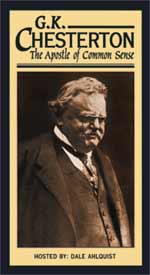


Over the weekend, I had the pleasure of visiting with one of the actors from the 3rd season of EWTN's Apostle of Common Sense, and I realized I had never seen Season Three, and here they are ready to begin taping Season Four! I better get with the program. If you haven't seen these on EWTN, you can just get them from the Chesterton Society and join me in watching them at your leisure. How 'bout it?
Tuesday, August 22, 2006
The Signature of Man
Naturally, being in the art business myself, I am interested in what Chesterton has to say about the subject. I'm also interested in what Dale Ahlquist says Chesterton says about the subject, so I'm reading the chapter in Common Sense 101 called "The Signature of Man."
Ahlquist begins:
"It is one of the great ironies that the twentieth century's greatest writer--G.K.Chesterton, for those of you who haven't been paying attention--never went to college. He went to art school [which he never finished--ed.]. And his definition of art school is itself a work of art: 'An art school is a place where about threee people work with feverish energy and everybody else idles to a degree that I should have conceived unattainable by human nature.'"
Which might explain why most of the artists I know have never been to art school, and work very hard at the art they do because they are attempting to make some kind of a living at it.
"Art," says Ahlquist, "is about being articulate."
I like that. And maybe that's why I've never really understood abstract art, because it is so inarticulate. Not that it can't be beautiful. It might simply be a statement about color or form, and then, perhaps, it is being articulate.
Last weekend our art booth was next to one of the most articulate artists I've ever seen. In fact, his paintings had warnings all over them stating things like: "These are NOT photographs, these are paintings." and "There are NO PHOTOGRAPHS in this booth!" because, as I suppose, people are frequently fooled into thinking that his very articulate paintings are so photo-realistic that they might be photos.
But I actually thought that they were less artistic because they were SO articulate. I like photography, after all, that's what my husband does. But when a painting is mistaken for a photograph, is that good or bad?
The articulate painter won the "Best of Show" award at the art show, so I think the judges really liked his articulation.
Naturally, I wasn't one of the award judges, or a photographer would probably have won "Best of Show."
Ahlquist begins:
"It is one of the great ironies that the twentieth century's greatest writer--G.K.Chesterton, for those of you who haven't been paying attention--never went to college. He went to art school [which he never finished--ed.]. And his definition of art school is itself a work of art: 'An art school is a place where about threee people work with feverish energy and everybody else idles to a degree that I should have conceived unattainable by human nature.'"
Which might explain why most of the artists I know have never been to art school, and work very hard at the art they do because they are attempting to make some kind of a living at it.
"Art," says Ahlquist, "is about being articulate."
I like that. And maybe that's why I've never really understood abstract art, because it is so inarticulate. Not that it can't be beautiful. It might simply be a statement about color or form, and then, perhaps, it is being articulate.
Last weekend our art booth was next to one of the most articulate artists I've ever seen. In fact, his paintings had warnings all over them stating things like: "These are NOT photographs, these are paintings." and "There are NO PHOTOGRAPHS in this booth!" because, as I suppose, people are frequently fooled into thinking that his very articulate paintings are so photo-realistic that they might be photos.
But I actually thought that they were less artistic because they were SO articulate. I like photography, after all, that's what my husband does. But when a painting is mistaken for a photograph, is that good or bad?
The articulate painter won the "Best of Show" award at the art show, so I think the judges really liked his articulation.
Naturally, I wasn't one of the award judges, or a photographer would probably have won "Best of Show."
Friday, August 18, 2006
Taking Ourselves Lightly
I've been thinking about our whole discussion following the Pope Benedict quote about taking ourselves lightly, and Chesterton's feelings and thoughts about that, and it being very hard to always keep things light. It takes humility to be light, and it is our pride that takes over when we make things heavy.
A Chestertonian friend sent me a Chesterton quote on this subject which I want to share with you.
"Another philosophy would say, for instance, that
laughter is due not to an animal cruelty but to a purely human
realization of the contrast between man's spiritual immensity within
and his littleness and restriction without, for it is itself a joke that a
house should be larger inside than out. According to such a view, the
very incomparability between the sense of human dignity and the
perpetual possibility of incidental indignities, produces the primary
or archetypal joke of the old gentleman sitting down suddenly on the
ice. We do not laugh thus when a tree or a rock tumbles down;
because we do not know the sense of self-esteem or serious
importance within. But such speculations in psychology, especially in
primitive psychology, have very little to do with the actual history of
comedy as an artistic creation. (Emphasis mine.)
("Humour" from the Encyclopedia Britannica, in Spice of Life 25)
This quote brings together some of the discussion on Harry Potter and magic houses that we've been having over on my personal blog, Flying Stars, and the Pope quote on humor.
A Chestertonian friend sent me a Chesterton quote on this subject which I want to share with you.
"Another philosophy would say, for instance, that
laughter is due not to an animal cruelty but to a purely human
realization of the contrast between man's spiritual immensity within
and his littleness and restriction without, for it is itself a joke that a
house should be larger inside than out. According to such a view, the
very incomparability between the sense of human dignity and the
perpetual possibility of incidental indignities, produces the primary
or archetypal joke of the old gentleman sitting down suddenly on the
ice. We do not laugh thus when a tree or a rock tumbles down;
because we do not know the sense of self-esteem or serious
importance within. But such speculations in psychology, especially in
primitive psychology, have very little to do with the actual history of
comedy as an artistic creation. (Emphasis mine.)
("Humour" from the Encyclopedia Britannica, in Spice of Life 25)
This quote brings together some of the discussion on Harry Potter and magic houses that we've been having over on my personal blog, Flying Stars, and the Pope quote on humor.
Wednesday, August 16, 2006
Summer Movie Edition of Gilbert Magazine
 The 2nd Annual Summer Movie Review Edition of Gilbert Magazine has a wonderful cover (I enjoy Wallace & Grommit) and will be coming to your mailbox soon. Six movie reviews and a great cover, what more could you ask for?
Check out Small Pax Guild while you are waiting.
Monday, August 14, 2006
Pope Benedict Quotes GKC

Pope Benedict the Sixteenth has shown his true colors recently by knowingly and deliberately quoting—Chestertonianly misquoting, too, I might add—Chesterton.
Pope Benedict was interviewed on German television.
Fuchs: Stories with humor in them too? In 1989 in Munich you were given the Karl Valentin Award. What role does humor play in the life of a pope?
I'm not a man who constantly thinks up jokes. But I think it's very important to be able to see the funny side of life and its joyful dimension and not to take everything too tragically. I'd also say it's necessary for my ministry. A writer once said that angels can fly because they don't take themselves too seriously. Maybe we could also fly a bit if we didn't think we were so important.
John Peterson Plays Along
John is having trouble with posting to this site, so he sent these along.
-One book that changed your life.
Let’s Eat Right to Keep Fit (Adele Davis).
-One book you’ve read more than once.
The Day of the Locust (Nathaniel West)
-One book you’d want on a desert Island.
The Holy Bible.
-One book that made you laugh.
Pick any book by P.G. Wodehouse
-One book that made you cry.
Post Modernism for Dummies.
-One book you wish you’d written.
Great Thoughts (John Peterson)
-One book you wish had never been written.
The Outline of History, H.G. Wells
-One book you are currently reading
Ancestral Shadows (Russell Kirk)
-One book you are meaning to read.
Half-Truths: What's Right (And What's Wrong) With the Cliches You and I Live by. (Montague Brown)
-One book that changed your life.
Let’s Eat Right to Keep Fit (Adele Davis).
-One book you’ve read more than once.
The Day of the Locust (Nathaniel West)
-One book you’d want on a desert Island.
The Holy Bible.
-One book that made you laugh.
Pick any book by P.G. Wodehouse
-One book that made you cry.
Post Modernism for Dummies.
-One book you wish you’d written.
Great Thoughts (John Peterson)
-One book you wish had never been written.
The Outline of History, H.G. Wells
-One book you are currently reading
Ancestral Shadows (Russell Kirk)
-One book you are meaning to read.
Half-Truths: What's Right (And What's Wrong) With the Cliches You and I Live by. (Montague Brown)
Sunday, August 13, 2006
What if GKC tagged Nancy Brown?
I don't usually play these games, I'm not like Chesterton about them; I don't know why I don't like them exactly, except that I like to post what I like to post when I like to post it, and memes are normally off-subject (for my mind anyway), unless something intrigues me, like books, for example.
1. One book that changed your life.
Something Beautiful for God by Malcolm Muggeridge caused me to abandon my life as a nurse and go to New York City and try to join up with Mother Teresa's group, the Missionaries of Charity. Now, since a lot of you know I'm married with kids, you also know that what I had planned was obviously not God's plan for me. But it still changed the direction of my life at that point in time.
2. One book that you’ve read more than once.
Orthodoxy by G.K.Chesterton
3. One book you’d want on a desert island.
The Ballad of the White Horse by GKC
4. One book that made you laugh.
The Chesterton University Student Handbook
5. One book that made you cry.
The Sea Chest by Tony Buzzeo
6. One book that you wish had been written.
A Chesterton book for homeschoolers. And I do hope to write it someday.
7. One book that you wish had never been written.
The DaVinci Code
8. One book you’re currently reading.
Harry Potter and The Order of the Phoenix by J.K.Rowling
9. One book you’ve been meaning to read.
Chesterton as a Seer of Science by Fr. Stanley Jaki
10. Tag five people:
Any of you reading this who wish to ge tagged, go for it!
1. One book that changed your life.
Something Beautiful for God by Malcolm Muggeridge caused me to abandon my life as a nurse and go to New York City and try to join up with Mother Teresa's group, the Missionaries of Charity. Now, since a lot of you know I'm married with kids, you also know that what I had planned was obviously not God's plan for me. But it still changed the direction of my life at that point in time.
2. One book that you’ve read more than once.
Orthodoxy by G.K.Chesterton
3. One book you’d want on a desert island.
The Ballad of the White Horse by GKC
4. One book that made you laugh.
The Chesterton University Student Handbook
5. One book that made you cry.
The Sea Chest by Tony Buzzeo
6. One book that you wish had been written.
A Chesterton book for homeschoolers. And I do hope to write it someday.
7. One book that you wish had never been written.
The DaVinci Code
8. One book you’re currently reading.
Harry Potter and The Order of the Phoenix by J.K.Rowling
9. One book you’ve been meaning to read.
Chesterton as a Seer of Science by Fr. Stanley Jaki
10. Tag five people:
Any of you reading this who wish to ge tagged, go for it!
Friday, August 11, 2006
I (GKC posting today) was tagged for a meme
The other day, someone tagged me in a blogging game about books. I love games, so here are my answers.
1. One book that changed your life.
I began by being what the pessimists called an optimist; I have ended by being what the optimists would very probably call a pessimist. And I have never in fact been either, and I have never really changed at all. I began by defending vermilion pillar-boxes and Victorian omnibuses although they were ugly. I have ended by denouncing modern advertisements or American films even when they are beautiful. The thing that I was trying to say then is the same thing that I am trying to say now; and even the deepest revolution of religion has only confirmed me in the desire to say it. For indeed, I never saw the two sides of this single truth stated together anywhere, until I happened to open the Penny Catechism and read the words, "The two sins against Hope are presumption and despair."
[Autobio CW16:320-1]
2. One book that you’ve read more than once.
Since I wrote recently of "The Open Conspiracy," the last book by Mr. H. G. Wells, I have read it again with closer interest and attention; for, indeed, my first criticism concerned only one small point. The book itself deserves the most considerate criticism, and yet it is not easy to criticise.
[ILN June 16, 1928 CW34:540]
3. One book you’d want on a desert island.
[GKC was] Asked once the traditional question what single book he would choose if cast on a desert island,
he replied Thomas's Guide to Practical Shipbuilding.
[GKC 204]
4. One book that made you laugh.
I solemnly assure the reader that I have read whole books about education written by intellectual people with great ingenuity; and I can only describe the effect on my mind by some kind of wild parallel. It felt as if I were reading a book called "How to Breed Horses," and it was all written like this: "Many people can enjoy the sweet voices of the horses singing at daybreak who nevertheless know little of the way they build their nests; and who (when they have tamed them) will often neglect to clean out their cages and be content merely with occasionally smoothing their feathers."
[ILN May 30, 1908 CW28:111-112]
5. One book that made you cry.
Now I opened the other day a book which I believe to deserve the praises it has received; a book somewhat in the manner of "Lux Mundi," written by a group of the younger academic writers, some of whom I have met and all of whom I admire. Yet here again my tragic fate pursued me. I opened on the very first sentence of the introduction, which began something like this: "To-day the world is asking questions": and I stopped dead. The
world has always been asking questions; and the only difference between us and our more orthodox ancestors is that they occasionally got some answers. However, I went on to the next clause.
The writer then said, I think: "Christianity arose in a world very different from that in which we live." That is true enough; and I felt encouraged. I hoped I had cleared the first fence for the first time; and perhaps I might be able to read a whole book properly after all. I went on to find out what, in the author's opinion, were the great differences between living under Augustus Caesar and living under George V. And the sentence began something like: "For them the stars circled round a stationary earth and --- " Then did I cast the book to the vultures and the jackals and the eagles of my garden; then did I beat my bosom and wail aloud, so that the clamour of my weeping was heard from the Chilterns to the Thames.
[ILN Nov 1, 1913 CW29:577]
6. One book that you wish had been written.
Of one thing I am quite absolutely convinced, that the very idlest kind of holiday is the very best. By being idle you are mixing with the inmost life of the place where you are; by doing nothing you are doing everything. The local atmosphere finds you unresisting and fills you, while all the others have filled themselves with the stuff of guide-books and the cheerless east wind of culture. Above all, refuse - refuse with passion - to see any places of interest. If you violently decline to see the Castle of Edinburgh, you will have your reward, a delight reserved for the very few: you will see Edinburgh. If you deny the very existence of the Morgue, the Madeleine, and the Louvre, the Luxembourg, the Tuileries, the Eiffel Tower, and the tomb of Napoleon, in the calm of that sacred clearance you will suddenly see Paris. In the name of everything that is sacred, this is not what people call paradox; it is a fragment from a sensible guidebook that has never been written.
[ILN Oct 14, 1905 CW27:36]
7. One book that you wish had never been written.
My own poems.
[GKC at the Catholic Poetry Society meeting] said rather grumpily: "Haven't got my poetry with me - anyone got a copy?" There was dead silence (I felt sorry for our hostess). Then someone had sufficient courage to
say: "Will you please recite 'The Donkey'?" "Don't know it", he replied.
Then Alfred Noyes stood up and said: "I do. May I recite it?" And he did so admirably.
Then Chesterton said: "Anyone got Belloc's poems?" And someone had.
"Ah, that's real poetry," said Chesterton, happy and gratified - and then proceeded to read some of the poems.
[RTC 147]
8. One book you’re currently reading.
"Whatever I find near me."
Gilbert is remembered by many, standing at the Marylebone bookstall reading detective stories and missing trains. Suddenly waking up, he would stuff a book or two into his pocket and stroll towards the train without paying for the books. A bill would later be posted to Frances. [RTC 143]
9. One book you’ve been meaning to read.
I confess there is more than one of Mr. Wells's recent novels that I have both read and not read. I am never quite sure that I have read all Shakespeare or all Boswell's Johnson; because I have so long had the habit of opening them anywhere.
[ILN July 15, 1922 CW32:408
10. Tag five people:
G. B. Shaw, H. G. Wells, E. C. Bentley, H. Belloc, and my dear wife Frances.
1. One book that changed your life.
I began by being what the pessimists called an optimist; I have ended by being what the optimists would very probably call a pessimist. And I have never in fact been either, and I have never really changed at all. I began by defending vermilion pillar-boxes and Victorian omnibuses although they were ugly. I have ended by denouncing modern advertisements or American films even when they are beautiful. The thing that I was trying to say then is the same thing that I am trying to say now; and even the deepest revolution of religion has only confirmed me in the desire to say it. For indeed, I never saw the two sides of this single truth stated together anywhere, until I happened to open the Penny Catechism and read the words, "The two sins against Hope are presumption and despair."
[Autobio CW16:320-1]
2. One book that you’ve read more than once.
Since I wrote recently of "The Open Conspiracy," the last book by Mr. H. G. Wells, I have read it again with closer interest and attention; for, indeed, my first criticism concerned only one small point. The book itself deserves the most considerate criticism, and yet it is not easy to criticise.
[ILN June 16, 1928 CW34:540]
3. One book you’d want on a desert island.
[GKC was] Asked once the traditional question what single book he would choose if cast on a desert island,
he replied Thomas's Guide to Practical Shipbuilding.
[GKC 204]
4. One book that made you laugh.
I solemnly assure the reader that I have read whole books about education written by intellectual people with great ingenuity; and I can only describe the effect on my mind by some kind of wild parallel. It felt as if I were reading a book called "How to Breed Horses," and it was all written like this: "Many people can enjoy the sweet voices of the horses singing at daybreak who nevertheless know little of the way they build their nests; and who (when they have tamed them) will often neglect to clean out their cages and be content merely with occasionally smoothing their feathers."
[ILN May 30, 1908 CW28:111-112]
5. One book that made you cry.
Now I opened the other day a book which I believe to deserve the praises it has received; a book somewhat in the manner of "Lux Mundi," written by a group of the younger academic writers, some of whom I have met and all of whom I admire. Yet here again my tragic fate pursued me. I opened on the very first sentence of the introduction, which began something like this: "To-day the world is asking questions": and I stopped dead. The
world has always been asking questions; and the only difference between us and our more orthodox ancestors is that they occasionally got some answers. However, I went on to the next clause.
The writer then said, I think: "Christianity arose in a world very different from that in which we live." That is true enough; and I felt encouraged. I hoped I had cleared the first fence for the first time; and perhaps I might be able to read a whole book properly after all. I went on to find out what, in the author's opinion, were the great differences between living under Augustus Caesar and living under George V. And the sentence began something like: "For them the stars circled round a stationary earth and --- " Then did I cast the book to the vultures and the jackals and the eagles of my garden; then did I beat my bosom and wail aloud, so that the clamour of my weeping was heard from the Chilterns to the Thames.
[ILN Nov 1, 1913 CW29:577]
6. One book that you wish had been written.
Of one thing I am quite absolutely convinced, that the very idlest kind of holiday is the very best. By being idle you are mixing with the inmost life of the place where you are; by doing nothing you are doing everything. The local atmosphere finds you unresisting and fills you, while all the others have filled themselves with the stuff of guide-books and the cheerless east wind of culture. Above all, refuse - refuse with passion - to see any places of interest. If you violently decline to see the Castle of Edinburgh, you will have your reward, a delight reserved for the very few: you will see Edinburgh. If you deny the very existence of the Morgue, the Madeleine, and the Louvre, the Luxembourg, the Tuileries, the Eiffel Tower, and the tomb of Napoleon, in the calm of that sacred clearance you will suddenly see Paris. In the name of everything that is sacred, this is not what people call paradox; it is a fragment from a sensible guidebook that has never been written.
[ILN Oct 14, 1905 CW27:36]
7. One book that you wish had never been written.
My own poems.
[GKC at the Catholic Poetry Society meeting] said rather grumpily: "Haven't got my poetry with me - anyone got a copy?" There was dead silence (I felt sorry for our hostess). Then someone had sufficient courage to
say: "Will you please recite 'The Donkey'?" "Don't know it", he replied.
Then Alfred Noyes stood up and said: "I do. May I recite it?" And he did so admirably.
Then Chesterton said: "Anyone got Belloc's poems?" And someone had.
"Ah, that's real poetry," said Chesterton, happy and gratified - and then proceeded to read some of the poems.
[RTC 147]
8. One book you’re currently reading.
"Whatever I find near me."
Gilbert is remembered by many, standing at the Marylebone bookstall reading detective stories and missing trains. Suddenly waking up, he would stuff a book or two into his pocket and stroll towards the train without paying for the books. A bill would later be posted to Frances. [RTC 143]
9. One book you’ve been meaning to read.
I confess there is more than one of Mr. Wells's recent novels that I have both read and not read. I am never quite sure that I have read all Shakespeare or all Boswell's Johnson; because I have so long had the habit of opening them anywhere.
[ILN July 15, 1922 CW32:408
10. Tag five people:
G. B. Shaw, H. G. Wells, E. C. Bentley, H. Belloc, and my dear wife Frances.
Thursday, August 10, 2006
Rare Autographed Chesterton Book for Sale
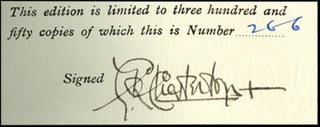
The Collected Poems of G.K. Chesterton
Limited Edition, 1927
350 signed and numbered copies. This is number 266.
Very Fine copy. Large format. Hand cut pages. Parchment spine, stamped in gilt.
This book is being offered exclusively through the American Chesterton Society.
UPDATE via the ACS: A gentleman contacted us who wants to sell it. He acquired it about 40 years ago in a used bookstore in Scotland. He is in serious need, and is starting to sell his treasures simply to pay the bills.
The fact is, it’s not something you can just go out and buy. So whoever buys it is helping out a needy soul – and the ACS to boot. But best of all, they’re getting an autographed Chesterton book.

Wednesday, August 09, 2006
Interesting Science Find
You can blame the monk, but if instead of writing prayers over it (and thereby ensuring its preservation through the ages) someone had just put a grocery list, or wrote out directions to the next town, would it still be here to even find?
Tuesday, August 08, 2006
Would Chesterton Like Blogs?
Our Sunday Visitor had a recent column titled, "Blah, blah, blog, blog" subtitled, "Is it a good thing that we have developed virtual and impersonal networks of contacts?"
His argument is something along the lines of that blogs are just another in a step to seperate us from our neighbors, friends and other real people contact.
I guess I have to wonder, how is a newspaper (the author, Greg Erlandson, is the publisher of the Our Sunday Visitor--OSV for short--newspaper) any more of a way to be in touch with real people? Is a newpaper "real" people-to-people contact in some way that a blog isn't I ask you?
One of the advantages of a blog is that it is very much like a newspaper, except you get the "letters to the editor" immediately, instead of two weeks later (as a weekly such as OSV must do, as it publishes in such a way that letters can't come in fast enough to get into the following week's "Letters" column). The conversation happens in a much more "real time" fashion on a blog, much more like real people having a conversation.
And who does Erlandson think is behind the blogs? Automatrons? Computer non-human geeks of some mechanical sort?
Erlandson turns the article into a mess about our parish churchs needing to do things so that people aren't anti-social. Ho-hum. Saying things like this reminds me of people who say "government should do this or that" as if people, as in US, aren't the issue, someone else must solve the problem.
So, I turn it on Erlandson. If your parish needs, help, volunteer. But don't use blogs as your excuse to say that that's what's wrong with churches today. That line of reasoning just won't fly with anybody who has a thinking brain.
And yes, I believe Chesterton would not only love blogs, but he'd have a blog, and it would be so popular he'd have to be on off-and-on all day putting out fires, stoking up conversations, and carrying on in a very, very lively way on-line. And in-between postings, he'd come down to the living room and see what Frances and the neices and nephews were doing, he'd play along for a while, throw a bun in the air and catch it in his mouth, and have ideas for more posts when he returned a few hours later.
;-)
His argument is something along the lines of that blogs are just another in a step to seperate us from our neighbors, friends and other real people contact.
I guess I have to wonder, how is a newspaper (the author, Greg Erlandson, is the publisher of the Our Sunday Visitor--OSV for short--newspaper) any more of a way to be in touch with real people? Is a newpaper "real" people-to-people contact in some way that a blog isn't I ask you?
One of the advantages of a blog is that it is very much like a newspaper, except you get the "letters to the editor" immediately, instead of two weeks later (as a weekly such as OSV must do, as it publishes in such a way that letters can't come in fast enough to get into the following week's "Letters" column). The conversation happens in a much more "real time" fashion on a blog, much more like real people having a conversation.
And who does Erlandson think is behind the blogs? Automatrons? Computer non-human geeks of some mechanical sort?
Erlandson turns the article into a mess about our parish churchs needing to do things so that people aren't anti-social. Ho-hum. Saying things like this reminds me of people who say "government should do this or that" as if people, as in US, aren't the issue, someone else must solve the problem.
So, I turn it on Erlandson. If your parish needs, help, volunteer. But don't use blogs as your excuse to say that that's what's wrong with churches today. That line of reasoning just won't fly with anybody who has a thinking brain.
And yes, I believe Chesterton would not only love blogs, but he'd have a blog, and it would be so popular he'd have to be on off-and-on all day putting out fires, stoking up conversations, and carrying on in a very, very lively way on-line. And in-between postings, he'd come down to the living room and see what Frances and the neices and nephews were doing, he'd play along for a while, throw a bun in the air and catch it in his mouth, and have ideas for more posts when he returned a few hours later.
;-)
Sorry lack of posting
We were traveling over the weekend, and I caught a cold, so thus, a lack of posting, sorry.
Saturday, August 05, 2006
Thursday, August 03, 2006
The Surprise
Based on the play my daughter read when I was preparing for ChesterCon 2006, she wants seven friends to get together with her and put on Chesterton's play, The Surprise.
I think it would really be fun for the high schoolers to do, so I am going to see what I can do to make it happen. One of the great things is that there are only eight actors. So I really think it could be easily done by a troop of homeschooled highschoolers.
I'll let you know when we're ready for production.
I think it would really be fun for the high schoolers to do, so I am going to see what I can do to make it happen. One of the great things is that there are only eight actors. So I really think it could be easily done by a troop of homeschooled highschoolers.
I'll let you know when we're ready for production.
Mowing in the Rain
It's raining here today, a much needed reprieve from the 95+ temps we've had all week.
So I hear the sound of a mower, and I have to wonder, who's mowing in the rain?
Oh, it's the lawn service our neighbor hired, who come every Thursday morning, rain or shine.
Which got me thinking about simplification. Does it simplify our lives to hire workers to do what we ourselves could do, but think we don't have time for?
My neighbor is a long haul trucker who tinkers on 1950's autos in his spare time, and incidentally, hates lawn work. So in his case, it isn't a lack of time.
He has a 20 year old son living there, who could be mowing, couldn't he? He doesn't look disabled as he plays hacky-sack on the back patio with his friends.
What have we taught the next generation?
My sister had a cleaning service for a while. (Read: maid)
As her kids got older, she asked the maid to stop cleaning their rooms, so that they would have to do it. My sister wanted her kids to be responsible for cleaning at least their own space. The kids resented this, and thought it didn't make sense.
After a while, my sister got tired of their protests and got rid of the maid. Now the kids help clean the whole house, with regular chores assigned to them. I think this will be better in the long run, that the kids know how to clean, strighten up, dust, vacuum, wash dishes, do loads of laundry and all of the other chores that make up running a house.
Teaching our children household chores takes time, and seems more complicated (less simple) than hiring help. And I suppose a distributistic argument could even be made for providing immigrants with jobs, for it is most often they who mow our lawns and become our cleaning women.
But what have we taught the children?
So I hear the sound of a mower, and I have to wonder, who's mowing in the rain?
Oh, it's the lawn service our neighbor hired, who come every Thursday morning, rain or shine.
Which got me thinking about simplification. Does it simplify our lives to hire workers to do what we ourselves could do, but think we don't have time for?
My neighbor is a long haul trucker who tinkers on 1950's autos in his spare time, and incidentally, hates lawn work. So in his case, it isn't a lack of time.
He has a 20 year old son living there, who could be mowing, couldn't he? He doesn't look disabled as he plays hacky-sack on the back patio with his friends.
What have we taught the next generation?
My sister had a cleaning service for a while. (Read: maid)
As her kids got older, she asked the maid to stop cleaning their rooms, so that they would have to do it. My sister wanted her kids to be responsible for cleaning at least their own space. The kids resented this, and thought it didn't make sense.
After a while, my sister got tired of their protests and got rid of the maid. Now the kids help clean the whole house, with regular chores assigned to them. I think this will be better in the long run, that the kids know how to clean, strighten up, dust, vacuum, wash dishes, do loads of laundry and all of the other chores that make up running a house.
Teaching our children household chores takes time, and seems more complicated (less simple) than hiring help. And I suppose a distributistic argument could even be made for providing immigrants with jobs, for it is most often they who mow our lawns and become our cleaning women.
But what have we taught the children?
Wednesday, August 02, 2006
Four-Year-Old Indoctrinations
I'm teaching Vacation Bible School this week at our parish to the four-year-olds.
I was reminded yesterday, after a few things the kids said, of Chesterton's great education quote:
"The point is that Man does what he likes. He claims the right to take his mother Nature under his control; he claims the right to make his child the Superman, in his image. Once flinch from this creative authority of man, and the whole courageous raid which we call civilization wavers and falls to pieces. Now most modern freedom is at root fear. It is not so much that we are too bold to endure rules; it is rather that we are too timid to endure responsibilities. And Mr. Shaw and such people are especially shrinking from that awful and ancestral responsibility to which our fathers committed us when they took the wild step of becoming men. I mean the responsibility of affirming the truth of our human tradition and handing it on with a voice of authority, an unshaken voice. That is the one eternal education; to be sure enough that something is true that you dare to tell it to a child. From this high audacious duty the moderns are fleeing on every side; and the only excuse for them is, (of course,) that their modern philosophies are so half-baked and hypothetical that they cannot convince themselves enough to convince even a newborn babe. This, of course, is connected with the decay of democracy; and is somewhat of a separate subject. Suffice it to say here that when I say that we should instruct our children, I mean that we should do it, not that Mr. Sully or Professor Earl Barnes should do it. The trouble in too many of our modern schools is that the State, being controlled so specially by the few, allows cranks and experiments to go straight to the schoolroom when they have never passed through the Parliament, the public house, the private house, the church, or the marketplace. Obviously, it ought to be the oldest things that are taught to the youngest people; the assured and experienced truths that are put first to the baby. But in a school to-day the baby has to submit to a system that is younger than himself. The flopping infant of four actually has more experience, and has weathered the world longer, than the dogma to which he is made to submit. Many a school boasts of having the last ideas in education, when it has not even the first idea; for the first idea is that even innocence, divine as it is, may learn something from experience." (Emphasis mine) GKChesterton, What's Wrong with the World
I was reminded yesterday, after a few things the kids said, of Chesterton's great education quote:
"The point is that Man does what he likes. He claims the right to take his mother Nature under his control; he claims the right to make his child the Superman, in his image. Once flinch from this creative authority of man, and the whole courageous raid which we call civilization wavers and falls to pieces. Now most modern freedom is at root fear. It is not so much that we are too bold to endure rules; it is rather that we are too timid to endure responsibilities. And Mr. Shaw and such people are especially shrinking from that awful and ancestral responsibility to which our fathers committed us when they took the wild step of becoming men. I mean the responsibility of affirming the truth of our human tradition and handing it on with a voice of authority, an unshaken voice. That is the one eternal education; to be sure enough that something is true that you dare to tell it to a child. From this high audacious duty the moderns are fleeing on every side; and the only excuse for them is, (of course,) that their modern philosophies are so half-baked and hypothetical that they cannot convince themselves enough to convince even a newborn babe. This, of course, is connected with the decay of democracy; and is somewhat of a separate subject. Suffice it to say here that when I say that we should instruct our children, I mean that we should do it, not that Mr. Sully or Professor Earl Barnes should do it. The trouble in too many of our modern schools is that the State, being controlled so specially by the few, allows cranks and experiments to go straight to the schoolroom when they have never passed through the Parliament, the public house, the private house, the church, or the marketplace. Obviously, it ought to be the oldest things that are taught to the youngest people; the assured and experienced truths that are put first to the baby. But in a school to-day the baby has to submit to a system that is younger than himself. The flopping infant of four actually has more experience, and has weathered the world longer, than the dogma to which he is made to submit. Many a school boasts of having the last ideas in education, when it has not even the first idea; for the first idea is that even innocence, divine as it is, may learn something from experience." (Emphasis mine) GKChesterton, What's Wrong with the World
Tuesday, August 01, 2006
Ignatius Press Interviews Dale Ahlquist

Excerpt:
IgnatiusInsight.com: You've already written one introductory book about Chesterton, The Apostle of Common Sense. How is Common Sense 101: Lessons From G.K. Chesterton different? What did you hope to accomplish with this book?
Ahlquist: The first book was specifically designed to be an introduction to Chesterton. The second book is not supposed to be a book about Chesterton but rather about seeing the world through Chesterton's eyes. And so I hope to give people a new take on art, literature, education, science, history, fads (like feminism), and many other things, to give them the Chestertonian perspective, which is always larger and truer than the narrow and sometimes dishonest way we usually see these things. I also take the opportunity to show how Chesterton goes about defending the faith.
Subscribe to:
Posts (Atom)


 Posts
Posts