As some of you know, James O'Keefe is invited to ChesterTen in August. I am really looking forward to hearing him speak.
So I was distressed to learn this past week of his arrest, along with three other young people, in the office of a senator in New Orleans. Somehow, I knew the immediate press judgments of Mr. O'Keefe and the lack of detail surrounding the story meant that there was probably more to it than met the eye. If the press had asked me (which they didn't) what I thought of the whole thing, I would have said I needed to wait until I had more information.
When the left says tolerance, and keep an open mind, they don't really mean that for themselves, do they? Did they allow their minds to remain open about James O'Keefe? Did they give him any tolerance?
Oh, and conservatives are distancing themselves. Yes, since they asked O'Keefe to give a speech next week when he'll still be under orders to remain at home, since they need a new speaker for the event, the press labeled that "distancing". Yes, that seems fair and tolerant and unbiased of the press.
My first thought was not, "Oh my gosh, the guy who busted Acorn is busted so let's discredit the heck out of him and 'distance' ourselves from him." First of all, we still believe in innocence until proven guilty in this country. Or at least, I do. Apparently the press and the left leaners don't.
My first thought was, Who is this senator, and why were James and his friends interested in her? What's going on in that office? A question I still find inadequately addressed by the press. Her phone's been off the hook? Her constituents can't reach her? Is she ignoring the voices of those she represents whom she disagrees with? What's going on there?
Secondly, I find it amazingly funny that the press runs away with the "wire tapping" story, when there was no evidence of what exactly the young people were trying to do there. I think wire tapping can be done without going directly into an office and asking to look at the phones. Duh! If you were trying to be secretive, would you actually operate that way? Obvious to me is the fact that the boys WEREN'T there to wire tap. Wire tapping, it seems to me, could be done quite effectively in secret. I bet the networks are digital these days. I bet Chloe Sullivan would be able to hack into the system and find out what's going on via the computer. THEN the FBI could trace the hack and someone would REALLY be arrested for "digital wire tapping" or whatever they call it. The fantastic thing is, when someone thought of the words wire tapping, everyone else did, too. And no one stopped to think, oh, wait a minute--I don't think people actually "wire tap" anymore. Or if they do, they don't have to physically go into the office to do it.
So then, could it be possible that until we hear from the four boys, we really don't understand the situation or what they were trying to do? Could that even exist as a possibility in people's minds for a little while? I hear there will be a hearing on Feb 17, I wonder, could we wait till then to find out what it is they were trying to do?
And one more thing. The FBI. Why were they there? I mean, yes, the four were there, and yes, they weren't telephone repair people. But they didn't have weapons, they weren't threatening anyone, they didn't seem to have any violent tendencies, nor did they resist arrest. They didn't appear to have made off with anything of value, nor did they even attempt to take anything. So, the FBI. Again, why? Local police couldn't have come by and asked, What are you boys doing here? Have the FBI been following James and his friends around? Have THEY been "wire tapping" or following them on Twitter or Facebook, or hacking into their cell phones, just to see what they're cooking up next? Hmmmm. Because O'Keefe is so dangerous, exposing government fiscal corruption and senators ignoring their constituents is such a violent crime, I suppose.
Despite the press, I am, now more than ever, interested in hearing from James O'Keefe.
You can listen to a podcast interview where I talked with James here.
Saturday, January 30, 2010
Friday, January 29, 2010
Ralph McInery
From Dale:I just got the word that Ralph McInerny died this morning.Read more here.
He graciously agreed to speak at our conference back in 2001. It was one of the best conferences we ever had.
His last words were “I commend my soul to God.”
Labels:
Friends of GKC's on the web
| Reactions: |
Thursday, January 28, 2010
The Tree and Subsidiarity
Wow, on the "Novus Order" calendar today is the feast of St. Thomas Aquinas! Be sure to get out GKC's book and savour some of its rich fare today:
For some time I have been collecting notes on a discussion of what Norton Juster called the Kingdom of Wisdom - and the "Phantom Tollbooth" which gives us access to that world. Since our study last year of GKC's Orthodoxy, we know that "The greatest of poems is an inventory." [CW1:267] And we also know from Rudyard Kipling that "poems are writ by fools like me - but only God can make a tree." It would be easy enough to make an inventory in the form of a list, which we find in its most classic form in the first chapter of Genesis, or Psalm 135 or 148 or the very famous Song of the Guys in the Furnace in the third chapter of Daniel. But almost anyone who begins to study questions like What Do We Study, and What Do We Do When We Study, and such finds out that things are lots more interconnected, and a simple list leaves a lot to be desired.
This essay of mine, long as it is, has a point, and it is not to be a historical review of epistemology and pedagogy and the question of the classes of human knowledge. I have no time for that today. Rather, I will take you right to the point - which, as you may expect, can be found in the Ages of Light, the wondrous Middle Ages. After all they had something we don't have - (remember what the Wizard of Oz told the Scarecrow!) They had Faith, and (let us say it together) "It is idle to talk always of the alternative of reason and faith. Reason is itself a matter of faith. It is an act of faith to assert that our thoughts have any relation to reality at all." [GKC Orthodoxy CW1:236] Since they believed in God, and were not afraid to talk about God, or mention Him and His work no matter what the present topic might be, they had a single unifying power which is all too lacking in our so modern technical artistic self-admiring time.
They would take some simple but comprehensive starting point - say a simple line from the Gospels like "I am the vine: you the branches. He that abideth in me, and I in him, the same beareth much fruit: for without me you can do nothing." [John 15:5] and erected their entire world - from farming to achitecture to art to mathematics to theology - upon it, because it was reliable, and continually proved itself to be trustworthy, and in fact efficient. Now remember what "efficient" really means: it means getting things done. The point is not that you do it "better" or "faster" - but that you have really and truthfully accomplished what you set out to do! The medievals get things done because they live in the REAL WORLD, which is the olny possible foundation on which one can build. As Chesterton told us, St. Thomas Aquinas
No, we get something a little more intense than a list, my friend - we get a tree. And that has everything to do with Subsidiarity.
Some time ago I think I mentioned that a few years back, a scholar named Nicholas Steneck wrote a book on Henry of Langenstein, a philosopher who died about 1397. Steneck mentioned something called the arbor scientiarum, the "tree of sciences" In a passage which is most Chestertonian and indeed very Newman-ian, he wrote:

Yes - a lovely binary tree, right out of the 14th century. The computer scientists cheer, to the delight of the Latinists and the philosophers - but there is a whole lot of detail missing, and indeed Henry's approach to this topic gave Doctor Steneck some wonderful work to do, but we must go on, since another friend obtained another tree for me to show you, which goes much further. This one, the very famous "Tree of Virtue", is from the famous university of Salamanca in Spain, from the Cursus Theologicus, and is supplied by my good friend Andrew at Loome:

Here we see in one utterly intense and fascinating picture, the medieval exemplar of Chesterton's famous "no such thing as a different subject" in all its ramifications. (Pun intended!) Alas, the image I have does not permit me to read some of the annotations - and of course there has been at least half a millennium of additions made since it was drawn. But behold the richness, the exquisite detail - it reminds me of the "Chart of the Metabolic Processes" which I have in my office - but that lacks the ornate allusions, the Bible verses... see too, the seven Gifts of the Holy Spirit, the Beatitudes - see how the variety of gifts from Optics and Geography, Surgery and Ethics and Music - the Trades, the Crafts, the Arts, the "sciences", the branches of philosophy - all are made one, and linked correctly together - watered by the Fountain: "Fons aquae salientis in vitam aeternam" that is, "a fountain of water springing up into life everlasting" [John 4:14] Yes: "multiplicabis me in anima mea virtute" - "thou shalt multiply strength in my soul." [Ps 137:3] Ah... it is a sermon and a prayer and a reference book all in one. (We are discussing the possibility of a good reproduction - but it also needs some updating and extension. I'll let you know.)
Yes, Doc - we know you like this a lot, and it sure is Chestertonian. But what does that have to do with Cable TV - and with Subsidiarity?
Of course I cannot go into all the technical details today. But the idea is as simple as the tree - it was known to Henry of Langenstein and all such scholars. The idea comes from the simple truth that each of us is a creation, a contingent being, and subject to limits. Chestertonians are fond of repeating the GKC epigrams on this truth, "Art, like morality, consists of drawing the line somewhere." [ILN May 5 1928 CW34:518] and "Art is limitation; the essence of every picture is the frame." [Orth CW1:243] But that is just as true of cars or engines or computers as it is of canvas and pen-and-paper, as true of carbon and sodium, of electricity and gravity as it is of logic and morals, of alliteration and hyperbole. And yes, ten years ago, it was a simple limitation in a computer which demanded a solution. And that is when a cable TV company heard these famous words from our Uncle Gilbert:
But we found a solution in ancient methods, in unlikely documents, once we had correctly set forth our Purpose and its Limits: if an inserter (a special computer) must be supplied with certain things so that it can do its work of managing its TV networks, and it can only manage no more than eight at once, and a given headend (the local distribution point for your cable TV) must supply 24 or 32 or more TV networks - thus requiring three or four or more inserters - and moreover only ONE of those inserters can ever communicate directly with our headquarters which is the only supply of whatever may be needed - why then we must make some arrangement of order and communication by which the things needed will get to where they are needed.
And just as Henry and the scholars of Salamanca, and Aquinas and Newman and Chesterton grasped the completeness, the unity, by resorting to thirteenth century metaphysics - why, so did we proceed. We saw the trinitarian idiom - we have root (our headquarters), branch (the portal which communicates with headquarters) and leaf (the others which only commuicate with the portal) - that is WE HAVE A TREE.
The greatest light of the Middle Ages, St. Thomas Aquinas teaches that "It belongs to wisdom to set things in order" [Summa, II-II Q45 A6 quoting Aristotle Metaphysics I:2] And that is how we got things done. For five and half years, over 200,000 spots were sent to our dozens of headends according to Subsidiarity - just as Moses listened to his father-in-law Jethro in organizing things by arranging a "tree" of judges over tens and fifies and hundreds and thousands [see Exodus 18:13-26] we arranged a tree of inserters, and ordered our Field of headends and their inserters.
Next time we shall hear another important part of this work: its order gets things done, not simply by making a tree as in the modern "org chart", but because the various branches in the tree are able to communicate with each other. The paradox lies between responding to an appeal for help and micromanagement, between doing things for one's self, and knowing what one cannot do by one's self. Stay tuned.
P.S. Last time I said I have two books on the topic. There sure are, though they are not yet in print. The non-fiction text is called Subsidiarity and you can see its first section here. The other is my novel about Joe the Control Room Guy, which I have available on a blogg, but you will have to e-mail me for access if you really wish to read it. It's an adventure kind of "tech fairy tale" which reveals the human side of Subsidiarity in a way that set theory and software and philosophy do not. Also, it has pictures.
The Corpus Christi Office is like some old musical instrument, quaintly and carefully inlaid with many coloured stones and metals; the author has gathered remote texts about pasture and fruition like rare herbs; there is a notable lack of the loud and obvious in the harmony; and the whole is strung with two strong Latin lyrics. Father John O'Connor has translated them with an almost miraculous aptitude; but a good translator will be the first to agree that no translation is good; or, at any rate, good enough. How are we to find eight short English words which actually stand for "Sumit unus, sumunt mille; quantum isti, tantum ille"? How is anybody really to render the sound of the "Pange Lingua", when the very first syllable has a clang like the clash of cymbals?Today, however, you will have to suffer some of my own remote texts which are more of a clashing of symbols - but I do hope and pray these shall provide some strength and insight into fruition - or at least into the fruit-bearing creature we call the Tree, which is such a wonderful Thomistic and medieval path to understanding more about Subsidiarity.
[GKC STA CW2:509]
For some time I have been collecting notes on a discussion of what Norton Juster called the Kingdom of Wisdom - and the "Phantom Tollbooth" which gives us access to that world. Since our study last year of GKC's Orthodoxy, we know that "The greatest of poems is an inventory." [CW1:267] And we also know from Rudyard Kipling that "poems are writ by fools like me - but only God can make a tree." It would be easy enough to make an inventory in the form of a list, which we find in its most classic form in the first chapter of Genesis, or Psalm 135 or 148 or the very famous Song of the Guys in the Furnace in the third chapter of Daniel. But almost anyone who begins to study questions like What Do We Study, and What Do We Do When We Study, and such finds out that things are lots more interconnected, and a simple list leaves a lot to be desired.
This essay of mine, long as it is, has a point, and it is not to be a historical review of epistemology and pedagogy and the question of the classes of human knowledge. I have no time for that today. Rather, I will take you right to the point - which, as you may expect, can be found in the Ages of Light, the wondrous Middle Ages. After all they had something we don't have - (remember what the Wizard of Oz told the Scarecrow!) They had Faith, and (let us say it together) "It is idle to talk always of the alternative of reason and faith. Reason is itself a matter of faith. It is an act of faith to assert that our thoughts have any relation to reality at all." [GKC Orthodoxy CW1:236] Since they believed in God, and were not afraid to talk about God, or mention Him and His work no matter what the present topic might be, they had a single unifying power which is all too lacking in our so modern technical artistic self-admiring time.
They would take some simple but comprehensive starting point - say a simple line from the Gospels like "I am the vine: you the branches. He that abideth in me, and I in him, the same beareth much fruit: for without me you can do nothing." [John 15:5] and erected their entire world - from farming to achitecture to art to mathematics to theology - upon it, because it was reliable, and continually proved itself to be trustworthy, and in fact efficient. Now remember what "efficient" really means: it means getting things done. The point is not that you do it "better" or "faster" - but that you have really and truthfully accomplished what you set out to do! The medievals get things done because they live in the REAL WORLD, which is the olny possible foundation on which one can build. As Chesterton told us, St. Thomas Aquinas
has thrown out a bridge across the abyss of the first doubt, and found reality beyond and begun to build on it.Ah - but what is this reality? Do we get a packing list for it? And what does all this have to do with Subsidiarity?
[GKC STA CW2:543]
No, we get something a little more intense than a list, my friend - we get a tree. And that has everything to do with Subsidiarity.
Some time ago I think I mentioned that a few years back, a scholar named Nicholas Steneck wrote a book on Henry of Langenstein, a philosopher who died about 1397. Steneck mentioned something called the arbor scientiarum, the "tree of sciences" In a passage which is most Chestertonian and indeed very Newman-ian, he wrote:
Disciplines, as branches of the arbor scientiarum, can be spoken of as individual entities, as had been made very clear in the Prologus, but none is ever totally separable from the tree. There is no reason to distinguish one branch from all others as an autonomous unit. More than this, there is no reason to limit one discipline exclusively to one method. This is not to say that some disciplines do not employ one method more than another. Certainly they do. But there is nothing to suggest that they ought to use only that method. If other disciplines have something valid to say about science, or the reverse, Henry is perfectly willing to go that route. Truth is truth no matter what its origin.Ah. But what is this arbor scientiarum? It took my appealing to a Chestertonian scholar to acquire a copy of Steneck's paper in which it appears... after some technical gear in which I was forced (like Gandalf) to resort to software I wrote in 1986, I can present it for your delight...
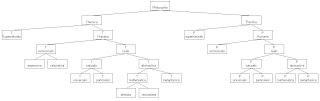
[Nicholas Steneck, Science and Creation in the Middle Ages: Henry of Langenstein (d. 1397) on Genesis, 145]

Yes - a lovely binary tree, right out of the 14th century. The computer scientists cheer, to the delight of the Latinists and the philosophers - but there is a whole lot of detail missing, and indeed Henry's approach to this topic gave Doctor Steneck some wonderful work to do, but we must go on, since another friend obtained another tree for me to show you, which goes much further. This one, the very famous "Tree of Virtue", is from the famous university of Salamanca in Spain, from the Cursus Theologicus, and is supplied by my good friend Andrew at Loome:

Here we see in one utterly intense and fascinating picture, the medieval exemplar of Chesterton's famous "no such thing as a different subject" in all its ramifications. (Pun intended!) Alas, the image I have does not permit me to read some of the annotations - and of course there has been at least half a millennium of additions made since it was drawn. But behold the richness, the exquisite detail - it reminds me of the "Chart of the Metabolic Processes" which I have in my office - but that lacks the ornate allusions, the Bible verses... see too, the seven Gifts of the Holy Spirit, the Beatitudes - see how the variety of gifts from Optics and Geography, Surgery and Ethics and Music - the Trades, the Crafts, the Arts, the "sciences", the branches of philosophy - all are made one, and linked correctly together - watered by the Fountain: "Fons aquae salientis in vitam aeternam" that is, "a fountain of water springing up into life everlasting" [John 4:14] Yes: "multiplicabis me in anima mea virtute" - "thou shalt multiply strength in my soul." [Ps 137:3] Ah... it is a sermon and a prayer and a reference book all in one. (We are discussing the possibility of a good reproduction - but it also needs some updating and extension. I'll let you know.)
Yes, Doc - we know you like this a lot, and it sure is Chestertonian. But what does that have to do with Cable TV - and with Subsidiarity?
Of course I cannot go into all the technical details today. But the idea is as simple as the tree - it was known to Henry of Langenstein and all such scholars. The idea comes from the simple truth that each of us is a creation, a contingent being, and subject to limits. Chestertonians are fond of repeating the GKC epigrams on this truth, "Art, like morality, consists of drawing the line somewhere." [ILN May 5 1928 CW34:518] and "Art is limitation; the essence of every picture is the frame." [Orth CW1:243] But that is just as true of cars or engines or computers as it is of canvas and pen-and-paper, as true of carbon and sodium, of electricity and gravity as it is of logic and morals, of alliteration and hyperbole. And yes, ten years ago, it was a simple limitation in a computer which demanded a solution. And that is when a cable TV company heard these famous words from our Uncle Gilbert:
I revert to the doctrinal methods of the thirteenth century, inspired by the general hope of getting something done.The method is to know the essence of things, and the solution was found in Rerum Novarum, a papal encyclical from 1891 that even GKC knew! Was it effective and efficient? Well... Oh sure, we could have done things in the typical post-American method - just get it done and don't think about it, use your goofy terms and anagrammatic labels, your SDLC and your six-sigmas, your tigers and your waterfalls, and find that you will keep having problems because you never tried to find the esse - the being which is the kernal, the heart, the Purpose of the system!
[GKC Heretics CW1:46]
But we found a solution in ancient methods, in unlikely documents, once we had correctly set forth our Purpose and its Limits: if an inserter (a special computer) must be supplied with certain things so that it can do its work of managing its TV networks, and it can only manage no more than eight at once, and a given headend (the local distribution point for your cable TV) must supply 24 or 32 or more TV networks - thus requiring three or four or more inserters - and moreover only ONE of those inserters can ever communicate directly with our headquarters which is the only supply of whatever may be needed - why then we must make some arrangement of order and communication by which the things needed will get to where they are needed.
And just as Henry and the scholars of Salamanca, and Aquinas and Newman and Chesterton grasped the completeness, the unity, by resorting to thirteenth century metaphysics - why, so did we proceed. We saw the trinitarian idiom - we have root (our headquarters), branch (the portal which communicates with headquarters) and leaf (the others which only commuicate with the portal) - that is WE HAVE A TREE. The greatest light of the Middle Ages, St. Thomas Aquinas teaches that "It belongs to wisdom to set things in order" [Summa, II-II Q45 A6 quoting Aristotle Metaphysics I:2] And that is how we got things done. For five and half years, over 200,000 spots were sent to our dozens of headends according to Subsidiarity - just as Moses listened to his father-in-law Jethro in organizing things by arranging a "tree" of judges over tens and fifies and hundreds and thousands [see Exodus 18:13-26] we arranged a tree of inserters, and ordered our Field of headends and their inserters.
Next time we shall hear another important part of this work: its order gets things done, not simply by making a tree as in the modern "org chart", but because the various branches in the tree are able to communicate with each other. The paradox lies between responding to an appeal for help and micromanagement, between doing things for one's self, and knowing what one cannot do by one's self. Stay tuned.
P.S. Last time I said I have two books on the topic. There sure are, though they are not yet in print. The non-fiction text is called Subsidiarity and you can see its first section here. The other is my novel about Joe the Control Room Guy, which I have available on a blogg, but you will have to e-mail me for access if you really wish to read it. It's an adventure kind of "tech fairy tale" which reveals the human side of Subsidiarity in a way that set theory and software and philosophy do not. Also, it has pictures.
Monday, January 25, 2010
People First
This morning I was meditating on Chesterton and Shaw and eugenics and politics and right and wrong and good and evil, and my mind was all over the place.
And after thinking about how Shaw and Stalin and Hitler and Sanger were eugenicists, and wondering how in the world Chesterton could have remained friends with Shaw knowing this awful thing about him.
And I think Chesterton's secret is that he could always see people as people first.
I mean that he could see through all the layers of labels. Conservative, liberal, pessimist, optimist, socialist, republican, Marxist, vegetarian, etc. He saw under all that to the person themselves.
And so he could deal with people as people first, and not as a label.
I think our country has moved more and more towards labeling, don't you think? It's so easy to stick a label on someone, and think we know all about them then, and how they think and who they are. It safely puts people in a category, in a box, on a shelf where we don't have to deal with them as people. And then we don't have conversations because they're [fill in the blank] protestant, or liberal, or progressive, or ultraconservative, or Catholic, or a Fabian, or an environmentalist, or whatever, and we couldn't possible converse with someone like that because we aren't like that.
Chesterton saw under that and could converse with anyone because he saw them as people first, a human like himself, and so he connected on a very elemental level with anyone and everyone.
I think we need to learn from that secret of his, so we can re-connect with humanity. The humanity in our own families first, then our neighbors, and certainly our community leaders.
Let's take up this challenge and see if we can live this way.
And after thinking about how Shaw and Stalin and Hitler and Sanger were eugenicists, and wondering how in the world Chesterton could have remained friends with Shaw knowing this awful thing about him.
And I think Chesterton's secret is that he could always see people as people first.
I mean that he could see through all the layers of labels. Conservative, liberal, pessimist, optimist, socialist, republican, Marxist, vegetarian, etc. He saw under all that to the person themselves.
And so he could deal with people as people first, and not as a label.
I think our country has moved more and more towards labeling, don't you think? It's so easy to stick a label on someone, and think we know all about them then, and how they think and who they are. It safely puts people in a category, in a box, on a shelf where we don't have to deal with them as people. And then we don't have conversations because they're [fill in the blank] protestant, or liberal, or progressive, or ultraconservative, or Catholic, or a Fabian, or an environmentalist, or whatever, and we couldn't possible converse with someone like that because we aren't like that.
Chesterton saw under that and could converse with anyone because he saw them as people first, a human like himself, and so he connected on a very elemental level with anyone and everyone.
I think we need to learn from that secret of his, so we can re-connect with humanity. The humanity in our own families first, then our neighbors, and certainly our community leaders.
Let's take up this challenge and see if we can live this way.
Labels:
The Apostle of Common Sense
| Reactions: |
Saturday, January 23, 2010
Brent Bozell on Virginity, Jonas Brothers, and Dawn Eden
H/T: Dave, thanks.
This is a great article about a VH1 show about Dawn "Thrill of the Chaste" Eden that didn't make it, and how the cynical show about how virginity is overrated and used as a marketing tool, did. Bozell does a great job with fair criticism.
Labels:
Friends of GKC's on the web
| Reactions: |
Thursday, January 21, 2010
Subsidiarity: Look to the Trees (a Roman Army maneuver)
I see that I caused a little confusion last week with my ancient Greek cable TV frogs, and apologise. I am infected (inflicted? inflected?) with a punish disease, and always seem to be tripping over my feet. Hee hee. The important thing, of course, was Subsidiarity, and we shall try to talk some more about that today as we approach the tenth anniversary of the activation of that famous cable TV system. Can you say "coax" cable? Ribbit, ribbit. Hee hee! (You know there is a Chesterton quote which really ought to go here, but I think I ought to let you do some work. It starts: "What did the first frog say?" and you can find the answer in Orthodoxy.)
Subsidiarity is paradoxical - which makes it, like so many other things, a little tricky to discuss. I have already heard various silly replies about it, and like so many other things we hear our Uncle Gilbert discuss, those replies reveal not what is wrong with my argument, or with the principle, but how little the opponent has paid attention to the topic at hand. But I am not going to reply - or even repeat - what my opponents have said, since I am not writing a "Summa" today.... I have already written one book - Oh, excuse me, Joe - yes, I mean two books! - on Subsidiarity, and won't go further until they are published. But a blogg is (as GKC says of his weekly newspaper) a fun thing to "splash around in" and so we shall proceed.
One of the more dramatic points about Subsidiarity is its modern antiquity. This is so Augustinian - you can hear him chuckling "tam antiqua, tam nova" as he contemplates the fusion of ancient Rome's army discipline with 21st century satellite transport methodology. But we are not going to be conquering Gaul today, nor playing with communications devices in geosynchronous orbit. (Rats, what a choice to be faced with!)
No, just as I started my analogy with frogs last week, today I shall start with another creature: the tree.
Now the tree is a source of a myriad of allusional possibilities: we can think of that strange plant in the garden of Eden - or the even stranger one on Calvary. We could consult texts on forestry or botany, distinguishing by bark and leaf, by seed and fruit, by habit and size - or perhaps we wish to harvest them for fruit or nuts or for the most wonderful substance, the natural plastic called "wood" ranging from balsa to mahogany, for violins or for pencils or for paper or for shade. If we go into subcreation, we can think of Bilbo Baggins' "Party Tree" or the glorious Telperion and Laurelin of the Valar - or Chesterton's "The Trees of Pride" or "My Uncle the Professor" (both in CW14); the famous challenge of tree and lamp between poets Gregory and Syme; the tree Innocent Smith climbed; the tree that Drummond Keith - ah, but I must not reveal what his Queer Trade was!
Yes. But there are other trees. In computing a very important data structure is called the tree, and it comes in dozens of forms from the simple binary tree taught to sophomores, up through the "trie" and the DAWG and other very intense structures, by which such things as data compression and encryption are accomplished. But in keeping with the vast power of the tree of nature, we computer guys use the tree in various other ways. You are quite likely using one now, even though you are not aware of it. You can see it if you use your "explorer" or "file browser" tool to visit the various storage areas of your computer. Yes, in most typical computers using the "UNIX" style of operating system (which even includes DOS and its windowed variants) your files are kept in a "tree" of directories. It will horrify the atheists to learn that this tree is a holy thing, for the technical term for this structure is "hierarchical" - that is, a "sacred organization" (from Greek hieros+archos) akin to the orders of the angels, or to the hierarchy of the Church: Pope, bishops, priests, laity. There is something called the "ROOT" of the tree, which typically looks like "c:\" and there are branches and sub-branches, which we call directories and subdirectories, and finally there are leaves, which we call files. A leaf, of course, does not branch - but a branch may itself give forth branches, as well as zero or more leaves. Splendid.
Now, what does all THAT have to do with Subsidiarity?
For one, the term "tree" links a whole lot of ideas together, both from literature and science and technology and history and culture - all the while embodying something very simple and yet so profound that books of technical detail have been written about its varying forms! (Here I could supply references in any of the above-mentioned fields, and I own some of them, in art, in botany, and in computing.)
But more, the tree even in its simplest form, suggests something trinitarian, which leads us back to Roma. I mean the Roman army - as you can learn from the Latin dictionary, the subsidium was also called the triarii: the "reserve", the "third line of defence behind the hastati and the principes". These were the experienced men, put there to assist the others and support them - so strong was this image that the word subsidium was abstracted to mean "aid, means of aid, help, succour" and transferred to non-military uses - we get words like "subsidy" and "subsidiary" and "subsidize" from it, all of which carry the concept of aid and assistance.
How strange to understand this mystical idea from these rugged and technical images - but it is easy to get confused. You might not grasp the point of the Roman army - that the smart experienced guys were not being "protected" by the guys in the first two lines! (Did you note the curious paradox that the principes were not the principal line? That was because the hastati (spearmen) were added, but they didn't bother altering the terms.) No; the point was that the experienced guys were put in the third line as backup - as support, ready to come to aid where they were needed. If you think the Romans were wrong about this, you have no clue about how terrified the rest of the world was of the Roman army. They had discipline, and they knew how to organize. But let me proceed.
This is the idea - yes, the trinitiarian idea - we also learn from the tree. There are three main classes or parts: the root, the branch, the leaf, just as there were three lines of the Roman army. Even though one may guess that the root is the foremost thing, being the biggest and strongest, this would be wrong, just as it would be wrong to think the Roman army was arranged with the other guys out in front to protect the triarii. No, both nature and the Romans seem to have looked ahead in the book, and found out a design trick from the Master Designer. The trunk and branches exist for the sake of the leaves, to get them as far apart as possible so they will have the most chances for getting sunlight. The Roman army was arranged to support and protect the first line of warriors, who would deal with the brunt of the opposing army.
Yes - in any system or organization founded upon Subsidiarity, the higher levels of an are there to support the lower, for
And if you want to SEE more about trees, you might look no further than your own eyes...
Subsidiarity is paradoxical - which makes it, like so many other things, a little tricky to discuss. I have already heard various silly replies about it, and like so many other things we hear our Uncle Gilbert discuss, those replies reveal not what is wrong with my argument, or with the principle, but how little the opponent has paid attention to the topic at hand. But I am not going to reply - or even repeat - what my opponents have said, since I am not writing a "Summa" today.... I have already written one book - Oh, excuse me, Joe - yes, I mean two books! - on Subsidiarity, and won't go further until they are published. But a blogg is (as GKC says of his weekly newspaper) a fun thing to "splash around in" and so we shall proceed.
One of the more dramatic points about Subsidiarity is its modern antiquity. This is so Augustinian - you can hear him chuckling "tam antiqua, tam nova" as he contemplates the fusion of ancient Rome's army discipline with 21st century satellite transport methodology. But we are not going to be conquering Gaul today, nor playing with communications devices in geosynchronous orbit. (Rats, what a choice to be faced with!)
No, just as I started my analogy with frogs last week, today I shall start with another creature: the tree.
Now the tree is a source of a myriad of allusional possibilities: we can think of that strange plant in the garden of Eden - or the even stranger one on Calvary. We could consult texts on forestry or botany, distinguishing by bark and leaf, by seed and fruit, by habit and size - or perhaps we wish to harvest them for fruit or nuts or for the most wonderful substance, the natural plastic called "wood" ranging from balsa to mahogany, for violins or for pencils or for paper or for shade. If we go into subcreation, we can think of Bilbo Baggins' "Party Tree" or the glorious Telperion and Laurelin of the Valar - or Chesterton's "The Trees of Pride" or "My Uncle the Professor" (both in CW14); the famous challenge of tree and lamp between poets Gregory and Syme; the tree Innocent Smith climbed; the tree that Drummond Keith - ah, but I must not reveal what his Queer Trade was!
Yes. But there are other trees. In computing a very important data structure is called the tree, and it comes in dozens of forms from the simple binary tree taught to sophomores, up through the "trie" and the DAWG and other very intense structures, by which such things as data compression and encryption are accomplished. But in keeping with the vast power of the tree of nature, we computer guys use the tree in various other ways. You are quite likely using one now, even though you are not aware of it. You can see it if you use your "explorer" or "file browser" tool to visit the various storage areas of your computer. Yes, in most typical computers using the "UNIX" style of operating system (which even includes DOS and its windowed variants) your files are kept in a "tree" of directories. It will horrify the atheists to learn that this tree is a holy thing, for the technical term for this structure is "hierarchical" - that is, a "sacred organization" (from Greek hieros+archos) akin to the orders of the angels, or to the hierarchy of the Church: Pope, bishops, priests, laity. There is something called the "ROOT" of the tree, which typically looks like "c:\" and there are branches and sub-branches, which we call directories and subdirectories, and finally there are leaves, which we call files. A leaf, of course, does not branch - but a branch may itself give forth branches, as well as zero or more leaves. Splendid.
Now, what does all THAT have to do with Subsidiarity?
For one, the term "tree" links a whole lot of ideas together, both from literature and science and technology and history and culture - all the while embodying something very simple and yet so profound that books of technical detail have been written about its varying forms! (Here I could supply references in any of the above-mentioned fields, and I own some of them, in art, in botany, and in computing.)
But more, the tree even in its simplest form, suggests something trinitarian, which leads us back to Roma. I mean the Roman army - as you can learn from the Latin dictionary, the subsidium was also called the triarii: the "reserve", the "third line of defence behind the hastati and the principes". These were the experienced men, put there to assist the others and support them - so strong was this image that the word subsidium was abstracted to mean "aid, means of aid, help, succour" and transferred to non-military uses - we get words like "subsidy" and "subsidiary" and "subsidize" from it, all of which carry the concept of aid and assistance.
How strange to understand this mystical idea from these rugged and technical images - but it is easy to get confused. You might not grasp the point of the Roman army - that the smart experienced guys were not being "protected" by the guys in the first two lines! (Did you note the curious paradox that the principes were not the principal line? That was because the hastati (spearmen) were added, but they didn't bother altering the terms.) No; the point was that the experienced guys were put in the third line as backup - as support, ready to come to aid where they were needed. If you think the Romans were wrong about this, you have no clue about how terrified the rest of the world was of the Roman army. They had discipline, and they knew how to organize. But let me proceed.
This is the idea - yes, the trinitiarian idea - we also learn from the tree. There are three main classes or parts: the root, the branch, the leaf, just as there were three lines of the Roman army. Even though one may guess that the root is the foremost thing, being the biggest and strongest, this would be wrong, just as it would be wrong to think the Roman army was arranged with the other guys out in front to protect the triarii. No, both nature and the Romans seem to have looked ahead in the book, and found out a design trick from the Master Designer. The trunk and branches exist for the sake of the leaves, to get them as far apart as possible so they will have the most chances for getting sunlight. The Roman army was arranged to support and protect the first line of warriors, who would deal with the brunt of the opposing army.
Yes - in any system or organization founded upon Subsidiarity, the higher levels of an are there to support the lower, for
henceforth the highest thing can only work from below.I know, you recognize this as his words about Bethlehem - unless you somehow think I have confused it with Elrond's words to the hobbits at the Council... But in either case, this is just a restatement of other, far more famous famous words, from One far greater than Elrond:
[GKC The Everlasting Man CW2:313]
Then after he had washed their feet and taken his garments, being set down again, he said to them: Know you what I have done to you? You call me Master and Lord. And you say well: for so I am. If then I being your Lord and Master, have washed your feet; you also ought to wash one another's feet. For I have given you an example, that as I have done to you, so you do also.Or perhaps, even better,
[John 13:12-15]
Whosoever is the greater among you, let him be your minister.Next time we shall see more about the tree, but from the great Ages of Light, the Middle Ages, when Science was still known as one of the gifts of the Holy Spirit.
[Mt 20:26]
And if you want to SEE more about trees, you might look no further than your own eyes...
Wednesday, January 20, 2010
Someone's excited about Scott Brown
G. K. Chesterton once said, “the need here is a need of complete freedom for restoration, as well as revolution.” Restoration and revolution—America has need for both.Read the whole article here.
“We the people” must restore the sacrosanct status of the Constitution; God’s place of honor in our Government and culture, and respect for the sanctity of life. There is much that has been lost; there is much to be restored.
There is also a revolution to be tended, stoked, and guided. Thomas Jefferson, author of The Declaration of Independence, was of the opinion that “the tree of liberty must be refreshed from time to time, with the blood of patriots and tyrants.” America clearly has its tyrants, and now that the patriots have awakened, perhaps it is time to refresh that “tree of liberty.”
Saturday, January 16, 2010
Catholic Worker Info
Including links to YouTube videos of Dorothy Day. Fascinating historical stuff.
Labels:
Distributism,
Economics,
social teaching
| Reactions: |
Friday, January 15, 2010
The Purple House
Thanks to reader KH for alerting me to this article about the Purple House which I mentioned in this post. Yes! This is the house, and now it's for sale.
Thursday, January 14, 2010
Greek Frogs and Cable TV and Subsidiarity
Yes, you read that title correctly. It says Greek Frogs and Cable TV. (Well, all right, perhaps it ought to say ancient Greek frogs!) Do you know the link between them?
And what do those things have to do with Subsidiarity - or with G. K. Chesterton?
Well, if you've been following along, you may recall that (sigh) once upon a time, there was this cable TV place which needed some work done, and they turned to this lunatic GKC-reading computer scientist... He resorted to "thirteenth century metaphysics" since he was inspired by the general hope of getting something done." [See GKC Heretics CW1:46] He designed a system to transport the "local spots" (TV commercials) over a satellite network to several dozen remote location - the method was based on the work of the Popes from Leo XIII to John Paul II, and the whole company learned to say the word "subsidiarity". It's a wonderful idea, and far more so now that we are nearing the tenth anniversary of the starting of that system which ran round the clock, 24/7, for about five and a half years. The work of designing, implementing, and supporting that system helped to define and illuminate the nature and character of subsidiarity, and a book has been written about it (though it is still awaiting a publisher). According to a monk and medieval scholar who has read that book, this study of a difficult theoretical abstraction by resorting to a known real-world analogy is most Thomistic, and fully in keeping with the traditional methods of the middle ages.

Yeah, that's the big dish that made everything work. What fun it was! And a useful, practical example of Subsidiarity, too. Amazing.
Ah, but what about them frogs?
Well... the point here is the same point as the Latin quotes which appeared on "WATCHER" the monitoring software for that cable system. The most famous was the great aphorism from Juvenal's sixth Satire: Quis Custodiet Ipsos Custodes? that is, "Who will watch the watchers themselves?" You may not understand why a cable TV company needed Latin aphorisms, but then you've not tried to approach the issue as Chesterton would. He understood the artistic magic of traffic lights (which he called "signal-boxes", and the magic of "pillar-boxes" which we call mailboxes - the magic of both goes right to the heart of that entire cable TV spot delivery system:
But why do I mention the frogs? Well... it's a lot worse of a pun, of course, but it is not my pun. You see, though I am a tech, I also know things like Chesterton, and the medievals like Hugh of St. Victor, and a bit of Latin, and even a sniff or two of Greek. And there was once an ancient Greek who wrote stuff - plays, among other things, as I am told. Here's just a little glimpse of GKC on him, relevant to my point:
The word, of course, if you've thought about the Frogs, is the hilarious sound they make in Aristophanes' play:
And what do those things have to do with Subsidiarity - or with G. K. Chesterton?
Well, if you've been following along, you may recall that (sigh) once upon a time, there was this cable TV place which needed some work done, and they turned to this lunatic GKC-reading computer scientist... He resorted to "thirteenth century metaphysics" since he was inspired by the general hope of getting something done." [See GKC Heretics CW1:46] He designed a system to transport the "local spots" (TV commercials) over a satellite network to several dozen remote location - the method was based on the work of the Popes from Leo XIII to John Paul II, and the whole company learned to say the word "subsidiarity". It's a wonderful idea, and far more so now that we are nearing the tenth anniversary of the starting of that system which ran round the clock, 24/7, for about five and a half years. The work of designing, implementing, and supporting that system helped to define and illuminate the nature and character of subsidiarity, and a book has been written about it (though it is still awaiting a publisher). According to a monk and medieval scholar who has read that book, this study of a difficult theoretical abstraction by resorting to a known real-world analogy is most Thomistic, and fully in keeping with the traditional methods of the middle ages.

Yeah, that's the big dish that made everything work. What fun it was! And a useful, practical example of Subsidiarity, too. Amazing.
Ah, but what about them frogs?
Well... the point here is the same point as the Latin quotes which appeared on "WATCHER" the monitoring software for that cable system. The most famous was the great aphorism from Juvenal's sixth Satire: Quis Custodiet Ipsos Custodes? that is, "Who will watch the watchers themselves?" You may not understand why a cable TV company needed Latin aphorisms, but then you've not tried to approach the issue as Chesterton would. He understood the artistic magic of traffic lights (which he called "signal-boxes", and the magic of "pillar-boxes" which we call mailboxes - the magic of both goes right to the heart of that entire cable TV spot delivery system:
It is common enough that common things should be poetical; it is not so common that common names should be poetical. In most cases it is the name that is the obstacle. A great many people talk as if this claim of ours, that all things are poetical, were a mere literary ingenuity, a play on words. Precisely the contrary is true. It is the idea that some things are not poetical which is literary, which is a mere product of words. The word "signal-box" is unpoetical. But the thing signal-box is not unpoetical; it is a place where men, in an agony of vigilance, light blood-red and sea-green fires to keep other men from death. That is the plain, genuine description of what it is; the prose only comes in with what it is called. The word "pillar-box" is unpoetical. But the thing pillar-box is not unpoetical; it is the place to which friends and lovers commit their messages, conscious that when they have done so they are sacred, and not to be touched, not only by others, but even (religious touch!) by themselves. That red turret is one of the last of the temples. Posting a letter and getting married are among the few things left that are entirely romantic; for to be entirely romantic a thing must be irrevocable. We think a pillar-box prosaic, because there is no rhyme to it. We think a pillar-box unpoetical, because we have never seen it in a poem. But the bold fact is entirely on the side of poetry. A signal-box is only called a signal-box; it is a house of life and death. A pillar-box is only called a pillar-box; it(Yes, and since that computer scientist is a Chestertonian, there 's a poem too - you can see it here. Hee hee!)a sanctuary of human words.
[GKC Heretics CW1:55-6]
But why do I mention the frogs? Well... it's a lot worse of a pun, of course, but it is not my pun. You see, though I am a tech, I also know things like Chesterton, and the medievals like Hugh of St. Victor, and a bit of Latin, and even a sniff or two of Greek. And there was once an ancient Greek who wrote stuff - plays, among other things, as I am told. Here's just a little glimpse of GKC on him, relevant to my point:
... the jokes of Aristophanes, like the jokes of Bernard Shaw, were good jokes; but they were obvious jokes. There was not normally any question of a new and secretive sense of humour, which only a certain school of aesthetes or critics could understand.Maybe you need to have read a little of Aristophanes - or maybe you need to have had a bit more knowledge of cable TV than what shows are playing at a given hour of the day. The cable bit is not all that tech, come to think of it, just as the lit'ry bit is not all that lit'ry - and not even all that Greek. And yes, it is a Greek word, but I checked in Lewis and Short and it really is in there.
[GKC The Well and the Shallows CW3:354-5]
The word, of course, if you've thought about the Frogs, is the hilarious sound they make in Aristophanes' play:
Brekekekex koax koaxOr to put it into Roman characters so more of us can read it:
Brekekekex, Coax Coax!Yeah, Cable and Frogs. If you don't get it, you really need to take some time off and read some more Chesterton. There's more to see, if you attend the school of GKC:
the object of my school is to show how many extraordinary things even a lazy and ordinary man may see if he can spur himself to the single activity of seeing.You may begin to see tech puns in Greek drama, write poems about traffic signals or post offices (or the net!) - and you may even learn how to use papal encyclicals to write software. It may be too large to notice until you start looking - but you have to start somewhere.
[GKC Tremendous Trifles
Interview with Dawn Eden
See what she's been up to since we saw her at the last conference, she's amazing. You go, girl!
Labels:
Books,
chestercon,
Conference
| Reactions: |
Friday, January 08, 2010
Why Scientists were called Philosophers before 1833
I just finished up a fascinating book, God's Philosophers, and I finally understand now why it's called that, when it's really the history of scientific development since the Middle Ages.
If you ever wonder why Chesterton was so defensive of the era revisionist historians misnamed the "dark" ages, this book might help.
Thursday, January 07, 2010
The Wonder of 1910
Hello! Happy 2010! Good to see you again. This year is the 100th anniversary of several of GKC's books - William Blake, What's Wrong With the World, The Ball and the Cross, and Alarms and Discursions - or so I am told.
As all Chestertonians know, truth is stranger than fiction - "since we have made made fiction to suit ourelves" [GKC Heretics CW1:66] So it will not come as a very big surprise to you that 2010 also commemorates another very curious centennial. According to a note in CW10, it is also the approximate date of the composition of the very famous poem called "Plakkopytrixophylisperambulatiobatrix", Chesterton's famous 14-syllable, 38-letter word. Now 38 is a very nice number, since as we all know it is the last Roman Numeral (Yes it is; like September is the longest month, and Wednesday the longest day. Think carefully.) But the word 38 (not the number) naturally made me think of another word, a word which is perhaps "the biggest word you've ever heard"... but that leads me back to the year 1910. I am interested in 1910, and the places where that number appears - and I wonder if you can think of at least two?
Some of us who listened to AM radio stations back in the 1960s may recall the famous rock group called "The Nineteen-Ten Fruitgum Company" which made the song "Simple Simon Says". But the one which really hit me was the one which I heard last week when I watched the Disney version of "Mary Poppins".
Yes, I read the book a very long time ago, and remember almost nothing about it, except that I was disappointed. I don't presently have a copy, so I will not attempt any criticism - rather I would prefer to delight in several very interesting things about the movie.
First, I must mention the citation. You may recall how George Banks is lecturing his wife Winifred about his life and what a nanny must be... it's in his little song where he says:
Then I recalled just a few minutes before how Mrs. Banks was singing her little "suffragette" song, which mentions how "Mrs. Pankhurst has been clapped in irons again!" When I saw the movie long ago, I had no idea what that meant, but I've seen her mentioned some 50-odd times in GKC's writing - though GKC calls her "MISS Pankhurst":
It is just then - as that horrible herd, that nightmare of Pankhursts appears - that the exception that proves the rule also appears. A Chestertonian would have called that scene "How The Great Wind Came To Cherry Tree Lane". Ah, Mary! It is not for nothing she is called Mary - and that Bert sings "no wonder that it's Mary that we love!" But here we wonder - is this the female Innocent Smith, with parrot-umbrella in hand, blowing down the wind? (Oh, I wish I knew more Greek so I could make an appropriate pun on pneuma the spirit... but you will think I am even more insane than you had imagined!)
She slides up the bannister, and pulls out from her carpetbag not a series of gaudy wine-bottles, but things just as magical, even if vaguely distorted: A plant and a lamp - and we wonder about Syme's argument with Gregory about seeing one in the light of the other. A mirror - which is glass, and "glass is a very beautiful thing, like diamonds; and transparency is a sort of transcendental colour." [GKC "The Crime of Gabriel Gale" in The Poet and the Lunatics] So is the strange colour of the mirror - and to emphasize this, Mary proceeds to sing a duet with her image! She measures things with a tape measure which adds its own comments - and there are several suitable comments GKC provides for this marvel: "A man might measure heaven and earth with a reed, but not with a growing reed." [Heretics CW1:117] or "It is always perilous to the mind to
reckon up the mind. A flippant person has asked why we say, 'As mad as a hatter.' A more flippant person might answer that a hatter is mad because he has to measure the human head." [Orthodoxy CW1:220]
I have no time to explore the links to Manalive, though the study seems well worth spending some time on. Alas, I am already late today, and have many things demanding my attention, so I must give you two other important items and then conclude.
First, the remarkable link of levity and gravity revealed in Uncle Albert's floating "affliction" of which Bert expressed such concern for the children: "it's contagious you know!" Ah yes - and so it is. But so Chestertonian, and we have covered it at length when we considered GKC's Orthodoxy last year. I forgo the delight in quoting the famous Two-Can line, and instead quote the converse: "Satan fell by force of gravity." [CW1:326]
Second, I think the whole effect a kind of reduction of the main thesis of GKC's What's Wrong With the World - the problems of Man (evinced by the dangers of even a small bank whenone forgets why one is working!) of Woman (crusading for Women's Votes when there are more important things which need crusading) and of Children (who put toads in the beds and pepper in the teas of those who ought to be leading them into light and not into darkness).
Instead we find a very Chestertonian antidote: we find the Lady of the Jolly Holiday: Mary, who makes the Sun Shine Bright, taking children into chalk pavement pictures ("A Piece of Chalk") or for tea-parties on the ceiling (like GKC would on the floor - this is recounted in WWWTW!!!) or dancing across the rooftops of London ("Coo- what a sight!" which sounds like Innocent Smith but also like Michael in The Ball and the Cross) or flying a kite. Recall that a famous bridge over the St. Lawrence River was begun by flying a kite - see David McCollough's The Great Bridge for details! But one wonders if the song-writer had not read Chesterton:
I wrote it earlier, but here it is again. Try saying it - try yelling it - it will make you feel - ah - well - paradoxical. I have broken it up a bit to make it easier for you to attempt:
Plakko- pytrixo- phylisper- ambu- lantio- batrix.
I also found that with just one minor slur you can even sing it to the same tune as the Poppins word, thusly:
And please do come over for some laughter and tea - on the ceiling at 16:07 this afternoon, all right? We'll go fly a kite and build a bridge... for it really is a jolly holiday with Mary:
As all Chestertonians know, truth is stranger than fiction - "since we have made made fiction to suit ourelves" [GKC Heretics CW1:66] So it will not come as a very big surprise to you that 2010 also commemorates another very curious centennial. According to a note in CW10, it is also the approximate date of the composition of the very famous poem called "Plakkopytrixophylisperambulatiobatrix", Chesterton's famous 14-syllable, 38-letter word. Now 38 is a very nice number, since as we all know it is the last Roman Numeral (Yes it is; like September is the longest month, and Wednesday the longest day. Think carefully.) But the word 38 (not the number) naturally made me think of another word, a word which is perhaps "the biggest word you've ever heard"... but that leads me back to the year 1910. I am interested in 1910, and the places where that number appears - and I wonder if you can think of at least two?
Some of us who listened to AM radio stations back in the 1960s may recall the famous rock group called "The Nineteen-Ten Fruitgum Company" which made the song "Simple Simon Says". But the one which really hit me was the one which I heard last week when I watched the Disney version of "Mary Poppins".
Yes, I read the book a very long time ago, and remember almost nothing about it, except that I was disappointed. I don't presently have a copy, so I will not attempt any criticism - rather I would prefer to delight in several very interesting things about the movie.
First, I must mention the citation. You may recall how George Banks is lecturing his wife Winifred about his life and what a nanny must be... it's in his little song where he says:
It's grand to be an Englishman in 1910;As I heard this, it actually dawned on me - this movie is occurring in the Time of Chesterton! What a wonder.
King Edward's on the throne, it's the age of men.
Then I recalled just a few minutes before how Mrs. Banks was singing her little "suffragette" song, which mentions how "Mrs. Pankhurst has been clapped in irons again!" When I saw the movie long ago, I had no idea what that meant, but I've seen her mentioned some 50-odd times in GKC's writing - though GKC calls her "MISS Pankhurst":
There is a much stronger historic argument for giving Miss Pankhurst a throne than for giving her a vote. She might have a crown, or at least a coronet, like so many of her supporters; for these old powers are purely personal and therefore female. Miss Pankhurst as a despot might be as virtuous as Queen Victoria, and she certainly would find it difficult to be as wicked as Queen Bess; but the point is that, good or bad, she would be irresponsible - she would not be governed by a rule and by a ruler. There are only two ways of governing: by a rule and by a ruler. And it is seriously true to say of a woman, in education and domesticity, that the freedom of the autocrat appears to be necessary to her. She is never responsible until she is irresponsible. In case this sounds like an idle contradiction, I confidently appeal to the cold facts of history. Almost every despotic or oligarchic state has admitted women to its privileges. Scarcely one democratic state has ever admitted them to its rights. The reason is very simple: that something female is endangered much more by the violence of the crowd. In short, one Pankhurst is an exception, but a thousand Pankhursts are a nightmare, a Bacchic orgie, a Witches Sabbath. For in all legends men have thought of women as sublime separately but horrible in a herd.Amazing. But this leads back to "that Poppins movie" and the scene where all the horrible nannies are lined up outside of 17, Cherry Tree Lane, waiting to be interviewed for the position.
[WWWTW CW4:145-6]
It is just then - as that horrible herd, that nightmare of Pankhursts appears - that the exception that proves the rule also appears. A Chestertonian would have called that scene "How The Great Wind Came To Cherry Tree Lane". Ah, Mary! It is not for nothing she is called Mary - and that Bert sings "no wonder that it's Mary that we love!" But here we wonder - is this the female Innocent Smith, with parrot-umbrella in hand, blowing down the wind? (Oh, I wish I knew more Greek so I could make an appropriate pun on pneuma the spirit... but you will think I am even more insane than you had imagined!)
She slides up the bannister, and pulls out from her carpetbag not a series of gaudy wine-bottles, but things just as magical, even if vaguely distorted: A plant and a lamp - and we wonder about Syme's argument with Gregory about seeing one in the light of the other. A mirror - which is glass, and "glass is a very beautiful thing, like diamonds; and transparency is a sort of transcendental colour." [GKC "The Crime of Gabriel Gale" in The Poet and the Lunatics] So is the strange colour of the mirror - and to emphasize this, Mary proceeds to sing a duet with her image! She measures things with a tape measure which adds its own comments - and there are several suitable comments GKC provides for this marvel: "A man might measure heaven and earth with a reed, but not with a growing reed." [Heretics CW1:117] or "It is always perilous to the mind to
reckon up the mind. A flippant person has asked why we say, 'As mad as a hatter.' A more flippant person might answer that a hatter is mad because he has to measure the human head." [Orthodoxy CW1:220]
I have no time to explore the links to Manalive, though the study seems well worth spending some time on. Alas, I am already late today, and have many things demanding my attention, so I must give you two other important items and then conclude.
First, the remarkable link of levity and gravity revealed in Uncle Albert's floating "affliction" of which Bert expressed such concern for the children: "it's contagious you know!" Ah yes - and so it is. But so Chestertonian, and we have covered it at length when we considered GKC's Orthodoxy last year. I forgo the delight in quoting the famous Two-Can line, and instead quote the converse: "Satan fell by force of gravity." [CW1:326]
Second, I think the whole effect a kind of reduction of the main thesis of GKC's What's Wrong With the World - the problems of Man (evinced by the dangers of even a small bank whenone forgets why one is working!) of Woman (crusading for Women's Votes when there are more important things which need crusading) and of Children (who put toads in the beds and pepper in the teas of those who ought to be leading them into light and not into darkness).
Instead we find a very Chestertonian antidote: we find the Lady of the Jolly Holiday: Mary, who makes the Sun Shine Bright, taking children into chalk pavement pictures ("A Piece of Chalk") or for tea-parties on the ceiling (like GKC would on the floor - this is recounted in WWWTW!!!) or dancing across the rooftops of London ("Coo- what a sight!" which sounds like Innocent Smith but also like Michael in The Ball and the Cross) or flying a kite. Recall that a famous bridge over the St. Lawrence River was begun by flying a kite - see David McCollough's The Great Bridge for details! But one wonders if the song-writer had not read Chesterton:
Why do children like playing with kites? Why do adults like playing with kites, and falsely profess to be playing with children? It is because there is something that makes any healthy human being almost lighthearted in the notion of sending something human, something like a part of ourselves, to travel among the clouds and the clear spaces round the sun and moon.Indeed. Wonderful. But I have forgotten that word - that Chesterton word - it makes you feel good just to say it!
[ILN Nov 24 1917 CW31:203]
I wrote it earlier, but here it is again. Try saying it - try yelling it - it will make you feel - ah - well - paradoxical. I have broken it up a bit to make it easier for you to attempt:
Plakko- pytrixo- phylisper- ambu- lantio- batrix.
I also found that with just one minor slur you can even sing it to the same tune as the Poppins word, thusly:
Plak-ko, pyt-trix-o, phyl-lisp-er, amb-u-lant-io- bat-trix!(You slur the "-io-" by using the Latin consonantal "I", saying "yo", not "ee-oh". Or you could also make it like ecclesial Latin: "am- bu- lan- tsio-")
And please do come over for some laughter and tea - on the ceiling at 16:07 this afternoon, all right? We'll go fly a kite and build a bridge... for it really is a jolly holiday with Mary:
[GKC was quoting someone's comments about Chaucer who] "concluded that he must have passed through a period of intense devotion, more especially towards the Virgin Mary. That is possible." [GKC goes on to say:] It is. It does occur from time to time. I do not quite understand why Chaucer must have 'passed through' this fit of devotion; as if he had Mariolatry like the measles. Even an amateur who has encountered the malady may be allowed to testify that it does not usually visit its victim for a brief 'period'; it is generally chronic and (in some sad cases I have known) quite incurable.No wonder that it's Mary that we love, in 1910, in 2010, or always.
[GKC Chaucer CW18:238-9]
Tuesday, January 05, 2010
Podcast #16 Interview with Kevin O'Brien
Happy New Year!
Interview with Kevin O'Brien, owner of Theater of the Word, Inc., actor in the Manalive movie, as well as To Follow the Light: The Conversion of John Henry Cardinal Newman, starring Frank C. Turner as Cardinal Newman.
Continuing discussion of William Oddie's biography of Chesterton, Chapter 3 Nightmare at the Slade
Links:
http://www.thewordinc.org/
http://manalivethemovie.com/
http://corpuschristiwatershed.org/
http://archive.constantcontact.com/fs047/1101340708370/archive/1102832572306.html
http://www.newmancause.co.uk/
http://barberi.wordpress.com/
http://www.imdb.com/name/nm0003964/
http://chesterton.org/acs/oddie.htm
Interview with Kevin O'Brien, owner of Theater of the Word, Inc., actor in the Manalive movie, as well as To Follow the Light: The Conversion of John Henry Cardinal Newman, starring Frank C. Turner as Cardinal Newman.
Continuing discussion of William Oddie's biography of Chesterton, Chapter 3 Nightmare at the Slade
Links:
http://www.thewordinc.org/
http://manalivethemovie.com/
http://corpuschristiwatershed.org/
http://archive.constantcontact.com/fs047/1101340708370/archive/1102832572306.html
http://www.newmancause.co.uk/
http://barberi.wordpress.com/
http://www.imdb.com/name/nm0003964/
http://chesterton.org/acs/oddie.htm
Monday, January 04, 2010
Saturday, January 02, 2010
Chesterton and Bertrand Russell--the sources
In Maisie Ward's book: Ward, GKC page 640
V15N4/V16N1 in the Boyd system (Nov 1989/Feb 1990)
Pearce has it in his book - pg. 458
But he was later asked to talk in a series on Freedom as a Catholic and also to debate with Bertrand Russell on "Who should bring up our children." In this debate he was especially brilliant, says Maurice Baring; and another friend wrote "I have just been listening not without joy to your putting it across Mr. Bertrand Russell....In the Chesterton Review number (which is I think
V15N4/V16N1 in the Boyd system (Nov 1989/Feb 1990)
Pearce has it in his book - pg. 458
It was in London town the following month that Chesterton crossed swords with Bertrand Russell, one of the century's most gifted atheists. The occasion was a debate, broadcast by the BBC, on 'Who Should Bring Up Our Children?'. Russell was, during this phase of his life, a keen and controversial educationist. In 1927 he had established a progressive school near Petersfield with his second wife, Dora Winifred Black, having published his educationist theories in his book On Education during the previous year. In 1932 he published Education and the Social Order, and it was the principles set out in this book which Russell sought to defend, and which Chesterton challenged, in the BBC debate. Russell contended that poor parents could not give their children the food, clothing and space they needed, while rich parents spoilt their children by giving them too much and expecting too much in return. All children should therefore be put in the care of officials, such as doctors, nurses and teachers, in especially adapted institutions. Chesterton countered that the family was a natural institution and that parents were fitted by nature to bring up their children. Instead of spending money on the special institutions desired by Russell, it could be more properly and profitably spent by providing the poor with better living conditions. Maurice Baring, admittedly a biased judge, considered Chesterton 'especially brilliant' during the debate.This is from the Chesterton Review:here is the intro from the CR--
The following account of a radio debate between G.K Chesterton and Bertrand Russell, the well-known Mathematician and Philosopher, was first published in the B.B.C. magazine, The Listener on November 27, 1935. Bertrand Russell (1872-1970) was known for his modern views about education and about the family. Part of Chesterton's criticism of him will be lost on readers who forget that Russell was also well known for his radical pacifism during the First World War. In the debate, Chesterton makes a teasing reference to Russell's inconsistent admiration for the "military loyalty" of those whom he would have had look after other people's children. Russell argued that "parents are unfitted by nature to bring up their own children"; Chesterton, of course, opposed that view. Although their debate has little direct connection with the themes developed in this special Bernanos issue, Chesterton is, nevertheless, defending a view dear to Bernanos. Both he and Chesterton were concerned with everything in modern life which threatened the child. The separation of the child from its natural protectors, the parents, was a modern development which both authors viewed with alarm.Thanks to Dr. Peter Floriani for help with the references.
Labels:
Bertrand Russell,
debates
| Reactions: |
More Online Classes that include Chesterton-High School
I just discovered that there are more classes available on line for high school that include works of Chesterton in their curriculum, a fact about which I am quite proud and glad.
The two I found are: English 1: The Short Story
and
English III/IV: The Christian Response to the Modern World: The Christian Response to Modern Scientism, which sound sparticularly intriguing.
To find these classes, click on the links above.
I'm pretty sure we can thank Martin Cothran for this, as he is a big Chestertonian and teaches at Memoria Press.
The two I found are: English 1: The Short Story
and
English III/IV: The Christian Response to the Modern World: The Christian Response to Modern Scientism, which sound sparticularly intriguing.
To find these classes, click on the links above.
I'm pretty sure we can thank Martin Cothran for this, as he is a big Chestertonian and teaches at Memoria Press.
Labels:
chesterton classes
| Reactions: |
Friday, January 01, 2010
Happy Octave of Christmas - the New Year 2010!!!
There is nothing really wrong with the whole modern world except that it does not fit in with Christmas. The modern world will have to fit in with Christmas or die. Those who will not rejoice in the end of the year must be condemned to lament it. We must accept the New Year as a new fact; we must be born again. No kind of culture or literary experience can save him who entirely refuses this cold bath of winter ecstasy. No poetry can be appreciated by him who cannot appreciate the mottoes in the crackers. No log-rolling can rescue him who will not roll the Yule log. Christmas is like death and child-birth - a test of our simple virtue; and there is no other such test left in this land to-day.
[GKC ILN Jan 9 1909 CW28:251]
[GKC ILN Jan 9 1909 CW28:251]
Subscribe to:
Posts (Atom)