Once again, I'm asking for you to share the information about the Mid-Atlantic Popular/American Culture Association conference. This year it will be held in Washington, DC. This will mark the third year of an official Chesterton panel at this event, a panel that was precipiated in the fall of 2007, when I presented a paper on Tolkien and Chesterton on the well-established Tolkien/Lewis panel. It is only thanks to Chesterton admirers and scholars of ACS that I've been able to make this little panel a reality.
In the official Call for Papers, you'll note the Chesterton panel (G.K. Chesterton
Jill Kriegel, Florida Atlantic University. Please note that although the CFP states a submission deadline of June 30, there is now an extension until July 19. I humbly apologize for this still-late notice. I admit that the whirlwind of finishing up my dissertation distracted me from other professional tasks that also deserved attention.
Please, at your convenience, disseminate this information on your blog...and in any other way you can. If anyone mentions needing a little time beyond 7/19, I believe I can get a little wiggle room.
Thanks, blessings, Jill
Call for Papers (CFP) MAPACA 2010
CROWNE PLAZA HOTEL, ALEXANDRIA, VA
October 28, 2010 to October 31, 2010
The Mid-Atlantic Popular and American Culture Association (MAPACA) invites academics, graduate and undergraduate students, independent scholars, and artists to submit papers for the annual conference, to be held in Alexandria, VA, in 2010. Those interested in presenting at the conference are invited to submit ONE proposal or panel to ONE of the areas listed below by June 30, 2010. Include a brief bio with your proposal. Single papers, as well as 3- or 4-person panels and roundtables, are encouraged. For further information, updates on areas and area chairs, please visit MAPACA’s web site at www.mapaca.net.
Tuesday, June 29, 2010
Call for Chestertonian Papers
This from Jill:


Friday, June 25, 2010
Dawn Eden Completes her Master's Thesis with Chesterton
This in from Kamilla:
I thought this might be a nice notice for the blog. Dawn Eden's master's thesis, "Towards a 'Climate of Chastity': Bringing Catechesis on the Theology of the Body into the Hermeneutic of Continuity" begins with a quote from Orthodoxy, "G. K. Chesterton's vision of the Church as a 'heavenly chariot [that] flies thundering through the ages," swerving "to left and right, so exactly as to avoid enormous obstacles," was never truer than in the Magisterium's responses to the moral upheavals of the 20th century."
Cool!
A copy of her thesis can be obtained by following the link on this page:
The Dawn Patrol
Kamilla
Thursday, June 24, 2010
Journey to the Middle (or, halfway between Gamma and ut)
Today is the last Thursday in June, and also the feast of the birthday of St. John the Baptist. As usual, I am nearly overwhelmed with thoughts and material to apply to these thoughts - while at the same time I am overwhelmed with other urgencies to keep me from expressing them to you. But I shall do what I can while I have time.
First, I wish to give my traditional warning which must be given at this point in the year - and it is a warning which reminds us of that marvellous contraption called the Calendar, that so very Roman a thing - a scheme of feasts and fasts, but also a scheme of anticipation. Those big husky Romans, who so often seem to be the adults in the ancient world, were very much like little children when it came to their calendars. That is because unlike ours, their calendars were count-downs, not count-ups... but I have no time to lecture on that. My point of bringing up the old Roman calendar scheme is to remind you - that is, to give my traditional warning - about the approach of that most glorious day, the Kalends of July. You can keep your Ides of March, with its murder in the Forum. Give me the Kalends of July, with its mysterious depths...
You do not recall the allusion? Alas for you!
There are many great messages which have appeared in history - and in fiction, and I should list them here but I will unduly lengthen this essay. One of the greatest of these, one which epitomises some of my points from last week about problem solving, is the famous parchment, just 3 inches by 5, found within the Heims-Kringla of Snorre Tarleson, and scrawled with incomprehensible runes. After much difficulties, the message was found to read as follows:
You don't know what I am talking about? Hurry to the library and read Journey to the Center of the Earth by Jules Verne.
Now, of course you wonder - what did Chesterton have to say about such fantasies? You know as well as I do that he loved mysteries, so much so that he wrote them. You know as well as I do that he often expressed his thanks for the work of Arthur Conan Doyle - and even admiration for the writing of sci-fi guys like H. G. Wells: there's a very famous allusion to Wells' The Time Machine in GKC's The Everlasting Man, a lovely sed contra in the Scholastic form against Evolution and all its pomps.... but what about Verne? Well, there is not a lot but there is a little, and what there is, is delightful:
That is why I want you to consider that word "middle" which I put in the title - a word which alluded to "Center" - but which I chose for other - what some call "pedagogical" - reasons.
The middle often is the center. And often the center is akin to the ends, or at least in harmony with them. But sometimes the center (or middle) is very much at odds with the ends. Since today is the feast of St. John the Baptist, you ought to go about your business singing the famous Do-re-me song from "The Sound of Music" - or, preferably, the far more appropriate song called "Ut queant laxis":
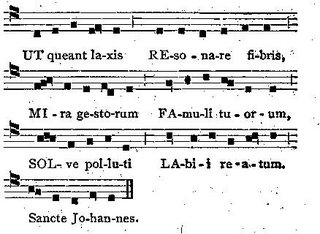
[from Elson's Music Dictionary, 21. For more see here.)
Now, what is the middle between ut (the old name for "do") and Gamma (which also indicates the same note, middle C) ? It lies halfway between "fa" and "sol" - what the chromatic crowd call "F-sharp". This note, you may know, makes a dissonance with C (the augmented fourth), and you get the scary diminshed seventh (C-D#-F#-A) if you put two of them together... but let us proceed on our journey.
You may get a certain feeling of latent humor here - and you should. There's a schoolboy delight in realizing the foundation-keys of music arise in an ancient hymn to St. John the Baptist, and there's more where that came from. Chesterton uses a schoolboy error to warn us of the paradoxical dangers of the "middle":
Indeed. This is why I moaned last week about "problem-solving skills". Here is the same thing. When I first contemplated today's essay, I wanted to give some sort of brief introduction to automata theory - not to scare you, but to attract you. Instead, when I realized it was nearing the Kalends of July, and saw the mystic union of thought centering on the "center", I saw an even larger treasure to point towards. And yet, I find I am half-way to my desire!
For the real mystery of the middle is in grammar, which is of a deeper stratum than the mathematics of "middle" which we can simply express as (a+b)/2, and grammar is of the same order of thought as automata. In fact, for finite purposes, the two are one - a machine or automaton (the singular of "automata") is shown to be IDENTICAL to its grammar, and vice versa... but now I am like a lit'ry scholar boasting of why the Soothsayer bids Caesar "beware the Ides of March" - and why it wasn't just a copyist's error for "the Ideas of March" - or for the "Nones of April"... so let us defer that. Instead, I must tell you a very brief story, which may help.
Once I happened to meet a certain person who had taken some sort of introductory class which mentioned "computers" or something like that. Perhaps he felt somewhat uneasy in meeting me, an experienced computing professional, though I was then not yet a Doctor of computer science. But he wanted to show that he had truly learned something in that class, and indeed he was very excited about having taken it. So he asked me, "How many computer languages do you know?"
And I responded, "Oh, I'm pretty good at three or four. Maybe five."
To which he answered, "Well, I know over twenty."
And then he proceeded to list them.
You see, he meant he knew the NAMES of those languages - whereas I meant their USE. I could read them and write in them. He knew their names, and nothing more besides.
Now, when it comes to human languages, as soon as one begins to study them from within, one obtains a universal key to others - the key which is called GRAMMAR. (This, of course, is one of the primordial "problem-solving skills" - and hence it is hated by the moderns who find it loathsome instead of thrilling...) As soon as you know enough to grasp the sense of something like "word" or "sentence" or "verb" you have the master key to other things - yes, even to computing... but we must not go there today.
It is that hilarious word "verb" to which I must call your attention. No, not the ibis of safety, but rather the puzzle set up by the bratty little kid called "Calvin" (who played with a stuffed tiger called "Hobbes"). One of the more interesting strips went something like this:
Now, here, I warn you. I admit to knowing ABOUT Greek - a very little ABOUT Greek. I do not pretend to KNOW Greek. You may recall what Chesterton says about this:
The Greek noun has something called the DUAL. (I am told English used to have it also, it shows up in some odd ways, when things regularly come in pairs, and why there's a mess in the uses of "between" and "among". Ahem.) What a handy idea! Greeks can have cat-2, (I don't know the real ending, so I write it this way). Having cat-2 is twice having one cat, and fewer than having several cats. Feel free to substitute the animal of your choice, if you prefer hippogriffs or dragons, use them: "A man cannot deserve adventures; he cannot earn dragons and hippogriffs." [GKC Heretics CW1:72]
Now, if that wasn't enough, to make extra endings for your nouns and pronouns (and adjectives and articles) to indicate one, or two, or many - the verbs are even more elaborate!
Of course verbs have to have the dual number. That proves handy for a husband-and-wife to speak with the dual voice - what a grand homage this makes to the sacrament of matrimony. (Which reminds me: let us not forget the anniversary of Gilbert and Frances is coming up next week...)
Greek also has multiple moods - not just indicative and subjunctive - who even knows what subjunctive is in English these days? (If I were a teacher... ahem.) And there are extra tenses, which someone like Marty McFly might have found useful when he went "back to the future"... I'm still not sure when "Aorist" fits in, but then I've never been sure about perfect and imperfect either. (If I could just get that flux capacitor to work, hmm.... where am I going to get 1.21 gigawatts?)
But here's the really stunning one, the one you've been waiting for.
The English verb has two voices: active and passive. Active is when I act: "I wash the car." Passive is when I am acted upon: "As a baby I was washed by my mother."
But - the Greek verb has three voices. Guess what the third one is called.
Yes. It's called the Middle Voice. It means I act upon myself: "I wash myself every morning."
Now, that's another handy problem solving skill - and you didn't even have to go to Iceland.
First, I wish to give my traditional warning which must be given at this point in the year - and it is a warning which reminds us of that marvellous contraption called the Calendar, that so very Roman a thing - a scheme of feasts and fasts, but also a scheme of anticipation. Those big husky Romans, who so often seem to be the adults in the ancient world, were very much like little children when it came to their calendars. That is because unlike ours, their calendars were count-downs, not count-ups... but I have no time to lecture on that. My point of bringing up the old Roman calendar scheme is to remind you - that is, to give my traditional warning - about the approach of that most glorious day, the Kalends of July. You can keep your Ides of March, with its murder in the Forum. Give me the Kalends of July, with its mysterious depths...
You do not recall the allusion? Alas for you!
There are many great messages which have appeared in history - and in fiction, and I should list them here but I will unduly lengthen this essay. One of the greatest of these, one which epitomises some of my points from last week about problem solving, is the famous parchment, just 3 inches by 5, found within the Heims-Kringla of Snorre Tarleson, and scrawled with incomprehensible runes. After much difficulties, the message was found to read as follows:
In Sneffels Yoculis craterem kem delebat umbra Scartaris Julii intra calendas descende, audas viator, et terrestre centrum attinges.Which dog Latin being translated gives the following, one of the great secret messages of all literature:
Kod feci.
Arne Saknussem.
Descend into the crater of Yocul of Sneffels which the shadow of Scartaris caresses, before the Kalends of July, audacious traveler, and you will reach the center of the earth.Yes - next Thursday is the Kalends of July - so if you are going to try to get to Sneffels-jokull to follow Arne Sakneussemm - yes, it is REALLY there, check a map - you had better get over to Iceland real soon. I am not sure if the eruption of that other jokull (which Verne tells us is Icelandic for "glacier") will give us any grief, but it should be quite an adventure in any case.
I did it.
Arne Saknussemm
You don't know what I am talking about? Hurry to the library and read Journey to the Center of the Earth by Jules Verne.
Now, of course you wonder - what did Chesterton have to say about such fantasies? You know as well as I do that he loved mysteries, so much so that he wrote them. You know as well as I do that he often expressed his thanks for the work of Arthur Conan Doyle - and even admiration for the writing of sci-fi guys like H. G. Wells: there's a very famous allusion to Wells' The Time Machine in GKC's The Everlasting Man, a lovely sed contra in the Scholastic form against Evolution and all its pomps.... but what about Verne? Well, there is not a lot but there is a little, and what there is, is delightful:
It would be grand (as in Jules Verne) to fire a cannonball at the moon; but would it not be grander to build a railway to the moon?And there is this, somewhat more intricate, and I will give you the entire paragraph for your delight:
[GKC "The Wings of Stone" in Alarms and Discursions]
I have just been entertaining myself with the last sensational story by the author of The Yellow Room, which was probably the best detective tale of our time, except Mr. Bentley's admirable novel, Trent's Last Case. The name of the author of The Yellow Room is Gaston Leroux; I have sometimes wondered whether it is the alternative nom de plume of the writer called Maurice Leblanc who gives us the stories about Arsene Lupin, the gentleman burglar. There would be something very symmetrical in the inversion by which the red gentleman always writes about a detective, and the white gentleman always writes about a criminal. But I have no serious reason to suppose the red and white combination to be anything but a coincidence; and the tales are of two rather different types. Those of Gaston the Red are more strictly of the type of the mystery story, in the sense of resolving a single and central mystery. Those of Maurice the White are more properly adventure stories, in the sense of resolving a rapid succession of immediate difficulties. This is inherent in the position of the hero; the detective is always outside the event, while the criminal is inside the event. Some would express it by saying that the policeman is always outside the house when the burglar is inside the house. But there is one very French quality which both these French writers share, even when their writing is very far from their best. It is a spirit of definition which is itself not easy to define. To say it is scientific will only suggest that it is slow. It is much truer to say it is military; that is, it is something that has to be both scientific and swift. It can be seen in much greater Frenchmen, as compared with men still greater who were not Frenchmen. Jules Verne and H. G. Wells, for instance, both wrote fairy-tales of science; Mr. Wells has much the larger mind and interest in life; but he often lacks one power which Jules Verne possesses supremely - the power of going to the point. Verne is very French in his rigid relevancy; Wells is very English in his rich irrelevance. He is there as English as Dickens, the best passages in whose stories are the stoppages, and even stopgaps. In a truly French tale there are no stoppages; every word, however dull, is deliberate, or directed towards the end.It is this sort of thing which I wish to inspire - no, not that my writing is like that - but I mean to urge you to attempt to treat each word, however dull, as being deliberate and directed to the end.
[GKC "The Domesticity of Detectives" in The Uses of Diversity
That is why I want you to consider that word "middle" which I put in the title - a word which alluded to "Center" - but which I chose for other - what some call "pedagogical" - reasons.
The middle often is the center. And often the center is akin to the ends, or at least in harmony with them. But sometimes the center (or middle) is very much at odds with the ends. Since today is the feast of St. John the Baptist, you ought to go about your business singing the famous Do-re-me song from "The Sound of Music" - or, preferably, the far more appropriate song called "Ut queant laxis":

[from Elson's Music Dictionary, 21. For more see here.)
Ut queant laxisThat is,
resonare fibris
mira gestorum
famuli tuorum,
Solve polluti
labii reatum,
Sancte Joannes.
This hymn was written by Paul the Deacon (720-799) and was chosen by Guido of Arezzo (990-1050) for the syllabic naming of the notes of the scale (given in bold).
That thy servants may be able to sing thydeeds of wonder with pleasant voices, remove, O holy John, the guilt of our sin-polluted lips.
[Matthew Britt, OSB, The Hymns of the breviary and Missal256-7]
Now, what is the middle between ut (the old name for "do") and Gamma (which also indicates the same note, middle C) ? It lies halfway between "fa" and "sol" - what the chromatic crowd call "F-sharp". This note, you may know, makes a dissonance with C (the augmented fourth), and you get the scary diminshed seventh (C-D#-F#-A) if you put two of them together... but let us proceed on our journey.
You may get a certain feeling of latent humor here - and you should. There's a schoolboy delight in realizing the foundation-keys of music arise in an ancient hymn to St. John the Baptist, and there's more where that came from. Chesterton uses a schoolboy error to warn us of the paradoxical dangers of the "middle":
All thinking people for thousands of years have agreed that, when all is said and done, there is such a thing as a golden mean, though perhaps the particular phrase is not very satisfactory. The true ideal is, rather, equilibrium, or, in other words, uprightness. There is something rather mean about the word "mean"; yet it is by no means easy to suggest a substitute devoid of such idle associations. No one can well be expected to talk idealistically about his "middle"; "balance" is associated with arithmetic and finance; while "medium" is associated with Spiritualism and with some sorts of gum. The schoolboy made a good shot at it when he translated "medio tutissimus ibis" as "the ibis is always safest in the middle." But under whatever form we take it, that ibis of the higher moderation, a chivalric and passionate moderation, must always be the crest of Christendom and of all sane civilisation. Unless that sagacious bird is allowed to be in the middle, there will be no place for the pelican of charity, the owl of wisdom, or the dove of peace.The Latin "medio tutissimus ibis" means "You will go more safely in the middle" and I am told is from Ovid's Metamorphoses. Here is some fodder for those who hunt for Chestertonian error. Does GKC urge us to stay in the middle, or to stay at the edge? Doesn't he tell us how Christianity had "a healthy hatred of pink"? [Orth CW1:302] Obviously we are not done with our journey to the middle.
[GKC Jan 20 1912 CW29:226]
Indeed. This is why I moaned last week about "problem-solving skills". Here is the same thing. When I first contemplated today's essay, I wanted to give some sort of brief introduction to automata theory - not to scare you, but to attract you. Instead, when I realized it was nearing the Kalends of July, and saw the mystic union of thought centering on the "center", I saw an even larger treasure to point towards. And yet, I find I am half-way to my desire!
For the real mystery of the middle is in grammar, which is of a deeper stratum than the mathematics of "middle" which we can simply express as (a+b)/2, and grammar is of the same order of thought as automata. In fact, for finite purposes, the two are one - a machine or automaton (the singular of "automata") is shown to be IDENTICAL to its grammar, and vice versa... but now I am like a lit'ry scholar boasting of why the Soothsayer bids Caesar "beware the Ides of March" - and why it wasn't just a copyist's error for "the Ideas of March" - or for the "Nones of April"... so let us defer that. Instead, I must tell you a very brief story, which may help.
Once I happened to meet a certain person who had taken some sort of introductory class which mentioned "computers" or something like that. Perhaps he felt somewhat uneasy in meeting me, an experienced computing professional, though I was then not yet a Doctor of computer science. But he wanted to show that he had truly learned something in that class, and indeed he was very excited about having taken it. So he asked me, "How many computer languages do you know?"
And I responded, "Oh, I'm pretty good at three or four. Maybe five."
To which he answered, "Well, I know over twenty."
And then he proceeded to list them.
You see, he meant he knew the NAMES of those languages - whereas I meant their USE. I could read them and write in them. He knew their names, and nothing more besides.
Now, when it comes to human languages, as soon as one begins to study them from within, one obtains a universal key to others - the key which is called GRAMMAR. (This, of course, is one of the primordial "problem-solving skills" - and hence it is hated by the moderns who find it loathsome instead of thrilling...) As soon as you know enough to grasp the sense of something like "word" or "sentence" or "verb" you have the master key to other things - yes, even to computing... but we must not go there today.
It is that hilarious word "verb" to which I must call your attention. No, not the ibis of safety, but rather the puzzle set up by the bratty little kid called "Calvin" (who played with a stuffed tiger called "Hobbes"). One of the more interesting strips went something like this:
Of course I felt a bit sad for Calvin, since poor English is so periphrastic - even in the best case, there's only five possible forms for a verb: eat/eats/eating/ate/eaten. And some other languages like Vietnamese have only one. But imagine if he had been speaking in Latin! Wow. Or even better - in Greek.
Calvin: I like to verb words.
Hobbes: What?
Calvin: I take a noun and put verb endings on it.
Hobbes: (looks confused)
Calvin: Verbing weirds language.
Hobbes: Eventually we can make language an impediment to communication.
[quoted from memory]
Now, here, I warn you. I admit to knowing ABOUT Greek - a very little ABOUT Greek. I do not pretend to KNOW Greek. You may recall what Chesterton says about this:
I myself have little Latin and less Greek. But I know enough Greek to know the meaning of the second syllable of "enthusiasm," and I know it to be the key to this and every other discussion.The second syllable, in case you did not know, means "God". I also have little Latin and less Greek, but I have learned some interesting things about these languages, and one of the most interesting is about the Greek verb. Greek seems, in almost every way, to be a far more powerful and delicate tool than English. It always seems to have something extra, something which we don't have in English, and would not even think about having. It was startling enough when I found out their nouns had an additional number. (That's the grammar word, not the math word!) You know, we can have one cat or several cats, one mouse or seveal mice - we have singular and plural.
[GKC The Thing CW3:139]
The Greek noun has something called the DUAL. (I am told English used to have it also, it shows up in some odd ways, when things regularly come in pairs, and why there's a mess in the uses of "between" and "among". Ahem.) What a handy idea! Greeks can have cat-2, (I don't know the real ending, so I write it this way). Having cat-2 is twice having one cat, and fewer than having several cats. Feel free to substitute the animal of your choice, if you prefer hippogriffs or dragons, use them: "A man cannot deserve adventures; he cannot earn dragons and hippogriffs." [GKC Heretics CW1:72]
Now, if that wasn't enough, to make extra endings for your nouns and pronouns (and adjectives and articles) to indicate one, or two, or many - the verbs are even more elaborate!
Of course verbs have to have the dual number. That proves handy for a husband-and-wife to speak with the dual voice - what a grand homage this makes to the sacrament of matrimony. (Which reminds me: let us not forget the anniversary of Gilbert and Frances is coming up next week...)
Greek also has multiple moods - not just indicative and subjunctive - who even knows what subjunctive is in English these days? (If I were a teacher... ahem.) And there are extra tenses, which someone like Marty McFly might have found useful when he went "back to the future"... I'm still not sure when "Aorist" fits in, but then I've never been sure about perfect and imperfect either. (If I could just get that flux capacitor to work, hmm.... where am I going to get 1.21 gigawatts?)
But here's the really stunning one, the one you've been waiting for.
The English verb has two voices: active and passive. Active is when I act: "I wash the car." Passive is when I am acted upon: "As a baby I was washed by my mother."
But - the Greek verb has three voices. Guess what the third one is called.
Yes. It's called the Middle Voice. It means I act upon myself: "I wash myself every morning."
Now, that's another handy problem solving skill - and you didn't even have to go to Iceland.
Tuesday, June 22, 2010
Schedule Changes for ChesterTen
This just in from Dale Ahlquist:
A schedule change at the conference:
Msgr. Swetland, from the host institution, can’t be there. He’s just taken a new job: President of Seton Hall University.
Dr. William Marshner, a theology professor from Christendom College to speak instead on “What’s Wrong with Theology?” (He’s brilliant. It will be a great talk.)
Joseph Pearce is moved to Friday evening, thereby moving Tom Martin to Thursday evening, and so Dale's talk is getting kicked to Saturday afternoon.
Thursday, June 17, 2010
GKC and Problem-Solving Skills
Having just examined the schedule of topics for this year's Moveable Feast (also known as The Chesterton Conference) I had thought it would be fun to do a series of essays orthogonal to the usual talks on the schedule. You know, instead of "the Mistake about Science" have "the Mistake about Literature" or instead of "the Mistake about Technology" have "the Mistake about Philosophy" - but such bitter sarcasm is not suitable for our use. We have larger things to do here, and should first consider our own mistakes before we take up those of others - whether they are truly mistakes, or just our own flawed interpretations. This is why the Scholastics worked so hard at writing up the arguments of their opponents: it is a very humbling method, and besides you may be surprised. First, sometimes you find that your opponent is right. Second, sometimes you may find that your opponent has formulated his own counterargument for you. It's quite a time-saver. You may wonder whether any of that is Chestertonian. It is, and it shows up in a very strange place... it's something I am still researching, but I keep getting diverted from that particular study. Ahem. Here's the quote:
There's far more we could say about Mistakes... in pondering the pleasant little word game called "proof-texting" (I think that is the usual term) I began to see a very interesting way of applying the methods of the Gödel Incompleteness Theorem - well, its style, or maybe its results - to other things like the Faith and Art - yes, even to Literature. But I shall save that for another time. Instead, I'd like to take this rather seething verbal porridge and do something else with it. It may be a good deal less controversial than the sort of thing I've been hinting at - but then again it may be worse. At the least, it is a bit easier to write about, and I think a good deal more humorous.
So... let us begin. what am I talking about when I say "GKC and Problem-Solving Skills"?
Since we are Scholastic in attitude (let us hope) we expect to find a definition of this odd phrase - but that is the one thing that never seems to be presented to us by those who insist on it so vehemently. The one thing that seems clear to me is that whatever a Problem-Solving Skill is, it is nothing like any of the usual subjects I learned in grade school, nor like the famous old Trivium and Quadrivium. Nor does it mean what we mean in computer science about the classical methods for problem-solving. (Yes, doesn't it sound funny to use the term "classical" when referring to computer science?) But then people like to say how the typical grade school student must become "technically competent" - when the most they learn about computers is how to double-click the mouse. I really expected they would begin to learn Automata Theory or at least Boolean Algebra... but I must not get ahead of myself.
No, I am NOT trying to re-write, or even re-tell, Chesterton's argument in What's Wrong With the World. Nor am I trying to rebut the usual nonsense as argued in the so-called graduate schools of education. Rather, I wish to do something else - make a practical suggestion or two, and begin the process of pointing to the real problem-solving skills - which (as Father Brown would say) are "too large to be seen". [See "The Three Tools of Death" in The Innocence of Father Brown]
The first required Skill is to understand the problem - any problem. Does this sound tautological? Well... perhaps - but it is an instance of the "too large to be seen" trait. You might also call it the ostrich-with-its-head-in-the-sand effect. Obviously, if you don't know there is a problem, you can never begin to solve it. If you didn't know there were strange dark lines in the spectrum of the sun, you'd never wonder why they are there... yet that is the modest and dull beginning of the concept of "quantum" - the keystone of modern atomic and nuclear science, and the explanation of many mysteries of chemistry. But there is a more grand truth than that to learn from those dark lines: they tell us the true composition of the sun itself! Yes, there is a message in the light from the sun, as Chesterton noted of Alice Meynell:
AaBbCcDdEeFfGgHhIiJjKkLlMmNnOoPpQqRrSsTtUuVvWwXxYyZz
- the marvellous and grand Alphabet - you are in a much worse position than Alice Meynell on her sickbed. You cannot get a message at all.
So if the first Skill is Understanding - that is, the first Mental Skill - we immediately have the result that the first Practical Skill must therefore be Reading. Yes, we can extend this concept to the general idea of any form of natural language - speech, Morse, Ann Sullivan's hand-signals, the interesting ideas proposed in "The Noticeable Conduct of Professor Chadd" in GKC's The Club of Queer Trades, and so forth - but since you are READING this, we shall apply synecdoche and let the message of the printed word stand for the whole realm of human communication.
In making our selections - that of Understanding and of Reading - we have made a significant advance upon our topic. In fact, we are really finished. The key to problem-solving - at the very least, the problem solving which anyone can expect from a young child - is simply the mystery of what the Middle Ages called "The Appeal To Authority". Chesterton has a lovely bit on this which we examined at length some time ago...
Now, you may already be quite good at reading, even if you most likely haven't yet read enough Chesterton. Indeed, you may need to be re-reading Chesterton. But it's not so much that we should resort to Chesterton as our first authority when we have a problem. (This is what we could call the "Mistake About Chesterton" - alas, some forget that GKC followed Jesus Christ. It's all written up in his book about St. Francis, I won't repeat it here.) But I didn't want to go that deep. Rather, I was thinking of an interesting bit I happened to encounter, which is yet another example of How To Be Chestertonian. You may dispose of all my rantings in today's column, but please do read this bit:
I really did see myself, and my real self, committing the murder. I didn't actually kill the men by material means; but that's not the point. Any brick or bit of machinery might have killed them by material means. I mean that I thought and thought about how a man might come to be like that, until I realised that I really was like that, in everything except actual final consent to the action. It was once suggested to me by a friend of mine, as a sort of religious exercise. I believe he got it from Pope Leo XIII, who was always rather a hero of mine.
[GKC "The Secret Of Father Brown" in The Secret of Father Brown]
There's far more we could say about Mistakes... in pondering the pleasant little word game called "proof-texting" (I think that is the usual term) I began to see a very interesting way of applying the methods of the Gödel Incompleteness Theorem - well, its style, or maybe its results - to other things like the Faith and Art - yes, even to Literature. But I shall save that for another time. Instead, I'd like to take this rather seething verbal porridge and do something else with it. It may be a good deal less controversial than the sort of thing I've been hinting at - but then again it may be worse. At the least, it is a bit easier to write about, and I think a good deal more humorous.
So... let us begin. what am I talking about when I say "GKC and Problem-Solving Skills"?
Since we are Scholastic in attitude (let us hope) we expect to find a definition of this odd phrase - but that is the one thing that never seems to be presented to us by those who insist on it so vehemently. The one thing that seems clear to me is that whatever a Problem-Solving Skill is, it is nothing like any of the usual subjects I learned in grade school, nor like the famous old Trivium and Quadrivium. Nor does it mean what we mean in computer science about the classical methods for problem-solving. (Yes, doesn't it sound funny to use the term "classical" when referring to computer science?) But then people like to say how the typical grade school student must become "technically competent" - when the most they learn about computers is how to double-click the mouse. I really expected they would begin to learn Automata Theory or at least Boolean Algebra... but I must not get ahead of myself.
No, I am NOT trying to re-write, or even re-tell, Chesterton's argument in What's Wrong With the World. Nor am I trying to rebut the usual nonsense as argued in the so-called graduate schools of education. Rather, I wish to do something else - make a practical suggestion or two, and begin the process of pointing to the real problem-solving skills - which (as Father Brown would say) are "too large to be seen". [See "The Three Tools of Death" in The Innocence of Father Brown]
The first required Skill is to understand the problem - any problem. Does this sound tautological? Well... perhaps - but it is an instance of the "too large to be seen" trait. You might also call it the ostrich-with-its-head-in-the-sand effect. Obviously, if you don't know there is a problem, you can never begin to solve it. If you didn't know there were strange dark lines in the spectrum of the sun, you'd never wonder why they are there... yet that is the modest and dull beginning of the concept of "quantum" - the keystone of modern atomic and nuclear science, and the explanation of many mysteries of chemistry. But there is a more grand truth than that to learn from those dark lines: they tell us the true composition of the sun itself! Yes, there is a message in the light from the sun, as Chesterton noted of Alice Meynell:
She could always find things to think about; even on a sick bed in a darkened room, where the shadow of a bird on the blind was more than the bird itself, she said, because it was a message from the sun.But we need not go so far, into science or into space, for an example. If you do not know these very symbols -
[GKC Autobiography CW16:269]
AaBbCcDdEeFfGgHhIiJjKkLlMmNnOoPpQqRrSsTtUuVvWwXxYyZz
- the marvellous and grand Alphabet - you are in a much worse position than Alice Meynell on her sickbed. You cannot get a message at all.
So if the first Skill is Understanding - that is, the first Mental Skill - we immediately have the result that the first Practical Skill must therefore be Reading. Yes, we can extend this concept to the general idea of any form of natural language - speech, Morse, Ann Sullivan's hand-signals, the interesting ideas proposed in "The Noticeable Conduct of Professor Chadd" in GKC's The Club of Queer Trades, and so forth - but since you are READING this, we shall apply synecdoche and let the message of the printed word stand for the whole realm of human communication.
In making our selections - that of Understanding and of Reading - we have made a significant advance upon our topic. In fact, we are really finished. The key to problem-solving - at the very least, the problem solving which anyone can expect from a young child - is simply the mystery of what the Middle Ages called "The Appeal To Authority". Chesterton has a lovely bit on this which we examined at length some time ago...
When your father told you, walking about the garden, that bees stung or that roses smelt sweet, you did not talk of taking the best out of his philosophy. When the bees stung you, you did not call it an entertaining coincidence. When the rose smelt sweet you did not say "My father is a rude, barbaric symbol, enshrining (perhaps unconsciously) the deep delicate truths that flowers smell." No: you believed your father, because you had found him to be a living fountain of facts, a thing that really knew more than you; a thing that would tell you truth to-morrow, as well as to-day. And if this was true of your father, it was even truer of your mother; at least it was true of mine...Ah, but so many people will whine about this - the famous Appeal To Authority - even though they are compelled to abide by it even as they whine - or they would by no means be comprehensible to others. It is the truth lurking in Chesterton's great epigram:
[GKC Orthodoxy CW1:360]
Free speech is a paradox.But even that will not soothe - because they fear that the Authority people like Chesterton or the far sillier and duller writer you are reading presently mean is THE POPE. No, this does NOT mean every child in grade school must instantly become a Roman Catholic! You need to read it a bit more slowly and think about it. What is the Appeal to Authority? It simply means that the First (and often the Last) form of Problem Solving is GO AND SEE WHAT SOMEONE ELSE DID THE LAST TIME HE HAD SUCH A PROBLEM. And that means "go and read it".
[GKC Browning]
Now, you may already be quite good at reading, even if you most likely haven't yet read enough Chesterton. Indeed, you may need to be re-reading Chesterton. But it's not so much that we should resort to Chesterton as our first authority when we have a problem. (This is what we could call the "Mistake About Chesterton" - alas, some forget that GKC followed Jesus Christ. It's all written up in his book about St. Francis, I won't repeat it here.) But I didn't want to go that deep. Rather, I was thinking of an interesting bit I happened to encounter, which is yet another example of How To Be Chestertonian. You may dispose of all my rantings in today's column, but please do read this bit:
As there is a thing called intensive cultivation, so there ought to be a thing called intensive reading; the reading of a sentence at a time, so as to feel the full weight of the common words we use. It would resemble, more than anything else, the verbal vigilance used in the atrocious task of proofreading, on which I have been engaged for some days; that task in which one must be always on the look-out for the rising sun appearing as a rising bun, and in which the powdered flunkey of romance sent out to call a cab must be watched over to see that he does not call a cat instead. But while the proofreader must be on the lookout for words that make nonsense, the intensive reader should be on the look-out for words that make sense, and seek to extract the real sense of them. If he takes any quite ordinary sentence, such as "Mary had a little lamb," he will find vistas of branching thought in every word. The word "Mary" reveals a forest of legends, creeds, and controversies. The word "had" is the pivot on which Socialism, Capitalism, Syndicalism, and the whole dizzy wheel of our industrial age is perpetually turning. The word "little" opens the bottomless chasms of the philosophic arguments about relativity and differences of degree: as well as suggesting, when taken with its context, the mystery of affectionate diminutives and the love of limited things. At first sight it seems needless to speak of a little lamb, lambs being seldom gigantesque. But the poet talks of a "little" lamb as the patriot talks of a "tight little" island; because we all make a thing little when we want to make much of it. And as for the word "lamb," there really seems to be nothing from hagiology to housekeeping that could not be talked about in connection with it. There is something more in a word than its first derivation or its last definition. There is its value, the power and magic in it; and the learned even more than the unlearned seem to-day to be singularly listless and reckless about the value of words.All right - now read it again. Then think about it - and try to use it yourself. (Take a stab at that "Free speech is a paradox" just for the sheer thrill of the effect.) And you thought you understood what reading was all about? Something you learned when you were little, and hardly give a thought to, as you browse through the web-sites and flip through the newspapers and magazines? You may be surprised at how powerful a problem-solving tool it can be... but you need to know more about your tools. (Notice, you are doing it now...)
[GKC ILN Sept 21 1912 CW29:361-2]
Thursday, June 10, 2010
A Deep, Dark, Cryptic, Thing
Oh, I wish I had time to write all the things I want to write to you today! But I can only write a little, and then I have to go and do ... uh ... other things. Like writing. In particular, I would like to give you some of the presently-under-development episode of the Great Saga I am writing - but that would not be fair, since you'd have to read a lot more first, since there are certain, er, mechanical or maybe I mean to say dramatic aspects about the order in which you read the thing. I mean, come ON people - you can't read about the road to Emmaus until after you've read about the road to Calvary! Remember how Dickens points out that Marley was dead, to begin with? Or take the famous episode in Acts of the Apostles about the Eunuch and Philip. It's sort of like that. But, rather like Virgil (if not Philip) I can give you some hints. And yes, it is very, very Chestertonian.
You see, what I am writing is rather like an Italian dinner. It's about Family, it's about Tradition. It's about very normal and natural things - like food - which are brought together in remarkably inventive ways. There are a lot of very simple things in my story, some of which may remind you of other stories - or perhaps of The Story - since every story must carry its brand-mark of The Story, or it is no more than a lie, or what I like to call "Thesaurus-in-a-Blender": words blended and torn and thrown together, without rhyme or reason. And we know who has to rescue Rhyme and Reason - a small boy. Ahem.
But let us get back to Chesterton.
One of the many many threads of Story which I am weaving is a certain tantalising line from one of the Father Brown stories. It is, unfortunately, fiction, and yet it is so steeped with a strong perfume of truth that... well. It has that tang of long-simmered tomato sauce, ah...
Say, Doc, didn't you tell us you were going to try to stop writing these things before lunch?
Yeah, well. Anyway, here is the line:
Now, there is a reality about this. Not about a cryptic symbol on the back of a cross, not about Antioch. A reality which is so much more profound it ought to be the origin point for dozens of stories, whether Catholic or Christian or merely secular. There really is a place wherein lies arcana from the very earliest Church.
It is in (or below) the crypt of St. Peter's basilica in Roma.
I am not going to review this architectural wonder, or the various studies (and debates) about it. It's a bit too fascinating just now for me to try that. Maybe another day. It would be rather like trying to write a journal article on the aerodynamics of Santa's sleigh, or on the geology of Orodruin and Sammath Naur. Or even on the ontological joke of the "aletheiometer", that poor atheist's handheld God. Oh, how I laughed when I heard of that! I thought of two ideas at once: one was GKC's famous aphorism about computers:
But the point of my essay today is this deep dark secret of the crypt, and the even darker one of the grave. Not just the one deep beneath St. Peter's - which as I said I hope to write about as time may permit. But MY grave, and yours. It may not be in a crypt, except in what we might call a grammatical sense. Ah, how to say what I mean? Hmm... It's a pity English is so periphrastic. Some days I wish I had a tool like the very lovely "Dative of Purpose" that Latin has. I need to put it into the Dative, because, you see, there is a Purpose for a grave, and that is storage...
Now what is the point of this Dative of Purpose (of a grave) being "storage"?
There is something very amazing I learned from one of the books I have read recently about the archaeological explorations under St. Peter's. My gosh I would be here for weeks if I told you all of it, there's so many splendid things! So many, many ideas, layers and cross-links and revisions in three-space, hints of the growth akin to that in the developing fetus, all shot through with the sense of the sacred, the reverent, the clever, the criminal, the destructive, the artistic, and so much more... But the best of all is what I wish to tell you about. For it proclaims the VERY SAME MESSAGE which G. K. Chesterton proclaims in his masterwork, The Everlasting Man.
It's not a very archaeological matter, except in that it was observed by archaeologists. It's not even all that scientific, or all that literary, or even all that theological, though of course as in the very best things (like that Italian dinner) it is a subtle and sagacious blend of them. It's very short, and so easy enough to contemplate:
The point is that our graves, even if they don't have deposita or another part of the verb deponere, really are "for deposit only". There's a way out, and like The Story, they really ought to have that wonderful and thrilling line that reads:
To Be Continued...
Now, now - that's not the end of our story today. I really wish I could give you more about the marvels of that exploration beneath St. Peter's... it's something which all but shouts "Chesterton" at me. But then of course that's because GKC was always speaking of our Lord, of God...
You see, what I am writing is rather like an Italian dinner. It's about Family, it's about Tradition. It's about very normal and natural things - like food - which are brought together in remarkably inventive ways. There are a lot of very simple things in my story, some of which may remind you of other stories - or perhaps of The Story - since every story must carry its brand-mark of The Story, or it is no more than a lie, or what I like to call "Thesaurus-in-a-Blender": words blended and torn and thrown together, without rhyme or reason. And we know who has to rescue Rhyme and Reason - a small boy. Ahem.
But let us get back to Chesterton.
One of the many many threads of Story which I am weaving is a certain tantalising line from one of the Father Brown stories. It is, unfortunately, fiction, and yet it is so steeped with a strong perfume of truth that... well. It has that tang of long-simmered tomato sauce, ah...
Say, Doc, didn't you tell us you were going to try to stop writing these things before lunch?
Yeah, well. Anyway, here is the line:
...in the coffin is a chain with a cross, common enough to look at, but with a certain secret symbol on the back found on only one other cross in the world. It is from the arcana of the very earliest Church and is supposed to indicate St. Peter setting up his See at Antioch before he came to Rome.Ah, please read that again and I hope you might feel a thrill as I do: "from the arcana of the very earliest Church ... St. Peter setting up his See..."
[GKC "The Curse of the Golden Cross" in The Incredulity of Father Brown]
Now, there is a reality about this. Not about a cryptic symbol on the back of a cross, not about Antioch. A reality which is so much more profound it ought to be the origin point for dozens of stories, whether Catholic or Christian or merely secular. There really is a place wherein lies arcana from the very earliest Church.
It is in (or below) the crypt of St. Peter's basilica in Roma.
I am not going to review this architectural wonder, or the various studies (and debates) about it. It's a bit too fascinating just now for me to try that. Maybe another day. It would be rather like trying to write a journal article on the aerodynamics of Santa's sleigh, or on the geology of Orodruin and Sammath Naur. Or even on the ontological joke of the "aletheiometer", that poor atheist's handheld God. Oh, how I laughed when I heard of that! I thought of two ideas at once: one was GKC's famous aphorism about computers:
"No machine can lie," said Father Brown, "nor can it tell the truth."And of course the other is the famous epigram he quotes in his amazing essay on the Papacy:
[GKC "The Mistake of the Machine" in The Wisdom of Father Brown]
There is a famous saying which to some has seemed lacking in reverence, though in fact it is a support of one important part of religion: "if God had not existed, it would have been necessary to invent Him." It is not at all unlike some of the daring questions with which St. Thomas Aquinas begins his great defence of the faith.No sooner does that unimaginative writer deny God than he immediately conjures Him up, if only in a hand-held form. No, I never read the book, and cannot even recall the title, but I heard that there was such a thing, and have been laughing ever since, it's really quite witty.
[GKC The Thing CW3:325]
But the point of my essay today is this deep dark secret of the crypt, and the even darker one of the grave. Not just the one deep beneath St. Peter's - which as I said I hope to write about as time may permit. But MY grave, and yours. It may not be in a crypt, except in what we might call a grammatical sense. Ah, how to say what I mean? Hmm... It's a pity English is so periphrastic. Some days I wish I had a tool like the very lovely "Dative of Purpose" that Latin has. I need to put it into the Dative, because, you see, there is a Purpose for a grave, and that is storage...
Every church ought to have a crypt, because a crypt is handy for storing things...Yes, in case you didn't know, Father O'Connor was the real priest from whom GKC designed Father Brown - just as I am told there was a Dr. Bell from whom the never-sufficiently-to-be-praised Arthur Conan Doyle designed Sherlock Holmes. Ahem.
[John O'Connor, Father Brown on Chesterton 19]
Now what is the point of this Dative of Purpose (of a grave) being "storage"?
There is something very amazing I learned from one of the books I have read recently about the archaeological explorations under St. Peter's. My gosh I would be here for weeks if I told you all of it, there's so many splendid things! So many, many ideas, layers and cross-links and revisions in three-space, hints of the growth akin to that in the developing fetus, all shot through with the sense of the sacred, the reverent, the clever, the criminal, the destructive, the artistic, and so much more... But the best of all is what I wish to tell you about. For it proclaims the VERY SAME MESSAGE which G. K. Chesterton proclaims in his masterwork, The Everlasting Man.
It's not a very archaeological matter, except in that it was observed by archaeologists. It's not even all that scientific, or all that literary, or even all that theological, though of course as in the very best things (like that Italian dinner) it is a subtle and sagacious blend of them. It's very short, and so easy enough to contemplate:
...it contains an undoubted Christian grave. The name and the span of years are no longer preserved, only the words "Anno(s)" and the decisive, though somewhat mutilated "Deposita". The use of the word deponere for burial is for practical purposes exclusively Christian. The body is entrusted to the earth but only as a depository, that is, on condition that it may be recalled. This simple word thus encloses a belief in the resurrection of the body.You recall the parallel line in Chesterton... it's perhaps the most grand line of so many grand lines:
[Engelbert Kirschbaum, S. J. The Tombs of St. Peter and St. Paul 32]
Christianity has died many times and risen again; for it had a god who knew the way out of the grave.You've got to expect this sort of thing. It's the whole thrill of the Story, don't you know? I must stop here, or I will be writing a whole book about it, and I have another book to be writing just now - besides, you can read a far better rendering in TEM just a few pages back, where he says "if there be indeed a God, his creation could hardly have reached any other culmination than this granting of a real romance to the world." (CW2:380)
[GKC The Everlasting Man CW2:382]
The point is that our graves, even if they don't have deposita or another part of the verb deponere, really are "for deposit only". There's a way out, and like The Story, they really ought to have that wonderful and thrilling line that reads:
To Be Continued...
Now, now - that's not the end of our story today. I really wish I could give you more about the marvels of that exploration beneath St. Peter's... it's something which all but shouts "Chesterton" at me. But then of course that's because GKC was always speaking of our Lord, of God...
VOICESI also wish I could give you more of my Saga - or even just a short story, perhaps based in the same world - but then I am not sure whether people would like to have this column distorted by fiction. I can always post it on my story-blogg, but, well, I'll see if you have any comments to make about that. It depends on how soon I come to the conclusion of the present episode. But for now, we'll proceed. Incidentally, speaking of the present, don't forget tomorrow is the feast of the Sacred Heart - perhaps I will write about that next week, since I am too far behind today to try to do it now. And Saturday is the feast of the Immaculate Heart of Mary. These are the last two lingering gleams of light from Easter, the last of the "moveable feasts" which shift through the calendar depending on the moon and sun. Also, I am told that there is information now available about another "moveable feast" which is called names like "ChesterCon" and other things. It is already less than two months away... and it may be that I shall get there this year - in which case I shall delight in meeting any of you who may also be attending. It is in God's hands...
The axe falls on the wood in thuds, "God, God."
The cry of the rook, "God," answers it
The crack of the fire on the hearth, the voice of the brook, say the same name;
All things, dog, cat, fiddle, baby,
Wind, breaker, sea, thunderclap
Repeat in a thousand languages -
God.
[GKC, collected in Ward, Gilbert Keith Chesterton 64]
Tuesday, June 08, 2010
Thursday, June 03, 2010
The Solution of a Large Place
It's a DEUCE of a business to have two calendars to track feast days with! Today, as "Feria V Post Festum Sanctissimae Trinitatis", is the Feast of the Most Holy Body of Christ, the famous "Corpus Christi" for which St. Thomas Aquinas wrote the office:
You see, the Introit for the "Sunday in the Octave of Corpus Christi" has a famous Chesterton pun, which was reprinted on his memorial card. Here it is:
So - whether you consider Corpus Christi today, or Sunday, we'll talk about the mystery just a little now, and you can read it today or save it for Sunday, or both. There are one or two famous lines which I've quoted before - two which leap out in my own memory:
But the one quote which perhaps gives us more of GKC's inward views (outside of his poetry) is the very famous conclusion to "The Insoluble Problem" - which is NOT his commentary on the Gödel Incompleteness Theorem, hee hee. Here you go:
The answer is very simple. GKC provided it elsewhere:
The Corpus Christi Office is like some old musical instrument, quaintly and carefully inlaid with many coloured stones and metals; the author has gathered remote texts about pasture and fruition like rare herbs; there is a notable lack of the loud and obvious in the harmony; and the whole is strung with two strong Latin lyrics.Of course, in some parts of the world, this feast is transferred to Sunday, and thus we don't get the famous "Sunday in the Octave of Corpus Christi" - the feast day on which G. K. Chesterton died. Which is a shame, not only liturgically - since there are elegant and very deep foundation-type reasons for the arrangement of feast days... do you know why Christmas "floats" through every day of the week and Easter is tied to Sunday? Ah. Well, you can do that one for homework. But there is another loss, and this one even those who have no interest in liturgy or celebrations can commiserate with us about.
[GKC St. Thomas Aquinas CW2:509]
You see, the Introit for the "Sunday in the Octave of Corpus Christi" has a famous Chesterton pun, which was reprinted on his memorial card. Here it is:
Factus est Dominus protector meus, et eduxit me in latitudinem: salvum me fecit, quoniam voluit me. Diligam te, Domine, virtus mea: Dominus firmamentum meum, et refugium meum, et liberator meus. [Ps 17:19-20, 2-3]A "LARGE" place.. .I should say! Well, it is quite consistent with what our Lord told us, isn't it? "My father's mansion has many dwelling places"... of course people like Aquinas and GKC no doubt get larger ones - but we are glad for that. (I've heard a rumor that Little St. Thérèse has the largest room of all... but then I really ought not spread these things around. Hee hee)
The Lord became my protector and he brought me forth into a large place. He saved me because he was well pleased with me. I will love Thee O Lord my strength. The Lord is my firmament and my refuge and my deliverer.
So - whether you consider Corpus Christi today, or Sunday, we'll talk about the mystery just a little now, and you can read it today or save it for Sunday, or both. There are one or two famous lines which I've quoted before - two which leap out in my own memory:
There's a good bit more in that book, and some very nice things in his book on Aquinas - but if you want a handy research project, try collecting GKC's thoughts on the Sacraments. You will be impressed.
As to Transubstantiation, it is less easy to talk currently about that; but I would gently suggest that, to most ordinary outsiders with any common sense, there would be a considerable practical difference between Jehovah pervading the universe and Jesus Christ coming into the room.
We have got to explain somehow that the great mysteries like the Blessed Trinity or the Blessed Sacrament are the starting-points for trains of thought far more stimulating, subtle and even individual ... to accept the Logos as a truth is to be in the atmosphere of the absolute, not only with St. John the Evangelist, but with Plato and all the great mystics of the world. ... To exalt the Mass is to enter into a magnificent world of metaphysical ideas, illuminating all the relations of matter and mind, of flesh and spirit, of the most impersonal abstractions as well as the most personal affections.
[GKC The Thing CW2:180, 299-300]
But the one quote which perhaps gives us more of GKC's inward views (outside of his poetry) is the very famous conclusion to "The Insoluble Problem" - which is NOT his commentary on the Gödel Incompleteness Theorem, hee hee. Here you go:
[Father Brown] raised his eyes and saw through the veil of incense smoke and of twinkling lights that Benediction was drawing to its end while the procession waited. The sense of accumulated riches of time and tradition pressed past him like a crowd moving in rank after rank, through unending centuries; and high above them all, like a garland of unfading flames, like the sun of our mortal midnight, the great monstrance blazed against the darkness of the vaulted shadows, as it blazes against the black enigma of the universe. For some are convinced that this enigma also is an Insoluble Problem. And others have equal certitude that it has but one solution.The only other one I shall give you today - since I must leave you rather abruptly, alas - is this other, which is quite relevant but sadly very poorly known, since it is from the uncollected collection in CW14:
[GKC "The Insoluble Problem" in The Scandal of Father Brown]
Marjory was watching him keenly: she had just had a gleam of hope. His eyes were slowly filling with the pale blue fire she knew well: it was so he used to look when she read him a poem, or when the sunset grew red and gold over the wooded hill. At such moments he would say something which she couldn't understand. At length the words came, with a kind of timid radiance.Why the deuce (you ask) do I quote THAT?
"May I have jam?"
"Certainly," she said, raising her eyebrows wearily.
He only smiled ravenously, but she felt sure that if any earthly chair had been high enough he would have kicked his legs. There was another silence.
"Some fellows like butter and jam," said the religious enthusiast of the morning's conversation. "I think that's beastly."
"The main benefit of existence," said Marjory bitterly, "seems to be eating."
"Hardly the main benefit surely," said Petersen calmly, "though I agree with you that it is a neglected branch of the poetry of daily life. The song of birds, the sight of stars, the scent of flowers, all these weak. admit are a divine revelation, why not the taste of jam?"
"Not very poetical to my fancy," said Marjory, scornfully.
"It is uncultivated," said Petersen, "but a time may come when it will be elaborated into an art as rich and varied as music or painting. People will say, 'There is an undercurrent of pathos in this gravy, despite its frivolity,' or 'Have you tasted that passionate rebellious pudding? Ethically I think it's dangerous.' After all, eating has a grander basis than the arts of the others senses, for it is absolutely necessary to existence: it is the bricks and mortar of the Temple of the Spirit."
And he took a large bite out of the bread and jam.
[GKC "The Man With Two Legs" in CW14:786-7]
The answer is very simple. GKC provided it elsewhere:
Mythology had many sins; but it had not been wrong in being as carnal as the Incarnation.It all comes down to whether we're going to have a God Who "pervades the universe" or one Who can walk into the room: "I stand at the door and knock. If you open to Me, I shall come in and sit down and we shall eat together" [see Apo/Rev 3:20]Let us pray that He shall lead us, like GKC into a Large Place, as the priest calls, just before he administers the sacrament of Corpus Christi: "Blessed are they that are called to the marriage supper of the Lamb." [ibid 19:9]
[GKC The Everlasting Man CW2:308]
Subscribe to:
Posts (Atom)


 Posts
Posts