Wednesday, February 28, 2007


TMWWT-Chapter Six
The Exposure
OK. Your turn.
What was funny?
Any words you had to look up in the dictionary?
What surprised you in this chapter?
My favorite line: "And this high pride in being human had lifted him unaccountably to an infinite height above the monstrous men around him."
Who is exposed?
OK. Your turn.
What was funny?
Any words you had to look up in the dictionary?
What surprised you in this chapter?
My favorite line: "And this high pride in being human had lifted him unaccountably to an infinite height above the monstrous men around him."
Who is exposed?
Tuesday, February 27, 2007
Gilbert and Frances Scholarship
2007 Gilbert and Frances Scholarship.
Good luck to all the entrants!
Two annual scholarships for $2500 each, named for Gilbert Keith Chesterton and longtime Chestertonian and Retired Gilbert Magazine Contributing Editor Frances Farrell. The Gilbert and Frances Scholarship is endowed by Bob and Joan Farrell in honor of Mrs. Farrell.Frances Farrell (the Frances in the name of this scholarship) is the Gilbert columnist whose retirement gave me the opportunity to become a Gilbert columnist.
The Scholarship has been created to assist and encourage Christian college students to engage the world on controversial issues and possibly pursue a career in journalism.
There are two categories: One for high school seniors entering college, and another for college freshmen, sophomores and juniors.
To apply, please submit the following:
1. A one-paragraph description of yourself and your goals. And your contact information.
2. On a separate page, an essay, not to exceed 900 words, that demonstrates a Chestertonian perspective on any current issue. The essay should be persuasive in nature, written for a secular audience or for readership not necessarily prone to agree with the main argument. It should read like a journalistic essay and not like a school report or an academic paper. No footnotes. But quoting Chesterton, of course, is a good idea.
Please use Times Roman 12-point text, single-spaced. Send hard copy and CD of documents to:
The American Chesterton Society
4117 Pebblebrook Circle
Minneapolis, MN 55437
DEADLINE:
May 1, 2007
Good luck to all the entrants!
Monday, February 26, 2007
TMWWT-Chapter Five
What did you think of Chapter Five?
Here we meet the Week Team. Or should I say the Weak Team.
Monday: we haven't learned his name yet, is Secretary
Tuesday: "Brother" Gogol, Polish,
Wednesday: The Marquis de St. Eustache
Thursday: Our Gabriel Syme
Friday: Professor de Worms, appropriate name for a guy who's half dead
Saturday: Bull, has opaque glasses which really frustrate Syme, who can't see his eyes.
Sunday: President. Has a huge face, almost too big to be real, huge body. He is a person enlarged.
Like popes and supreme court justices, each Weekday team member must die before the "Day" is replaced by someone else.
Dictionary alert: diablerie, cicerone
Dream evidence: "the last nightmare touch..." "the eerie sensation of having strayed into a new world..." the way Sunday's face is described.
Funniest line: "I'd better tell you that he is carrying out his notion of concealing ourselves by not concealing ourselves to the most extraordinary lengths just now."
Another funny piece: one of them was a "common or gardener Dynamiter" not unlike how people describe a certain kind of snake.
Another funny moment: when Syme considers Sunday's great weight possibly tipping the balcony right off. Certainly Chesterton had to consider his own considerable weight in moments such as this. And there are stories where Chesterton entered a hansome cab, for example, tipping it back so far that it appeared as if the horses were flying for a moment.
Artist's touch: Chesterton describes Sunday as "enlarged terribly to scale".
Micawber (dark humor) detail: de Worms moves as if at any moment an arm or leg might fall off. *shivers*
Question: What does "spiritual evil" smell like?
Here we meet the Week Team. Or should I say the Weak Team.
Monday: we haven't learned his name yet, is Secretary
Tuesday: "Brother" Gogol, Polish,
Wednesday: The Marquis de St. Eustache
Thursday: Our Gabriel Syme
Friday: Professor de Worms, appropriate name for a guy who's half dead
Saturday: Bull, has opaque glasses which really frustrate Syme, who can't see his eyes.
Sunday: President. Has a huge face, almost too big to be real, huge body. He is a person enlarged.
Like popes and supreme court justices, each Weekday team member must die before the "Day" is replaced by someone else.
Dictionary alert: diablerie, cicerone
Dream evidence: "the last nightmare touch..." "the eerie sensation of having strayed into a new world..." the way Sunday's face is described.
Funniest line: "I'd better tell you that he is carrying out his notion of concealing ourselves by not concealing ourselves to the most extraordinary lengths just now."
Another funny piece: one of them was a "common or gardener Dynamiter" not unlike how people describe a certain kind of snake.
Another funny moment: when Syme considers Sunday's great weight possibly tipping the balcony right off. Certainly Chesterton had to consider his own considerable weight in moments such as this. And there are stories where Chesterton entered a hansome cab, for example, tipping it back so far that it appeared as if the horses were flying for a moment.
Artist's touch: Chesterton describes Sunday as "enlarged terribly to scale".
Micawber (dark humor) detail: de Worms moves as if at any moment an arm or leg might fall off. *shivers*
Question: What does "spiritual evil" smell like?
Saturday, February 24, 2007
Another Audio inspired by TMWWT
A few weeks ago, I was sent information about The Man Who Was Thursday audio project. I've just discovered there's another one in the UK. Here's the audio book, you can download it as an MP3 file. Cool. Here it is in LARGE PRINT. Even the Chesterteens recently had a discussion about TMWWT. Looks like someone's working on a comic book version of TMWWT? Interesting. The BBC's Radio show Audio version looks like it is also available.
And that's our roundup of TMWWT stuff for the weekend. Tune in Monday when we resume out discussion with Chapter Five, where we meet Monday, Tuesday, Wednesday, Friday and Saturday for the first time.
And that's our roundup of TMWWT stuff for the weekend. Tune in Monday when we resume out discussion with Chapter Five, where we meet Monday, Tuesday, Wednesday, Friday and Saturday for the first time.
Friday, February 23, 2007
Pause for Poetry
Assignment for Monday: Read Chapter Five of TMWWT
Friday break: enjoy this Chesterton poem.
"The Black Virgin"
[CW10:122-125]
One in thy thousand statues we salute thee
On all thy thousand thrones acclaim and claim
Who walk in forest of thy forms and faces
Walk in a forest calling on one name
And, most of all, how this thing may be so
Who know thee not are mystified to know -
That one cries "Here she stands" and one cries "Yonder"
And thou wert home in heaven long ago.
Burn deep in Bethlehem in the golden shadows,
Ride above Rome upon the horns of stone,
From low Lancastrian or South Saxon shelters
Watch through dark years the dower that was thine own:
Ghost of our land, White Lady of Walsinghame,
Shall they not live that call upon thy name
If an old song on a wild wind be blowing
Crying of the holy country whence they came?
Root deep in Chartres the roses blown of glass
Burning above thee in the high vitrailles,
On Cornish crags take for salute of swords
O'er peacock seas the far salute of sails,
Glooming in bronze or gay in painted wood,
A great doll given when the child is good,
Save that She gave the Child who gave the doll,
In whom all dolls are dreams of motherhood.
I have found thee like a little shepherdess
Gay with green ribbons; and passed on to find
Michael called Angel hew the Mother of God
Like one that fills a mountain with a mind:
Molten in silver or gold or garbed in blue,
Or garbed in red where the inner robe burns through,
Of the King's daughter glorious within:
Change shine unchanging light with every hue.
Clothed with the sun or standing on the moon
Crowned with the stars or single, a morning star,
Sunlight and moonlight are thy luminous shadows,
Starlight and twilight thy refractions are,
Lights and half-lights and all lights turn about thee.
But though we dazed can neither see nor doubt thee,
Something remains. Nor can man live without it
Nor can man find it bearable without thee.
There runs a dark thread through the tapestries
That time has woven with all the tints of time.
Something not evil but grotesque and groping,
Something not clear; not final; not sublime;
Quaint as dim pattern of primal plant or tree
Or fish, the legless elfins of the sea,
Yet rare as this shine image in ebony
Being most strange in its simplicity.
Rare as the rushing of the wild black swans
The Romans saw; or rocks remote and grim
Where through black clouds the black sheep runs accursed
And through black clouds the Shepherd follows him.
By the black oak of the aeon-buried grove
By the black gems of the miner's treasure-trove
Monsters and freaks and fallen stars and sunken -
Most holy dark, cover our uncouth love
From thine high rock look down on Africa
The living darkness of devouring green
The loathsome smell of life unquenchable,
Look on low brows and blinking eyes between:
On the dark heart where white folk find no place,
On the dark bodies of an antic race,
On all that fear thy light and love thy shadow,
Turn thou the mercy of thy midnight face.
This also is in thy spectrum; this dark ray:
Beyond the deepening purples of thy Lent
Darker than violet vestment; dark and secret
Clot of old night yet cloud of heaven sent:
As the black moon of some divine eclipse,
As the black sun of the Apocalypse,
As the black flower that blessed Odysseus back
From witchcraft; and he saw again the ships.
In all thy thousand images we salute thee,
Claim and acclaim on all thy thousand thrones
Hewn out of multi-coloured rocks and risen
Stained with the stored-up sunsets in all tones -
If in all tones and shades this shade I feel
Come from the black cathedrals of Castille
Climbing these flat black stones of Catalonia,
To thy most merciful face of night I kneel.
Friday break: enjoy this Chesterton poem.
"The Black Virgin"
[CW10:122-125]
One in thy thousand statues we salute thee
On all thy thousand thrones acclaim and claim
Who walk in forest of thy forms and faces
Walk in a forest calling on one name
And, most of all, how this thing may be so
Who know thee not are mystified to know -
That one cries "Here she stands" and one cries "Yonder"
And thou wert home in heaven long ago.
Burn deep in Bethlehem in the golden shadows,
Ride above Rome upon the horns of stone,
From low Lancastrian or South Saxon shelters
Watch through dark years the dower that was thine own:
Ghost of our land, White Lady of Walsinghame,
Shall they not live that call upon thy name
If an old song on a wild wind be blowing
Crying of the holy country whence they came?
Root deep in Chartres the roses blown of glass
Burning above thee in the high vitrailles,
On Cornish crags take for salute of swords
O'er peacock seas the far salute of sails,
Glooming in bronze or gay in painted wood,
A great doll given when the child is good,
Save that She gave the Child who gave the doll,
In whom all dolls are dreams of motherhood.
I have found thee like a little shepherdess
Gay with green ribbons; and passed on to find
Michael called Angel hew the Mother of God
Like one that fills a mountain with a mind:
Molten in silver or gold or garbed in blue,
Or garbed in red where the inner robe burns through,
Of the King's daughter glorious within:
Change shine unchanging light with every hue.
Clothed with the sun or standing on the moon
Crowned with the stars or single, a morning star,
Sunlight and moonlight are thy luminous shadows,
Starlight and twilight thy refractions are,
Lights and half-lights and all lights turn about thee.
But though we dazed can neither see nor doubt thee,
Something remains. Nor can man live without it
Nor can man find it bearable without thee.
There runs a dark thread through the tapestries
That time has woven with all the tints of time.
Something not evil but grotesque and groping,
Something not clear; not final; not sublime;
Quaint as dim pattern of primal plant or tree
Or fish, the legless elfins of the sea,
Yet rare as this shine image in ebony
Being most strange in its simplicity.
Rare as the rushing of the wild black swans
The Romans saw; or rocks remote and grim
Where through black clouds the black sheep runs accursed
And through black clouds the Shepherd follows him.
By the black oak of the aeon-buried grove
By the black gems of the miner's treasure-trove
Monsters and freaks and fallen stars and sunken -
Most holy dark, cover our uncouth love
From thine high rock look down on Africa
The living darkness of devouring green
The loathsome smell of life unquenchable,
Look on low brows and blinking eyes between:
On the dark heart where white folk find no place,
On the dark bodies of an antic race,
On all that fear thy light and love thy shadow,
Turn thou the mercy of thy midnight face.
This also is in thy spectrum; this dark ray:
Beyond the deepening purples of thy Lent
Darker than violet vestment; dark and secret
Clot of old night yet cloud of heaven sent:
As the black moon of some divine eclipse,
As the black sun of the Apocalypse,
As the black flower that blessed Odysseus back
From witchcraft; and he saw again the ships.
In all thy thousand images we salute thee,
Claim and acclaim on all thy thousand thrones
Hewn out of multi-coloured rocks and risen
Stained with the stored-up sunsets in all tones -
If in all tones and shades this shade I feel
Come from the black cathedrals of Castille
Climbing these flat black stones of Catalonia,
To thy most merciful face of night I kneel.
Thursday, February 22, 2007
Thursday
Yesterday was Ash Wednesday. So, I shall suspend my exploration of the great collection of Dover Publications, and spend some time with GKC in thinking about Lent, and about the Passion of Jesus Christ.
So many people mention GKC as a focus for conversion. (What a GREAT Latin word, which means "hearth", the brilliant and warm centre of the home!) In this time, even those of us who were baptised as babies must turn and be converted again, and the starting point of such conversion must be prayer.
It was for GKC. One of the most moving of all the letters collected by Maisie Ward in her 1943 biography is that from Maurice Baring, himself a convert, in which Baring states:
This column provided by Dr. Thursday--with gratitude.
So many people mention GKC as a focus for conversion. (What a GREAT Latin word, which means "hearth", the brilliant and warm centre of the home!) In this time, even those of us who were baptised as babies must turn and be converted again, and the starting point of such conversion must be prayer.
It was for GKC. One of the most moving of all the letters collected by Maisie Ward in her 1943 biography is that from Maurice Baring, himself a convert, in which Baring states:
I have hardly ever entered a church without putting up a candle to Our Lady or to St. Joseph or St. Anthony for you. And both this year and last year in Lent I made a Novena for you. I know of many other people, better people far than I, who did the same. Many Masses were said for you and prayers all over England and Scotland in centres of Holiness. I will show you some day a letter from some Nuns on the subject. A great friend of mine one of the greatest saints I have known, Sister Mary Annunciation of the Convent Orphanage, Upper Norwood, used always to pray for you.From this same year we may cite one of GKC's short stories, in which he selects the crayon of Lent to render one of his splendid scenes:
[Aug 25, 1922; quoted in Ward, Gilbert Keith Chesterton 475, emphasis added]
As the sunset clouds were heavy with a purple which typifies the rich tragedy of Lent, so on this evening passion seemed to weigh on him with something of the power of doom. ... as he gazed upwards for an instant, from the place where he had fallen, he saw above the black forest and against the vivid violet clouds, something strangely suitable to that tragic purple recalling the traditions of Lent. It was a great face between outstretched gigantic arms; the face upon a large wooden crucifix. The figure was carved in the round but very much in the rough, in a rude archaic style, and was probably an old outpost of Latin Christianity in that labyrinth of religious frontiers.But let us not simply note the use of colour. Let us recall what it is we are about to recall, as we set forth on the road to Calvary:
["The Tower of Treason" in CW14:300]
...the life of Jesus went as swift and straight as a thunderbolt. It was above all things dramatic; it did above all things consist in doing something that had to be done. It emphatically would not have been done if Jesus had walked about the world for ever doing nothing except tell the truth. And even the external movement of it must not be described as a wandering in the sense of forgetting that it was a journey. This is where it was a fulfilment of the myths rather than of the philosophies; it is a journey with a goal and an object, like Jason going to find the Golden Fleece, or Hercules the golden apples of the Hesperides. The gold that he was seeking was death. The primary thing that he was going to do was to die. [Mt 16:21, Lk 12:49-50] He was going to do other things equally definite and objective; we might almost say equally external and material. But from first to last the most definite fact is that he is going to die.Note: If you are seeking some appropriate Chesterton texts for this time, I would recommend a careful reading of the above-excerpted chapter, "The Strangest Story in the World". And let's remember to pray for those who are converting.
[GKC, The Everlasting Man CW2:339]
This column provided by Dr. Thursday--with gratitude.
Wednesday, February 21, 2007
TMWWT-Chaper Four
Chapter Four contains the "back story" of how Syme became a detective. Rather stumbled into it, not unlike how he stumbled into becoming Thursday?
I found it funny that Syme turns out to rebel against rebellion because of his parents....just when those parents thought they were being so liberal and everything.
Funny Stuff: What Syme calls "undenominational education." When the policeman says, "outbreaks of the human will." The fact that an assassination was stopped because a detective understood a "triolet." The policeman calls what they do an "army against anarchy." The outer ring are "mere anarchists" (rings a CS Lewis bell doesn't it?), that is: men who believe that rules and formulas have destroyed human happiness. Chesterton must have talked to my brother-in-law.
When Chesterton writes that Syme "went forth to track and fight the enemy in all the drawing-rooms of London," somehow, it sounds like he's describing himself.
Why does the mysterious chief of the Anarchy-Detecting Police Secret Group say to Syme "I am condemning you to death"?
I found it funny that Syme turns out to rebel against rebellion because of his parents....just when those parents thought they were being so liberal and everything.
Funny Stuff: What Syme calls "undenominational education." When the policeman says, "outbreaks of the human will." The fact that an assassination was stopped because a detective understood a "triolet." The policeman calls what they do an "army against anarchy." The outer ring are "mere anarchists" (rings a CS Lewis bell doesn't it?), that is: men who believe that rules and formulas have destroyed human happiness. Chesterton must have talked to my brother-in-law.
When Chesterton writes that Syme "went forth to track and fight the enemy in all the drawing-rooms of London," somehow, it sounds like he's describing himself.
Why does the mysterious chief of the Anarchy-Detecting Police Secret Group say to Syme "I am condemning you to death"?
Tuesday, February 20, 2007
Chapter Three
Wow. I just finished re-reading chapter three. It is the sign of excellent writing that I could be held in such tension every second, wondering what was going to happen. The twists and turns, the verbal sparring, the men giving speeches exactly the opposite of what they actually believe...and yet, Syme was the more believable in his ability to understand the mind and heart of the anarchists.
Great moments: We are in the same boat. Yes, and jolly sea-sick.
This is a reference back to the first chapter's discussion about chaos, and sea-sickness being quite un-poetical, chaotic, and revolting.
The police are described as essential to anarchy.
The former Thursday was remembered for his bombs and dynamite. Funny line: "He organized the great dynamite coup of Brighton which, under happier circumstances, ought to have killed everybody on the pier."
Yet, this bomb-throwing, dynamite-blasting Thursday died saving a cow from the cruelty of being milked. Ha HA! There are plenty of people today who appear to love animals more than humans. Save the baby Whale! Abortion Rights Now!
Gregory's line: They never learn about anarchists from anarchists, reminds one of atheists who talk about Chrsitianity: they never learn about Christianity from Christians, or some Christians in their beliefs towards Catholics: they never learn about Catholicism from Catholics.
Witherspoons interjections are fun: I'm not meek! Down with love! Why aren't we cannibals?
I love how Chesterton writes the speech with the interjections (hear, hear) giving one a feeling of being there at the meeting.
Great line: Truth is terrible, even in fetters.
And another surprise at the end of the chapter.
What does Syme mean, "There is nothing possible between us but honour and death" ?
In the Combox, tell us your funniest line from Chapter Three.
Mine is the one about the former Thursday's beliefs about milk.
Great moments: We are in the same boat. Yes, and jolly sea-sick.
This is a reference back to the first chapter's discussion about chaos, and sea-sickness being quite un-poetical, chaotic, and revolting.
The police are described as essential to anarchy.
The former Thursday was remembered for his bombs and dynamite. Funny line: "He organized the great dynamite coup of Brighton which, under happier circumstances, ought to have killed everybody on the pier."
Yet, this bomb-throwing, dynamite-blasting Thursday died saving a cow from the cruelty of being milked. Ha HA! There are plenty of people today who appear to love animals more than humans. Save the baby Whale! Abortion Rights Now!
Gregory's line: They never learn about anarchists from anarchists, reminds one of atheists who talk about Chrsitianity: they never learn about Christianity from Christians, or some Christians in their beliefs towards Catholics: they never learn about Catholicism from Catholics.
Witherspoons interjections are fun: I'm not meek! Down with love! Why aren't we cannibals?
I love how Chesterton writes the speech with the interjections (hear, hear) giving one a feeling of being there at the meeting.
Great line: Truth is terrible, even in fetters.
And another surprise at the end of the chapter.
What does Syme mean, "There is nothing possible between us but honour and death" ?
In the Combox, tell us your funniest line from Chapter Three.
Mine is the one about the former Thursday's beliefs about milk.
Monday, February 19, 2007
Has anyone ever seen a live version (stage play) of The Man Who Was Thursday?
What was it like? Was it the Ada Chesterton-written play?
Saturday, February 17, 2007
TMWWT-Chapter Two--The Wild Joy of Being Thursday!
Chapter Two takes up deep, deep, deep into the subterranean world of the anarchist's hidyhole. Guns, bomb, rifles and weapons line the walls like artistic metal sculptures on wallpaper. The two principles drop down into the hole like Alice in Wonderland. And our angel Gabriel reveals his deep dark secret. Why? Why does he tell his secret?
Questions: When they get to the restaurant, why does the table have one wooden leg? What are the other three, metal? plastic?
Dream evidence: "I don't often have the luck to have a dream like this. It is new to me for a nightmare to lead to a lobster. It is commonly the other way."
Anti-Dream evidence: "You are not asleep, I assure you..."
Cute: They aren't just anarchists, they are "serious" anarchists.
Sarcastic wit: "Oh don't apologize," said Syme, "I know your passion for law and order..."
Best line which describes those like-minded souls of today: "We hate Rights as we hate Wrongs. We have abolished Right and Wrong." (Although today, don't you think? they love rights, as long as it is the right to do wrong.)
Why does Gregory feel Syme is almost like his mother?
Syme carries a sword stick, and wears a heavy looking cloak or cape. Is Syme Chesterton? Does he sound like Chesterton? Does he talk like Chesterton? Does he think like Chesterton?
Now, I'm looking for the funniest line. What is you opinion? Mine is the one above about Gregory having a passion for law and order (when he's hoping to be elected to the Council for Chaos!)
Questions: When they get to the restaurant, why does the table have one wooden leg? What are the other three, metal? plastic?
Dream evidence: "I don't often have the luck to have a dream like this. It is new to me for a nightmare to lead to a lobster. It is commonly the other way."
Anti-Dream evidence: "You are not asleep, I assure you..."
Cute: They aren't just anarchists, they are "serious" anarchists.
Sarcastic wit: "Oh don't apologize," said Syme, "I know your passion for law and order..."
Best line which describes those like-minded souls of today: "We hate Rights as we hate Wrongs. We have abolished Right and Wrong." (Although today, don't you think? they love rights, as long as it is the right to do wrong.)
Why does Gregory feel Syme is almost like his mother?
Syme carries a sword stick, and wears a heavy looking cloak or cape. Is Syme Chesterton? Does he sound like Chesterton? Does he talk like Chesterton? Does he think like Chesterton?
Now, I'm looking for the funniest line. What is you opinion? Mine is the one above about Gregory having a passion for law and order (when he's hoping to be elected to the Council for Chaos!)
Friday, February 16, 2007

Read About Thursday
Homework: Read up on Thursday.
1. Read Dale Ahlquist's lecture on Thursday.
2. Read the 82 customer reviews at Amazon
3. Read what Maisie Ward had to say about the book
4. Read any Google review site
5. Read the reviews that came out when the book was originally published
6. But Most of All: Read Chapter Two of TMWWT because we're going to go on to that tomorrow. Strap on your seat belts, it's going to be a bumpy ride!
1. Read Dale Ahlquist's lecture on Thursday.
2. Read the 82 customer reviews at Amazon
3. Read what Maisie Ward had to say about the book
4. Read any Google review site
5. Read the reviews that came out when the book was originally published
6. But Most of All: Read Chapter Two of TMWWT because we're going to go on to that tomorrow. Strap on your seat belts, it's going to be a bumpy ride!
Thursday, February 15, 2007
Screen Play
What I do in computing has to do with"output" - that is, the results, or appearance, of a program. People want to see action - color, motion, dynamic effects - also called "graphics". It's what you are seeing right now on the screen in front of you. Well, OK, this is just boring characters, but as Chestertonians know, it's what the characters say that matters.
Now, today's title might have reminded you of high-tech computer graphics. Or it might have reminded you of a certain football strategy.
But it also possibly reminds you of a Father Brown story. A story which, unless you have read a certain book, you will lose quite a bit in the translation.
I recently acquired that book from Dover, and it really helps. The book is interesting and will give you important - indeed, essential background, if you want to understand the trick of GKC's "The Actor and the Alibi" which can be found in The Secret of Fr. Brown. For just around the corner from the church where Father Brown was stationed is a theatre, and one day Mr. Mundon Mandeville calls him in to assist with a problem actress:
Post by Dr. Thursday, thank you Dr. T!
Now, today's title might have reminded you of high-tech computer graphics. Or it might have reminded you of a certain football strategy.
But it also possibly reminds you of a Father Brown story. A story which, unless you have read a certain book, you will lose quite a bit in the translation.
I recently acquired that book from Dover, and it really helps. The book is interesting and will give you important - indeed, essential background, if you want to understand the trick of GKC's "The Actor and the Alibi" which can be found in The Secret of Fr. Brown. For just around the corner from the church where Father Brown was stationed is a theatre, and one day Mr. Mundon Mandeville calls him in to assist with a problem actress:
"What is the play?"If you want to thoroughly enjoy this Father Brown, you should first enjoy the famous two-century-old comedy by Richard Brinsley Sheridan called The School For Scandal. And you will learn that strange things can happen on the other side of the screen...
asked Father Brown with a touch of curiosity.
"The School for Scandal," said Mandeville. "It may be literature,
but I want plays. My wife likes what she calls classical comedies. A
long sight more classic than comic."
... the mystery occurs ...
Father Brown scrambled to his feet looking very harassed and distressed.
"This is awful," he said. "I'm not sure it isn't the worst business I
ever had. But I've got to go through with it. Would you go and ask Mrs.
Mandeville if I may speak to her in private?"
"Oh, certainly," said Jarvis as he turned towards the door. "But what's
the matter with you?"
"Only being a born fool," said Father Brown, "a very common complaint in
this vale of tears. I was fool enough to forget altogether that the play
was The School for Scandal."
Post by Dr. Thursday, thank you Dr. T!
Wednesday, February 14, 2007
Everyone Ready to Start Chapter One? OK, Let's Go
Chapter One of TMWWT is titled: The Two Poets of Saffron Park
Chesterton is setting the stage for his fantastical story, and since the subtitle is "A Nightmare" I think we can take the hints that most of this book is really supposed to be a dream. There are several clues in the first chapter, for example,
I noticed two things that reminded me of C.S. Lewis, the references to "a son of Adam" and the lamppost.
There are an unbelievable number of references to numerous other books and ideas: the Bible (Eden, "no man born of woman", etc.) Elizabeth and Queen Anne, artists, poets, colors, philosophy, theology, feminism/emancipation, order/disorder/chaos, the Baker Street reference to Sherlock Holmes, the Bradshaw reference (the train timetables), etc.
Maybe it was obvious, but Gregory's name is Lucian. Now, Gilbert had a good friend named Lucian Oldershaw, one of the original three Junior Debate Club, but I suspect, since Syme's name is Gabriel, that the names are supposed to be contrasted: the good angel and the bad angel.
Memorable quotes:
Words I had to look up in a dictionary: empyrean epical
So we have three characters so far: Lucian Gregory, the Anarchist Poet [Gilbert calls him the "hero" of the story, is he? We'll find out.], Gabriel Syme, the orderly poet, (the "two poets" the chapter heading was referring to) Lucian's sister Rosamund Gregory, thrown in as a love interest? to ask questions so Gabriel can answer them? We'll find out.
So, there we have the first chapter. If you haven't read it yet, go ahead. Post your impressions, your questions, your comments, your favorite lines if you want.
Chesterton is setting the stage for his fantastical story, and since the subtitle is "A Nightmare" I think we can take the hints that most of this book is really supposed to be a dream. There are several clues in the first chapter, for example,
"The place was not only pleasant, but perfect, if once he could regard it not as a deception but rather as a dream."and again
"...she kept recurring like a motive in music through all his mad adventures afterwards...like a red thread through those dark and ill-drawn tapestries of the night. For what followed was so improbable, that it might well have been a dream."and once more,
"...that you thought a paradox might wake men up to a neglected truth."There is another reference to "dream" but I'll let you find it. I am not putting page numbers down because I figure we all have different editions.
I noticed two things that reminded me of C.S. Lewis, the references to "a son of Adam" and the lamppost.
There are an unbelievable number of references to numerous other books and ideas: the Bible (Eden, "no man born of woman", etc.) Elizabeth and Queen Anne, artists, poets, colors, philosophy, theology, feminism/emancipation, order/disorder/chaos, the Baker Street reference to Sherlock Holmes, the Bradshaw reference (the train timetables), etc.
Maybe it was obvious, but Gregory's name is Lucian. Now, Gilbert had a good friend named Lucian Oldershaw, one of the original three Junior Debate Club, but I suspect, since Syme's name is Gabriel, that the names are supposed to be contrasted: the good angel and the bad angel.
Memorable quotes:
"...it is always the humble man who talks too much; the proud man watches himself too closely."
"He seemed like a walking blasphemy, a blend of the angel and the ape."
"Sometimes a man like your brother really finds a thing he does mean. It may be only a half-truth, quarter-truth, tenth-truth; but then he says more than he means--from sheer force of meaning it."To which I can say, I've been there, done that.
Words I had to look up in a dictionary: empyrean epical
So we have three characters so far: Lucian Gregory, the Anarchist Poet [Gilbert calls him the "hero" of the story, is he? We'll find out.], Gabriel Syme, the orderly poet, (the "two poets" the chapter heading was referring to) Lucian's sister Rosamund Gregory, thrown in as a love interest? to ask questions so Gabriel can answer them? We'll find out.
So, there we have the first chapter. If you haven't read it yet, go ahead. Post your impressions, your questions, your comments, your favorite lines if you want.
Tuesday, February 13, 2007
E.C.Bentley
Chesterton's first real friend, Edmund Clerihew Bentley. It is fitting that Chesterton's novel is dedicated to his good friend, a friend who had seen him through this teen years and into adulthood. Now, they are both married and working on their careers.
Chesterton writes a long introductory poem to his friend. There are clues to the story in the poem, allusions to poems and stories that Bentley and Chesterton must both have read. And of this line:
Chesterton tells Bentley:
My favorite line is:
Chesterton writes a long introductory poem to his friend. There are clues to the story in the poem, allusions to poems and stories that Bentley and Chesterton must both have read. And of this line:
"And none shall understand but you..Oh who shall understand but you; yea, who shall understand?"...leading one reviewer to comment that if Bentley was the only one who would understand this book, wasn't it unreasonable to expect anyone else to read it?
Chesterton tells Bentley:
"This is a tale of those old fearsOne can certainly read TMWWT without reading this poem, but I think it makes it more personal and puts Chesterton's mind at the time in perspective to read the poem.
even of those emptied hells
the doubts...
such truth can now be told..."
My favorite line is:
"We have found common things at last, and marriage, and a creed..."I don't know Bentley's faith life, or if he had any kind of conversion, or who he married of if they had children (who would have been nieces and nephews), but we know Bentley remained friends with Gilbert all his life, even attempting to visit him two days prior to his death. Bentley dedicated his best selling novel Trent's Last Case to Gilbert.
Monday, February 12, 2007
We Have Been Nominated
Surprizingly, we've been nominated for Best Group Blog at the Catholic Blog Awards. Surprizing because we're not a Catholic blog (of course, maybe I should keep that quiet and just accept the nomination as it is), and we're really not a group blog, either. Although we do get help each Thursday from Dr. Thursday; and then we do get help from all our regular readers and commentors, without which this blog wouldn't be much of anything. So, I guess the group means you. Thanks to whomever it was that nominated us, that was nice.
Now, if you want to vote, you have to go through the tiny bit of trouble of signing in. It really is quick and painless, so, if you feel so inclined, go vote for us. Then I can go to the conference this year and brag about us being an "award-winning" blog, instead of just a blog. OK? Thanks.
Now, if you want to vote, you have to go through the tiny bit of trouble of signing in. It really is quick and painless, so, if you feel so inclined, go vote for us. Then I can go to the conference this year and brag about us being an "award-winning" blog, instead of just a blog. OK? Thanks.
The Title and Reactions
TMWWT=The Man Who Was Thursday
Over the weekend, you hopefully had the chance to read a bit of The Man Who Was Thursday.
Have you read it before? What did you think? Did you love it? Were you confused?
We watched the last episode of Season 3 of the Apostle of Common Sense yesterday, and guess what? It had a scene from TMWWT acted out by Kevin O'Brien (as the policeman) and one of his troup (as Syme). My husband and girls were watching with me. The scene was rather long. They all said afterwards, "We didn't understand anything about that scene."
That's Chesterton for you. Writing a play, using people's normal conversations, but talking about something completely different. Why are policemen talking about philosophy on the street corner? That's not normal. Why is there a secret society trying to arrest those who have bad thinking? That's not normal.
First task: Let's discuss your initial reactions. It seems to me that today, in 2007, if you've heard of TMWWT at all, someone's usually told you something about it. "This is a great book." "This is good, but confusing." "This is the best Chesterton novel!" etc. And then you read it, and you feel a certain way about it. What was your first reaction?
The title: What's great about the title? What's confusing about the title?
Over the weekend, you hopefully had the chance to read a bit of The Man Who Was Thursday.
Have you read it before? What did you think? Did you love it? Were you confused?
We watched the last episode of Season 3 of the Apostle of Common Sense yesterday, and guess what? It had a scene from TMWWT acted out by Kevin O'Brien (as the policeman) and one of his troup (as Syme). My husband and girls were watching with me. The scene was rather long. They all said afterwards, "We didn't understand anything about that scene."
That's Chesterton for you. Writing a play, using people's normal conversations, but talking about something completely different. Why are policemen talking about philosophy on the street corner? That's not normal. Why is there a secret society trying to arrest those who have bad thinking? That's not normal.
First task: Let's discuss your initial reactions. It seems to me that today, in 2007, if you've heard of TMWWT at all, someone's usually told you something about it. "This is a great book." "This is good, but confusing." "This is the best Chesterton novel!" etc. And then you read it, and you feel a certain way about it. What was your first reaction?
The title: What's great about the title? What's confusing about the title?
Saturday, February 10, 2007
Dr. Thursday: Exclusive News
Dr. Thursday, besides being special guest here every Thursday, has his own blog. However, he has decided to give that up due to several projects and books and things that need to get done, and Blogger-Which-They-Claim-to-Be-Formerly-Beta-But-Which-Still-Acts-Beta difficulties.
However, I'm pleased to announce that he will continue to be our guest blogger on Thursdays, so you can find him here.
However, I'm pleased to announce that he will continue to be our guest blogger on Thursdays, so you can find him here.
Friday, February 09, 2007
Homework Assignment

For those of you who would like to follow along with our The Man Who Was Thursday book discussion, sing-a-long, and in-depth analysis of Chesterton's great, some would say greatest, novel; here is the information. It was published exactly 100 years ago this year, in 1907, which is why we are thinking about it this year particularly.
If you don't have your own copy of it, you can buy the book, buy the book with notes, or read it, download it, and print it here.
On Monday, we'll discuss the title, the dedication and the dedication poem, then hopefully proceed to Chapter One, so if you are going to be prepared, read to the end of Chapter One. Have a great weekend, and it will be great, if you're reading Chesterton. ;-)
Young People and GKC
I was trying to entice another young person (age 17) to come to our reading of GKC's "The Surprise" which we are starting on Monday. We need a couple more guys for the guy parts, so I was recruiting.
I hope he comes Monday. We need another Guardsman.
"What is it again?" the young man asked.I am please to say my daughter corrected him.
"A play, by G.K.Chesterton," I answered. "You know who Chesterton is, right?"
"Oh yeah," he answered, "he wrote one of my favorite books, Mere Christianity."
I hope he comes Monday. We need another Guardsman.
Thursday, February 08, 2007
The Switch to Google/Blogger/That Which was Formerly Known as Beta
I couldn't figure out why I couldn't switch this over, until I discovered this morning that GKC actually *owns* this blog, so I had to get *him* to switch it over. He was able to do it, and now it's done.
Dr. Thursday's Post
Required Lab Equipment (according to GKC, Dover, and Vatican II)
As you may have seen, I had some - uh - mechanical difficulties last
week, and I am not quite back to my normal arrangements. I do thank
those who pray for me, and hope you will continue, as I remember all
bloggers when I attend Mass on Mondays. (I had to switch from Thursdays,
and I expect to switch back shortly.)
Yes, our technical tools can be wonderful, but they can give
difficulties - and at present I am quite behind my work, so I will do
something silly for a change, and mention a book or two which GKC did
not read but would have enjoyed. We must, after all, bear in
mind that "An adventure is only an inconvenience rightly considered. An
inconvenience is only an adventure wrongly considered." [GKC ILN Jul 21
1906] as Bilbo Baggins found out. Read more.
Now, a journalist who writes a weekly newspaper column with bits like
this:
would have to be completely amused at
book:
basement (yes, I did!) I was completely delighted to see that Dover
considers a pipe organ to be an important part of the Modern Scientific
Laboratory (mad, or otherwise). We all know that it is standard
equipment on submarines. (See 20,000 Leagues Under the Sea by
Jules Verne.) And even Vatican II stated that it was supposed to be
"held in high esteem" which "powerfully lifts up man's mind to God". We
all remember GKC's dictum that "the test of a good religion is whether
you can joke about it" - and the high esteem of pipe organs came in
handy when (in a Father Brown story) someone tried to explain how Father
Brown could play "mind games" with people. But Mr. Fenner, one of the
witnesses to the "Miracle of Moon Crescent", saw through that argument:
"Hang it," protested Fenner, "you don't think he walked down the
corridor carrying a church organ?"@
Dover has some books about pipe organs, in case you want to build one,
or play one - I might especially note the two-volume collection of
Widor's 10 organ symphonies, which are some very uplifting works. But
even more profound is the reality that one musician can control the
complex internal structure of the pipe organ - a truth so indicative of
deeper philosophical matters which GKC also proposed:
As you may have seen, I had some - uh - mechanical difficulties last
week, and I am not quite back to my normal arrangements. I do thank
those who pray for me, and hope you will continue, as I remember all
bloggers when I attend Mass on Mondays. (I had to switch from Thursdays,
and I expect to switch back shortly.)
Yes, our technical tools can be wonderful, but they can give
difficulties - and at present I am quite behind my work, so I will do
something silly for a change, and mention a book or two which GKC did
not read but would have enjoyed. We must, after all, bear in
mind that "An adventure is only an inconvenience rightly considered. An
inconvenience is only an adventure wrongly considered." [GKC ILN Jul 21
1906] as Bilbo Baggins found out. Read more.
Now, a journalist who writes a weekly newspaper column with bits like
this:
How could physical science prove that man is not
depraved? You do not cut a man open to find his sins. You do not boil
him until he gives forth the unmistakable green fumes of depravity.
[GKC ILN Sep 28 1907 CW27:559]
would have to be completely amused at
book:
Create Your Own Mad Scientist’s Laboratory...Now, since I myself once built a pipe organ in my parents'
Delightfully eerie laboratory comes complete with an antique pipe organ,
vampires, skeletons and other assorted monsters, plus a curious
collection of levers, chains, lightning bolts, a sack labeled "assorted
body parts" and more.
[from the Dover web site]
basement (yes, I did!) I was completely delighted to see that Dover
considers a pipe organ to be an important part of the Modern Scientific
Laboratory (mad, or otherwise). We all know that it is standard
equipment on submarines. (See 20,000 Leagues Under the Sea by
Jules Verne.) And even Vatican II stated that it was supposed to be
"held in high esteem" which "powerfully lifts up man's mind to God". We
all remember GKC's dictum that "the test of a good religion is whether
you can joke about it" - and the high esteem of pipe organs came in
handy when (in a Father Brown story) someone tried to explain how Father
Brown could play "mind games" with people. But Mr. Fenner, one of the
witnesses to the "Miracle of Moon Crescent", saw through that argument:
"Hang it," protested Fenner, "you don't think he walked down the
corridor carrying a church organ?"@
Dover has some books about pipe organs, in case you want to build one,
or play one - I might especially note the two-volume collection of
Widor's 10 organ symphonies, which are some very uplifting works. But
even more profound is the reality that one musician can control the
complex internal structure of the pipe organ - a truth so indicative of
deeper philosophical matters which GKC also proposed:
Nothing
is really organised except an organism. We naturally use the terms of it
in an easier and more extensive fashion, just as the same word "organ,"
which is applied to the heart or the stomach, may also mean a
barrel-organ or a church organ. But we should be misled if we expected
from the barrel-organ the peculiar antics of the man or even the monkey.
The organ cannot invent a tune anymore than it can grow a tail. And such
things cannot be done merely by a social machine any more than by a
musical machine. In church the largest and most elaborate organ must
still depend upon the smallest and most minute organist. And, just as
mistakes may be made by the organist because he is a man, mistakes may
be made by the organiser because he is a man.
[GKC, ILN May 28 1921 CW32:176-7]
Wednesday, February 07, 2007

This is a long article
...but I thought some of you Distributists would like to get in on their conversation.
What do you think?
It has been suggested by the commentors below that perhaps we ought to discuss The Man Who Was Thursday, in anticipation of the 100th anniversay of its publishing, and the high probability it will be performed on the stage at the Chesterton Conference this June. I like the idea, what do you think?
We could read a chapter and have daily discussions of its content. I would rely on those of you (Dr. Thursday, Sean, Mr. Peterson, T.W., etc.) who know more about Thursday than I do to help us out.
Good idea?
We could read a chapter and have daily discussions of its content. I would rely on those of you (Dr. Thursday, Sean, Mr. Peterson, T.W., etc.) who know more about Thursday than I do to help us out.
Good idea?
Chance to Meet Chesterton in the Oakland, CA area

(You'll really meet John "Chuck" Chalberg, but he does put on a great Chestertonian show.)
When?I see Chuck's going to be in LA on the 11th, so you can catch him there, as well. His schedule is linked to his picture above.
Friday, February 9th, 2007
Cocktails at 5pm
Dinner - 6pm
Performance - 7:30 pm
Where?
St. Margaret Mary's Church
1219 Excelsior Ave
Oakland, CA 94610
Beer, Brewing, Thursday and Sunday
"Throughout The Man Who was Thursday, the reader is confronted with the larger-than-life character of Sunday. He is Chesterton’s literary representation of God, complete with difficulty and ambiguity. His plans are perplexing, his ways sometimes infuriating. Every undercover cop on the Anarchist Council is forced to struggle with the identity, purpose, and ambiguity of this colossal man."
Tuesday, February 06, 2007
An Essay on Education by Miss Frances Blogg
Parents Review Volume XI 1900 pages 772-774
"To travel deliberately through one's ages, is to get the heart out of a liberal education."
R.L. STEVENSON (Dedication of the Vol. Virginibus Puerisque)
In reading the essays and delightful letters of that "child curious innocent," as Henley so aptly called his friend R.L.S., one is struck more and more each time with the extraordinarily elemental personality of the man. We all know the way in which children give themselves up to the matter in hand, and the utter impossibility that grow-up people find of explaining to a child that the charm of jumping off the table into the arms of the patient nurse or sister ceases after the ninth or tenth time. "Again," or "more," is all the answer one receives. Stevenson, realizing that he possessed "the knowledge sure he should endure a child until he died," perhaps consciously cultivated this power of intentness on the matter under consideration--this getting to the heart of things which, he maintained, could only come by a full and fixed determination on the part of each human being to go through life in the spirit of the true explorer.
This one remark of Stevenson's, which I have quite at the head of this little paper, seems to me so full of meaning and of courage, that I have thought it worth while to try and piece together some of the many suggestive hints it seems to hold as to this very essential aspect of education.
To read more, click on the link above.
"To travel deliberately through one's ages, is to get the heart out of a liberal education."
R.L. STEVENSON (Dedication of the Vol. Virginibus Puerisque)
In reading the essays and delightful letters of that "child curious innocent," as Henley so aptly called his friend R.L.S., one is struck more and more each time with the extraordinarily elemental personality of the man. We all know the way in which children give themselves up to the matter in hand, and the utter impossibility that grow-up people find of explaining to a child that the charm of jumping off the table into the arms of the patient nurse or sister ceases after the ninth or tenth time. "Again," or "more," is all the answer one receives. Stevenson, realizing that he possessed "the knowledge sure he should endure a child until he died," perhaps consciously cultivated this power of intentness on the matter under consideration--this getting to the heart of things which, he maintained, could only come by a full and fixed determination on the part of each human being to go through life in the spirit of the true explorer.
This one remark of Stevenson's, which I have quite at the head of this little paper, seems to me so full of meaning and of courage, that I have thought it worth while to try and piece together some of the many suggestive hints it seems to hold as to this very essential aspect of education.
To read more, click on the link above.
Monday, February 05, 2007
A New Find: Review of Wild Knight by Brimley Johnson
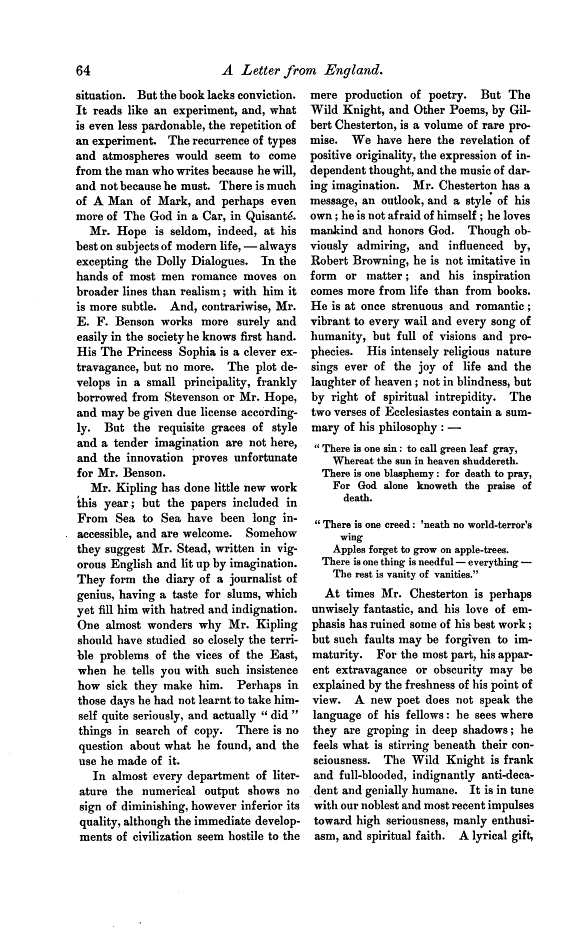
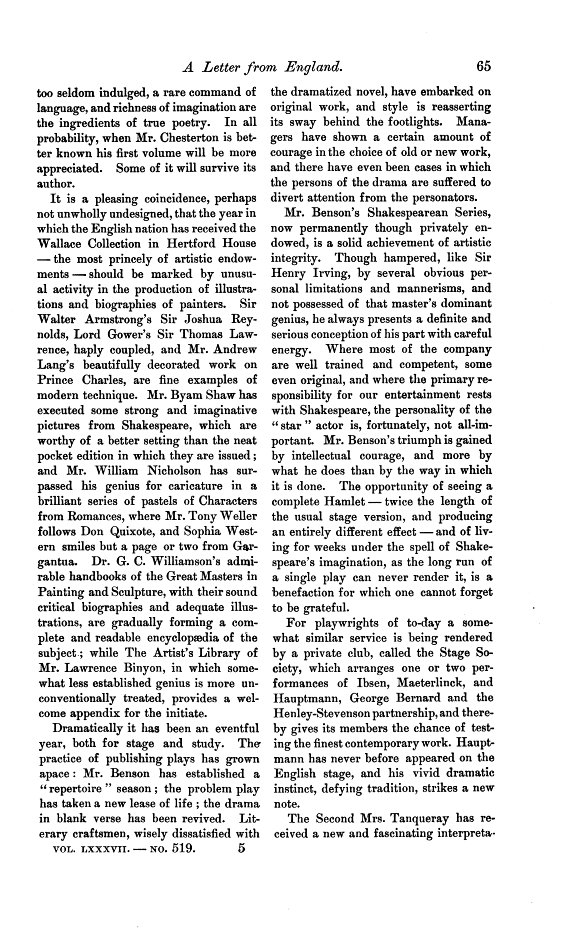
When you click on the link above, you can read the whole article, but the review of Chesterton's new book, Wild Knight is on page 64, which you can click and link directly to.
The Wild Knight is frank and full-blooded, indignantly anti-decadent and genially humane. It is in tune with our noblest and most recent impulses toward high seriousness, manly enthusiam, and spiritual faith. A lyrical gift, too seldom indulged, a rare command of language, and richness of imagination are the ingredients of true poetry. In all probability, when Mr. Chesterton is better know his first volume will be more appreicated. Some of it will survive its author.Which indeed, it has.
Saturday, February 03, 2007
For Those Who Missed Dr. Thursday's Post
His computer crashed this week. Pray he can recover the data. Thanks. He will return when he can.
Meanwhile, he sent me another Candlemas quote. (From another computer.)
Meanwhile, he sent me another Candlemas quote. (From another computer.)
It might be said, for instance, that there are few more vivid or typical scenes in the Stevensonian tales than that of the duel at midnight in The Master of Ballantrae. But there again the exception proves the rule; the description insists not on the darkness of night but on the hardness of winter, the 'windless stricture of the frost'; the candles that stand as straight as the swords; the candle-flames that seem almost as cold as the stars. I have spoken of the double meaning of a woodcut; this was surely, in the same double sense, a steel engraving. A steely cold stiffens and steadies that tingling play of steel; and that not only materially but morally. The House of Durrisdeer does not fall after the fashion of The House of Usher. There is in that murderous scene I know not what that is clean and salt and sane; and, in spite of all, the white frost gives to the candles a sort of cold purification as of Candlemas. But the point is, at the moment, that when we say this deed was done at night, we do not mean that it was done in the dark. There is a sense of exactitude and emphatic detail that belongs entirely to the day. [from Robert Louis Stevenson CW18:56]
Friday, February 02, 2007
Today
Thanks, Dr. T.
"The Paradox"
These wells that shine and seem as shallow as pools,
These tales that, being too plain for the fool's eyes,
Incredibly clear are clearly incredible -
Truths by their depth deceiving more than lies.
When did the ninety and nine just men perceive
A far faint mockery in their title's sense
In the strange safety of their flocks and herds
And all the impenitence of innocence ?
The sons of reason sin not and throw stones,
Nor guess where burn behind the battered door,
In the shining irony of Candlemas,
A hundred flames to purify the pure.
[from Queen of Seven Swords 20]
Thursday, February 01, 2007
Picture or Info Please

Once again, in doing research, I am looking for the year of Frances Alice Blogg Chesterton's birth.
I know it is chiseled into the gravestone in the graveyard in Beaconsfield, but from the pictures on-line, I can't see Frances's information, only Gilbert's. They are buried in the same grave with a mutual marker.
Several sites on-line list her as being born in 1875, and I was pretty sure I had it that she was born in 1869. So, I need to either see a picture of the gravestone, or have someone verify her birth year for me.
Thanks for your help.
New Reader Discovers Chesterton and requires Albuterol for breathing treatments
(JK--as they say [just kidding]) Still, wonderful to read about a new reader of Chesterton.
And we are not a tacky trivia website, either, so says Still Breathing.
And we are not a tacky trivia website, either, so says Still Breathing.
Subscribe to:
Posts (Atom)


 Posts
Posts