...and if I lived here, I think I would consider driving it for my sanity's sake.
I am at a conference. Lest you get too excited by that word, this is a Framing Conference. Where we learn how to stretch canvas, and display our frame corner samples, and pick up cheap China oil paintings to display in our stores. I am not here for any retail kind of purpose, I'm here with my artist to see what we can do to improve our presentation.
In syn city. They even make fun of that name. A young woman in front of me in class yesterday sported a t-shirt with "Sinner" across her shoulders, loud and clear. Unless she was a recent born-again, I think she was making fun of this city's other name.
Reno is only 8 hours away, you can make it to the local Chesterton meetings once a month. If I lived here, I would do it.
Are there any Chestertonians in this city?
Tuesday, January 30, 2007


Monday, January 29, 2007
St. Francis Study Guide
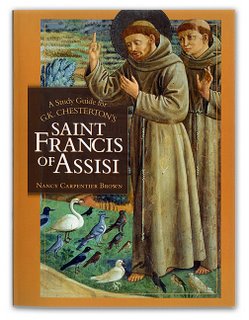 The St. Francis Study Guide is just published, and Dr. Thursday, avid and knowledgeable Chestertonian (so this means a lot to me), who is a regular reader here, has written an awesome review of it after his first read-through. No, that's wrong, as he says, this is not the review, he will review it later. This is his first reaction.
I just received the GKC SFA Study Guide...WOW, what a work!!! I read it straight through last night. Very good. Now I have to read the GKC book again! [This is what I hoped for when I wrote it, that those who knew Chesterton's work would want to read it again; those that didn't couldn't wait to get their hands on a copy.-ed]...But it is quite wonderful, and also inspiring. The best bit for me was the point about STA [St. Thomas Aquinas-ed]- it sure is funny to think that GKC liked SFA so much he wrote another whole chapter about him in a book about somebody else! ...There are other good points here, and indeed so rich that one could even find a doctoral topic among your questions! ...it is a very nice book, and (like your other) ought to help get GKC into the hands of more people. It certainly will help enlighten more people about St. Francis, too - which is a very Chestertonian thing...once I re-read SFA I will do a review. But for now I will just write one word. Splendid! [emphasis mine-ed]Thanks, Dr. T.
What do you get when you purchase the St. Francis Study Guide?
In the Introduction, I give you a history of Chesterton's love for St. Francis, and some pertinent background information about the writing of his book. Plus quotes from biographers about Chesterton writing St. Francis.
Next, I explain how to use the study guide, and who the study guide is for.
Who? This study guide is much more in depth than the Blue Cross, so I've recommended it for upper high school students, Juniors and Seniors, and college age. Plus, this book would be ideal for a Chesterton study group, or an upper high school book club. It could also be used at a parish reading club, or in High School religion or lit classes, or Religious Education classes.
I have broken down the study by chapters, and there are questions for each chapter, writing prompts, and deeper thinking discussion questions. There are 10 chapters in Chesterton's book, so this would make an ideal 10 week study, or if you squished together two of them, a 9 month school calendar study.
There is an extensive Resource Listing in the back, as well as a time line of St. Francis's life, and the Canticle of Brother Sun.
The student will think about
* Who was St. Francis?
* What does courtesy have to do with saintliness?
* What was unique about the world Francis was born into?
* What is the meaning of Le Jongleur De Dieu? A Troubadour?
* What is the difference between praising nature and nature worship?
* And much, much more.
 Note: You will need the St. Francis book, which you can get here, be sure to join the ACS so you can get the 20% discount on the books.
If you have any questions about this book, please don't hesitate to e-mail me. You can get an autographed copy from me by clicking on the button on the left, or from the publisher.
Saturday, January 27, 2007
Two Titles Available Again

I was excited to see that Maisie Ward's Biography of Chesterton is back in print. This is a really excellent biography which, along with the Pearce, gives you a wonderful picture of what Chesterton was like as a person.
In addition, there is a new Fancies vs. Fads out.
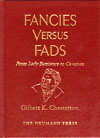 Both books would make great additions to your Chesterton collection.
Friday, January 26, 2007
Chicago Area Event-Joseph Pearce
Joseph is speaking on Friday, March 9, 2007.
The monthly Forum is sponsored by the Catholic Citizens of Illinois. These are monthly luncheon meetings held at the Chicago Athletic Association, 12 S Michigan Avenue, at 12 noon. The luncheon is $25, and attendees pay at the door. Reservations are required, and must be made at least five days in advance. For reservations, call Maureen at 708 352-5834. If a reservation must be cancelled, the sponsors ask that Maureen be notified -- otherwise they will have to pay for the meal ordered in your name.
The monthly Forum is sponsored by the Catholic Citizens of Illinois. These are monthly luncheon meetings held at the Chicago Athletic Association, 12 S Michigan Avenue, at 12 noon. The luncheon is $25, and attendees pay at the door. Reservations are required, and must be made at least five days in advance. For reservations, call Maureen at 708 352-5834. If a reservation must be cancelled, the sponsors ask that Maureen be notified -- otherwise they will have to pay for the meal ordered in your name.
Thursday, January 25, 2007
1500 Years of Light from Death Row
In the picture for this post, you see our hero, Dale Ahlquist, between two great English writers - er - between actors portraying two great English writers. Even I - no lit'ry guy - know who they are. I hope you know too.
Today, as I peruse the amazing treasure-house of Dover Publications, in awe of its strong resonance with the works of G. K. Chesterton, I would like to tell you about a book not by Chesterton - but which is mentioned by Chesterton. GKC's Chaucer links not two great writers (like Dale in the picture!) but three - Alfred the Great, (849-899) the King of Wessex; Jeff (aka Geoffrey) Chaucer (ca. 1340-1400); and Anicius Manlius Severinus Boethius, executed for treason (?) in 524 A.D.
I mention the full name of the third author in order to avoid the confusion GKC fell into:
But so did Chaucer.
If you want to read more about Boethius and his book, and how this relates to Chaucer, order CW18 from The American Chesterton Society.
Or click here for an excerpt...
Here's an excerpt from GKC's Chaucer:
Translations of this book, The Consolation of Philosophy by Boethius, are still available, and can still have an effect. It affected me when I first heard about it in (of all places) a fraternity magazine! Though I have read it, I shall not attempt a review - I would make a far worse mess than the legend tells King Alfred made with the cakes. But it begins with Boethius in prison, and the mystic appearance of Philosophy as a beautiful woman with her robe (made by her own hands) bordered over and over with the great Q above the P yet connected by stairs - stirring and profound symbols teaching the resolution of the great conflict of the "liberal" versus the "technical" arts, and yet ignored by so many... the great prayer for wisdom she makes to God, for the enlightenment of Boethius... the explanation, settling forever the concept of "fortune" or "chance" versus the Divine Will... An amazing book read by people for more than a millennium, and still enlightening today.
Today, as I peruse the amazing treasure-house of Dover Publications, in awe of its strong resonance with the works of G. K. Chesterton, I would like to tell you about a book not by Chesterton - but which is mentioned by Chesterton. GKC's Chaucer links not two great writers (like Dale in the picture!) but three - Alfred the Great, (849-899) the King of Wessex; Jeff (aka Geoffrey) Chaucer (ca. 1340-1400); and Anicius Manlius Severinus Boethius, executed for treason (?) in 524 A.D.
I mention the full name of the third author in order to avoid the confusion GKC fell into:
I wrote in these columns some reference to Alfred the Great translating Boethius. [See August 27, 1910 CW 28:588; July 26, 1927 CW 34:343, or October 19, 1935] When this was mentioned. in the hotel then my home, I naturally supposed it was an interest in Alfred the Great. I found everybody indifferent to that glory of Wessex and the world, but full of a most commendable cultural curiosity about Boethius. One four-square Yorkshire merchant faced me firmly and said, "Who was Boethius?" I told him the very little I know about that sage of the Dark Ages; how he made a digest of the old pagan philosophy for the use of Christians, and was a popular authority throughout the Middle Ages; how he was killed by Theodoric; see any encyclopaedia. A moment after, a lady shot up to me, shrill with congratulations, and cried, "Oh, Mr. Chesterton, I'm so glad you mentioned Boethius." I was bemused. I went out into the night. In the front of the hotel I found the porter - and the portent. For the porter also pronounced the name of Boethius, though he pronounced it in a curious way. Also, he went into fits of laughter. I then found that Boethius was the name of a horse, running in a race of enormous national importance. ... it is much more exciting that Alfred translated Boethius than that he did or did not burn cakes. For those who can appreciate a fight, when it is a fight for anything worth fighting for, the career of Alfred of Wessex is much more thrilling than a horse-race. Nor is it irrelevant, in the matter of the race between rival ideas in history. Alfred in translating Boethius had certainly picked a winner. It is all part of one very dramatic story, which stars with Boethius being murdered by a barbarian chief, and ends with Alfred being victorious over the barbarian chiefs. The relation between the Saxon king and the Roman philosopher stands for that relation between England and Europe, which was actually in some ways more intimate and international in the rude conditions of the Dark Ages than in the more refined conditions of the modern age.Yes, King Alfred the Great (the hero in GKC's "Ballad of the White Horse" - no pun intended!) did indeed translate Boethius.
[GKC ILN Feb 8, 1936; thanks to Frank Petta and my mother]
But so did Chaucer.
If you want to read more about Boethius and his book, and how this relates to Chaucer, order CW18 from The American Chesterton Society.
Or click here for an excerpt...
Here's an excerpt from GKC's Chaucer:
The business of the translation of Boethius touches a general truth, even at the beginning, which will become more apparent and important towards the end. The relation of medieval men to philosophy, and enlightenment in general, was rather curious; and is not covered by the natural metaphors employed. We used to talk of the Dark Ages; most of us know by now that the true Dark Ages came before the true Middle Ages; and that in many ways the Middle Ages were far from dark. But, following the figure of an age of darkness, we are apt to think of an age of twilight; or perhaps, of grey morning light. But the metaphor itself is misleading. Twilight means an equally diffused light; and the difficulty of medievalism was the difficulty of diffusion. It would be truer to compare even the Dark Ages to a dark room, with certain chinks in the shutters through which particular rays of light could pierce. But the light was daylight, what there was of it; and not even a dull or troubled daylight. It was broad daylight that came through a narrow hole. Or it was like some long narrow ray of a searchlight sent out from a great city and falling like a spotlight on a remote village or a lonely man. And just as any man, however much in darkness, if he looks right down the searchlight, looks into a furnace of white-hot radiance, so any medieval man, who had the luck to hear the right lectures or look at the right manuscript, did not merely 'follow a gleam', a grey glimmer in a mystical forest; but looked straight down the ages into the radiant mind of Aristotle. There was indeed, as I have said, any amount of indirect transmission of light; any amount of reflection - in every sense. But I am not talking of the quantity, but of the quality of the light. Such light as they had came, not only from the broad daylight, but from the brilliant daylight; it was the buried sunlight of the Mediterranean. These men seem to be, and in some ways were, men simple or primitive. But their philosophy was not merely simple or primitive. In some cases it came from a ripe and rounded civilization; in some cases even from an over-ripe, from an autumnal civilization; from an over-civilized civilization. We might compare them to children in some cold and gloomy March, looking at the barns filled with the grain garnered by dead men in a forgotten autumn; but anyhow they fed their wild boyhood on things that were mature, and sometimes more than mature. Hence we have the paradox that a rude and primitive society, in some sense starting afresh, yet had so often for its guides, not merely the writers of the old world, but the writers of the world when it was growing old. All such paradoxes work back to the paradox: that the further we go back to first ages of the modern world, the nearer we are to the last ages of the ancient world: as King Arthur stands in Britain at once as the first of the Britons and last of the Romans. Thus a primitive poem, like Abbo's 'Siege of Paris', stops amid the storm of northern arrows rattling on rude roofs and walls, to make mythological conceits that had been copied from the copyists of Ovid or Virgil for five hundred years. But Ovid and Virgil are not the less civilized poets because barbarians continued to copy them. The men of a new civilization were not the less able to understand the civilized poets, because they had been continually copied. In a word, medieval men were not in the twilight; what they knew they knew. They had not read Homer at all; and (strange as it seems in a literate and enlightened age) did not despise him because they had not read him. They had read Virgil much more fully and thoroughly than we have. Anyone who doubts it may make the experiment of quoting beautiful Virgilian lines in a first-class railway carriage, full of politicians and captains of industry. In a word, though their knowledge of civilized antiquity was in a sense scrappy, though the scraps were not only old scraps but sometimes stale scraps, they had enough of them to understand what the great ancients had meant by wisdom; and, unlike some others, they had the great wisdom truly to try to be wise.
The case of Boethius illustrates specially the second truth; that the spring of medievalism had fed on the autumn of classicism. Boethius was a man who lived very late in the break-up of the Empire, under Theodoric. The period, with its power of amalgating [sic] old and new, has been much underrated. Boethius hands on the Stoic memories; but it is not really necessary to deny that he was a Christian or assert that he was a nominal Christian. Many pagan philosophers were converted by Christian philosophy. His work was a sort of distillation of all that had been best in Paganism; small in quantity but good in quality. Thus he served very truly as a guide, philosopher and friend to many Christians; precisely because, while his own times were corrupt, his own culture was complete. Generally speaking, the cultured Mediterranean man had come to play this part towards northern men. His disciples had not read Homer, but he had; they did not remember one kingdom acknowledged from Scotland to Syria, but he did; they did not know in detail what fine shades of feeling or criticism had come with Catullus or Lucian, but he did. Thus (in the special case of Boethius) we find this mirror of maturity still reflecting a lost daylight in the darkest age; and playing a unique part, especially in the development of the English. Boethius, who had been martyred for justice by his barbarian master, wrote in prison a book called 'The Consolations of Philosophy'; in which he summed up all the truth and tradition of antiquity. Alfred of Wessex, the first great man of our own island story, wishing to educate his half-savage Saxons, assumes at once that it can be done best by translating Boethius. He also, like those who followed him, put a great deal into Boethius that is not in Boethius. He may be said to have completed the old Stoic's conversion to Christianity after his death. Chaucer, perhaps the last great Englishman of the same united Christendom, feeling the same need of portable philosophy, instantly turned to the same idea of a translation of Boethius. He also quotes from Boethius, consciously and unconsciously, in any number of his ordinary poems. Boethius was a point of view; it was a calm and cultured and well-balanced point of view; and the essential thing to realize is that a medieval man could have it as a common and normal point of view; and take it quite easily, like Chaucer.
[GKC, Chaucer, CW18:242-5]
Translations of this book, The Consolation of Philosophy by Boethius, are still available, and can still have an effect. It affected me when I first heard about it in (of all places) a fraternity magazine! Though I have read it, I shall not attempt a review - I would make a far worse mess than the legend tells King Alfred made with the cakes. But it begins with Boethius in prison, and the mystic appearance of Philosophy as a beautiful woman with her robe (made by her own hands) bordered over and over with the great Q above the P yet connected by stairs - stirring and profound symbols teaching the resolution of the great conflict of the "liberal" versus the "technical" arts, and yet ignored by so many... the great prayer for wisdom she makes to God, for the enlightenment of Boethius... the explanation, settling forever the concept of "fortune" or "chance" versus the Divine Will... An amazing book read by people for more than a millennium, and still enlightening today.
Tuesday, January 23, 2007
Inaugural Address of the Philosophical Society, 1926
"I wish to acquit myself of the charge of contemptuousness. All my life I have endeavoured to explain that my sympathies are entirely with the mass of people in their ordinary instincts. I am not a highbrow. I realise that it is this mass of normal people which keeps the world straight and that, without them, the world would soon qualify for a lunatic asylum." GKC
Monday, January 22, 2007
Huge Long But Surprisingly Interesting Report on the Chestertonian Adventure to Birmingham last week

Be prepared to read. And read. And read. And don't forget to click the link to the pictures, because you will enjoy them.
Saturday, January 20, 2007
New Pearce book available in the US
 Biographer of G.K.Chesterton, Joseph Pearce has a new book out, Small is Still Beautiful, subtitled: Economics as if Families Mattered. From the publisher:
A third of a century ago, E. F. Schumacher rang out a timely warning against the idolatry of giantism with his book Small Is Beautiful. Since then, millions of copies of Schumacher’s work have been sold in dozens of different languages; few books before or since have spoken so profoundly to urgent economic and social considerations. Schumacher, a highly respected economist and adviser to third-world governments, broke ranks with the accepted wisdom of his peers to warn of impending calamity if rampant consumerism, technological dynamism, and economic expansionism were not checked by human and environmental considerations. Humanity was lurching blindly in the wrong direction, argued Schumacher. Its obsessive pursuit of wealth would not, as so many believed, ultimately lead to utopia but more probably to catastrophe.
Schumacher's greatest achievement was the fusion of ancient wisdom and modern economics in a language that encapsulated contemporary doubts and fears about the industrialized world. The wisdom of the ages, the perennial truths that have guided humanity throughout its history, serves as a constant reminder to each new generation of the limits to human ambition. But if this wisdom is a warning, it is also a battle cry. Schumacher saw that we needed to relearn the beauty of smallness, of human-scale technology and environments. It was no coincidence that his book was subtitled Economics as if People Mattered. Joseph Pearce revisits Schumacher’s arguments and examines the multifarious ways in which Schumacher’s ideas themselves still matter. Faced though we are with fearful new technological possibilities and the continued centralization of power in large governmental and economic structures, there is still the possibility of pursuing a saner and more sustainable vision for humanity. Bigger is not always best, Pearce reminds us, and small is still beautiful.
Book discussion here.
Interview with Pearce about this book here.
Friday, January 19, 2007
The Blue Cross Study Guide

The publisher of The Blue Cross Study Edition , Hillside Education, has just informed me that The Blue Cross is going into a second edition. Which I am thrilled about.
Then she told me about all the places that are selling The Blue Cross, and I found it fascinating to think about it. You can find the book at Aquinas and More, Adoremus Books, Sacred Heart Books & Gifts, and, of course, The American Chesterton Society's Merchandise & Books page. And naturally, you can get it from Hillside Education and from me, too (and I'll even autograph is, although that might lower the resale value of it :-\ ).
If your Chesterton group would like to do The Blue Cross, this would be a great aid; if your homeschool group would like to study The Blue Cross, this would be a great guide; if you'd like to introduce your high schooler to the work of G.K. Chesterton, this would be the perfect start; if you would like to get more out of reading The Blue Cross, this is your book.
Thursday, January 18, 2007
A Sword Adventure(r)
By now you may have received another wonderful issue of Gilbert! with glimpses from GKC's own turf - and so the topic of "swords" may be a bit out of date - no pun intended.
But, since you are a Chestertonian, you will be interested to know that there are several sword books available from Dover, including titles like
* The Archaeology of Weapons: Arms and Armour from Prehistory to the Age of Chivalry
* The Sword Through the Centuries
* The American Sword 1775-1945
and there is even a colouring book!
But in particular I want to mention The Book of the Sword: With 293 Illustrations by Sir Richard F. Burton. That name may be familiar to careful readers of GKC.
Richard Francis Burton, 1821-1890, was a British explorer and Orientalist who mastered some 40 languages and dialects. Not only did he have adventures, he wrote about them, including places like Mecca and Medina (which he visited in disguise!), Lake Tanganyika, and Salt Lake City. (Some of these look quite interesting, and are reprinted by Dover; do your own exploration by simply using their search box on "Burton".)
One other book by Burton which I seen GKC mention is his The Essential Anatomy of Melancholy, which GKC must have known well enough (and expected his readers to know well enough) to refer to as an example in his ILN columns:
PS: One of the sword-items which I don't recall seeing mentioned in the "Sword Issue" is the very interesting short story called "The Sword of Wood". It is to be found (along with many other interesting stories and fragments) in the very important CW14, which is one of the must-have volumes of CW. So visit the ACS web site today and get your own copy! You will be glad you did.
Update:
I have learned that Encomium Moriae by Erasmus is available (in English) from Dover under the title In Praise of Folly; however, I was not able to find The Wallet of Kai-Lung in their catalog.
But, since you are a Chestertonian, you will be interested to know that there are several sword books available from Dover, including titles like
* The Archaeology of Weapons: Arms and Armour from Prehistory to the Age of Chivalry
* The Sword Through the Centuries
* The American Sword 1775-1945
and there is even a colouring book!
But in particular I want to mention The Book of the Sword: With 293 Illustrations by Sir Richard F. Burton. That name may be familiar to careful readers of GKC.
Richard Francis Burton, 1821-1890, was a British explorer and Orientalist who mastered some 40 languages and dialects. Not only did he have adventures, he wrote about them, including places like Mecca and Medina (which he visited in disguise!), Lake Tanganyika, and Salt Lake City. (Some of these look quite interesting, and are reprinted by Dover; do your own exploration by simply using their search box on "Burton".)
One other book by Burton which I seen GKC mention is his The Essential Anatomy of Melancholy, which GKC must have known well enough (and expected his readers to know well enough) to refer to as an example in his ILN columns:
We all know that the principle of abridgment is abroad just now. It is applied to things to which it is approximately applicable, as to very voluminous ancient works from which few modern people ever see any extract at all; things like Burton's "Anatomy of Melancholy, " or the "Encomium Moriae" of Erasmus. It is also applied to things to which it is absurdly inapplicable; like the most poetical plays of Shakespeare, which nearly everybody can obtain and almost anybody should enjoy. But at least in most of these cases there is no doubt or mystery about whether the work is abridged or not.Also:
[GKC, ILN Dec 12 1925 CW33:608]
I have had occasion recently, for various dark and nefarious purposes of my own, to read a good deal of what has lately been written about Robert Louis Stevenson. I had no need to read what was written by Robert Louis Stevenson, for I have read it all long ago and many times over; and I have remembered it, which does not seem to be the case with some who depreciate it. For I have found the critics not so much criticising Stevenson as criticising somebody else and putting it down to the discredit of Stevenson. The strangest things are said on the subject. One distinguished critic said that Stevenson was only an inferior imitator of Poe; which is like saying that Dickens is only one mass of plagiarism from Byron, or that "The Wallet of Kai-Lung" is a sort of reprint of Burton's "Anatomy of Melancholy." I simply do not know what the statement means.As I have not yet read Burton's book, I too do not know what the statement means. But now I know where to find the book if I want it, and so do you.
[GKC ILN Oct 8 1927 CW34:392]
PS: One of the sword-items which I don't recall seeing mentioned in the "Sword Issue" is the very interesting short story called "The Sword of Wood". It is to be found (along with many other interesting stories and fragments) in the very important CW14, which is one of the must-have volumes of CW. So visit the ACS web site today and get your own copy! You will be glad you did.
Update:
I have learned that Encomium Moriae by Erasmus is available (in English) from Dover under the title In Praise of Folly; however, I was not able to find The Wallet of Kai-Lung in their catalog.
Wednesday, January 17, 2007
* FLASH * - Dale on EWTN Tonight
We have just received word (!) that Dale Ahlquist, president of the ACS, will be on EWTN tonight - live!
(Please check your local listings for details of time and channel.)
Dale also told us that filming (er, recording?) of GKC's "The Surprise" was completed - it will be a two-hour special presentation, not part of the new season IV, now being produced, of his AWESOME "GKC, the Apostle of Common Sense" show - these 13 new episodes will be shown in the fall.
Don't forget, you can get the three older series (seasons I, II, III) from the American Chesterton Society.
Incidentally, you may have noticed that "Apostle of Common Sense" has the same initials - ACS - as "American Chesterton Society". Hee hee.
(Please check your local listings for details of time and channel.)
Dale also told us that filming (er, recording?) of GKC's "The Surprise" was completed - it will be a two-hour special presentation, not part of the new season IV, now being produced, of his AWESOME "GKC, the Apostle of Common Sense" show - these 13 new episodes will be shown in the fall.
Don't forget, you can get the three older series (seasons I, II, III) from the American Chesterton Society.
Incidentally, you may have noticed that "Apostle of Common Sense" has the same initials - ACS - as "American Chesterton Society". Hee hee.
Chesterton in Alabama: Postings and Pictures
A blogger with a blog called Tremendous Trifles, a name that should sound familiar to you, was on the set of the filming of ACS IV.
He has information here, picture and post here, and lots more pictures and a post here.
Hat tip: Sean.
He has information here, picture and post here, and lots more pictures and a post here.
Hat tip: Sean.
Tuesday, January 16, 2007
Posting Position
Here is my attempt to clarify what this blog is all about.
Any questions or comments?
1. This blog exists for people who love Chesterton's writing to have
a place to meet on the internet.
2. This blog will attempt to bring up topics of conversation. The
readers and commentors on the blog are in charge of carrying on the
conversation.
3. If you don't like what this blog is doing, Blogger is free: Get
your own blog.
4. This blog is interested in everything that Chesterton was
interested in. That means everything is a potential topic for
conversation.
5. This blog does not exist to serve the blogmistress nor its
frequent commentors. This blog exists for everyone.
6. This blog will only improve and/or get interesting and exciting
when YOU join in the conversation and leave a comment.
7. This blog, like any newspaper or website, has an editor, and she
reserves the right to edit or delete any comments which she deems
inappropriate, demeaning or hurtful; contains harmful or crude
language, looks or smells like spam, or if there is any
meanspiritedness.
8. This blog tries, as Chesterton did, to engage in arguments, and
not in slander against individual persons. We encourage discussion on points which we seem to disagree, but we discourage disagreement for the sake of disagreement.
9. This blog will promote the American Chesterton Society and the
work it does and the books it sells whenever it feels like it.
Any questions or comments?
Monday, January 15, 2007
If you missed Belloc at the Conference...

Over the past several months, our family has been watching one Apostle of Common Sense each Sunday. We're on Season Three, and yesterday, we had the pleasure of watching the episode titled, "Friends" in which Mr. Ahlquist discusses Hilaire Belloc and the Third Man (from the portrait), Maurice Baring.
During the discussion about Belloc, there was a pleasant surprise: Kevin O'Brien performed the famous "Don" poem he wrote in defense of Chesterton. O'Brien had recited this poem for us at the Chesterton conference about two years ago, and what a treat it was. I remember him appearing in a tuxedo, mopping his brow with a handkerchief, and the audience quite in stitches.
If you missed the performance at the conference, isn't it wonderful to know that you can still see it? The Apostle of Common Sense season three would be a great gift to give yourself, or to suggest someone get for you.
Saturday, January 13, 2007
Filming at EWTN
I knew they were filming Season 4 of The Apostle of Common Sense this week at EWTN Studios, I forgot that Mark Shea was involved. He's been blogging it here, here, and here.
Sounds like, from the comboxes,
Sounds like, from the comboxes,
Monday on The Journey Home, the guest will be Nathan Allen, a former non-denominational fundamentalist and member of the Twin Cities Chesterton Society who came to the Catholic Church thanks to Chesterton. Nathan also is the unofficial official homebrewer for the annual Chesterton conference in St. Paul, so I hope Marcus asks him about that.Catch these if you can (and if you have EWTN on your cable.)
Wednesday, Dale [Ahlquist] himself will be on EWTN Live, hosted by Fr. Mitch Pacwa.
Getting into someone's mind
I was thinking about Dr. Thursday's posts on Dover. What's fascinating about the Dover books is that you can play detective. Find out what Chesterton was reading, get into Chesterton's mind a little bit. It's the same as my lower post, wondering about what Dale Ahlquist was reading in 2006. Our human curiosity about other people leads us, especially if they are admirable, to wonder how they come to think the way they do and what forms their ideas.
So these Dover posts by Dr. Thursday feel, to me, like puzzle pieces, like detective work. Chesterton refers to many of the works he's just read in his writing; his clues are everywhere. It take a lot of time to read all of Chesteton's own work, much less the work Chesterton read before he wrote, but that's what makes being a Chestertonian so fun: There's always more to read.
So these Dover posts by Dr. Thursday feel, to me, like puzzle pieces, like detective work. Chesterton refers to many of the works he's just read in his writing; his clues are everywhere. It take a lot of time to read all of Chesteton's own work, much less the work Chesterton read before he wrote, but that's what makes being a Chestertonian so fun: There's always more to read.
Friday, January 12, 2007
Thursday, January 11, 2007
Where Robots Come From
We continue our exploration of Chestertonian books from Dover Publications. But before I proceed to today's topic, I want to mention another title, which it perhaps one of the funniest titles in the Dover collection: Great English Essays from Bacon to Chesterton . Hee hee! (Good thing it's lunchtime.)
--Dr. Thursday.
According to the introduction in the Dover edition of today's book, the word "robot" was invented by Josef Capek, older brother of Karel Capek (1890-1938), in 1920, from a Czech dialect word meaning "drudgery" - and it was introduced in Karel's play, "R. U. R." - "Rossum's Universal Robots" - a play about humanity, labor, and pride. Its importance lies not only in its hints and overtones of the dangers in the misuse of science and technology, but also in its opening of the question of what labor and work and employment - and humanity - is for. Such a deep, but universal topic remains as important now as it did when Pope Leo XIII wrote his Rerum Novarum in 1891, beginning the current phase of "Catholic Social Teaching" with its focus on human labor, the family, and the State. I won't say it is a pleasant play, but then my purpose here is not to review the play - merely to give a bit of "stage-setting" (no pun intended!) of today's selection.
R. U. R. by Karel Capek.
Humanity, and man's purpose on earth - and labor, and the Social Thing - is a famous Chestertonian topic, covered in many places from What's Wrong With the World and The Outline of Sanity to hints in Fatber Brown stories like "The Invisible Man" (which has mechanical men too!) and ILN essays. Such a play, which soon appeared in English (it was on Broadway in 1923) would quickly attract GKC's attention:
There was a debate the other day about the play of "R.U.R.," the Bohemian play about Robots, or mechanical men. It took place at the theatre where this and other stimulating and problematic plays have been presented; I happened to take part in it, and found myself arguing with Mr. Bernard Shaw. As I did so, there came on me that mysterious and elusive feeling of which Wordsworth wrote, and which many psychologists have noted as a mystery of the mind. It seemed, somehow, as if it had all happened before, possibly in some previous existence. Surely this was not the first time I had argued with Mr. Bernard Shaw. Surely I had done it before; many, many times before. But, despite these weird recurrences, I should be very glad to do it again, for it seemed to me that the debate left off precisely at the point at which it came in sight of the true difference. And the difference does not merely concern him and me, but hundreds of other people who are thinking what can be done with modern mechanical civilization.GKC mentioned another of Capek's works in a different place, and though our play is not mentioned directly, there are important overtones and suggestions which play into its topic, and so I shall quote it at length:
[ILN July 14, 1923 CW33:134]
I see that Mr. Karel Capek has written a most amusing and disarming little book about Italy, and among other foreign critics I think he is a thousand times more likely to be right because he continually confesses that he may be wrong. This attitude is so startling in an art critic, that I hail it with the veneration due to something great and heroic; and all the more so because I think he is wrong. He thinks that Christianity died with the Gothic and the Byzantine and that Catholicism, something different and practically Pagan, came in with the classical and the florid. There are a hundred answers to this; over and above an obvious query about Catholicism only beginning about the same time as Protestantism. Perhaps the shortest answer is to point out that the very period which plastered all the churches with naked cherubim and saints looking like sun-gods was the period that produced some of the most sensitive and humble and sympathetic of all the great Christians of history; that people like St. Vincent de Paul and St. Francis of Sales and St. Theresa walked in some such wilderness of white new marble and glaring tropic gold; their souls as delicate and transparent and tenderly coloured as any window of the Middle Ages. The real explanation is not that they thought so much more of gold and marble, but that they thought so much less of them.
Christianity or Catholicism (and, with best wishes to Mr. Capek, they are not different) is something more than a mood. It is something more like an event; an event like a baby being born in a family. The parents know they will have hundreds of moods about the baby; ranging from something approaching idolatry to something drifting towards infanticide. But the fact is not altered, and other things including moods, are adjusted to the fact. There can be all sorts of discussions in the family about the best style of toys for the baby; just as there are all sorts of discussions about the best style of art for the Church. There is a Golliwog School as there is a Gothic School; there are people who do not feel a wax doll from the Lowther Arcade as too florid or foolish, just as there are people who do not feel a Madonna of Murillo as too like a wax doll from the Lowther Arcade. There are others who would have every puppet in the nursery as perfect in form and balance as a Greek god in a temple; like that little figure of the Flying Mercury which was knocked off a motor-car in one of Mr. Wells's novels and picked up by a child, who preferred it to all his Punches and Teddy Bears. There is an endless and equal quarrel between the classic and the fantastic. It can always be said that reason and order are better than unreason and anarchy; and answered that there lies beyond our reason a world of wilder and more wonderful mysteries; and answered again that pure harmony is really the same as perfect liberty; and answered yet again that a more perfect liberty would seem to our limited vision imperfect. It is quite true, on the one hand, that the straight limbs of the Greek hero, or even the straight lines of the stiff Egyptian god, may be in truth a still whirlwind of perfect motion and energy. It is true again that there is something in us at once antic and domestic. Something for which a thing is not quite familiar unless it is a little outlandish. Something that is more at home with the goblins than the gods. That dispute can rage round the dolls of the nursery as round the idols of the temple. But those of us who are really concerned to apply it to the nursery or the temple do not really treat the differences as differences of deep or allegiance; they are a matter of means and not of ends. We, in the sense of those whose allegiance is the same as mine, do not feel about these schools of taste as the modern critics imagine, when they treat them as schools of thought. We like the doll that is as graceful as a dryad or the golliwog that is as hideous as a gargoyle. We pit them against each other and urge that this or that will be the more educational emblem; but we are not in the last resort thinking about these things. We are not merely comparing pleasures or merely pleasing ourselves; for to us a child is born.
[GKC, The Resurrection of Rome CW21:374-6, emphasis added]
Ah... did you hear Handel's music there? I did. I quoted at length for the sake of that last line, for that hints at the crisis of "R.U.R." - and indeed at the mystery of creation, and the role of man-and-woman as co-creators... Capek's play is only 58 pages long: it is powerful, and well worth the energy and time - and thought.
Wednesday, January 10, 2007
Do you want to know what Dale Ahlquist read in 2006?

Besides Chesterton, I mean.
I made the wonderful discovery of Alice Thomas Ellis this year. She is an English writer who died just a couple years ago. A Catholic convert, mother of seven, and a great cook, she wrote on food, family, and faith, with an incredible caustic wit that is a sort of combination of Jane Austen with a stiletto and Attila the Hun without the soft parts. I read her novels, The Inn at the Edge of the World, The Sin-Eater, Birds of Desire, The Summer House, and The 27th Kingdom, and two books of her Catholic essays, A Cat Among Pigeons and God Has Not Changed, which were no-holds-barred attacks on modernism. Savage delights.--Dale Ahlquist
Tuesday, January 09, 2007
Prayers Please
Two things:
1. The American Chesterton Drama Team is in Alabama right now, filming Season 4 of The Apostle of Common Sense. Please pray that this adventure will be fruitful in terms of good things happening to those who will eventually watch. And for safe journeys for all those who must go long distances to be there and go back.
2. Please pray for our Gilbert editor and his family, whom we've been incommunicado since his son had surgery. I am hoping no news is good news, and they've just been too busy to check in. Andrew, 20 months, had brain surgery, so this is very serious. So, without further news, we just pray, right?
1. The American Chesterton Drama Team is in Alabama right now, filming Season 4 of The Apostle of Common Sense. Please pray that this adventure will be fruitful in terms of good things happening to those who will eventually watch. And for safe journeys for all those who must go long distances to be there and go back.
2. Please pray for our Gilbert editor and his family, whom we've been incommunicado since his son had surgery. I am hoping no news is good news, and they've just been too busy to check in. Andrew, 20 months, had brain surgery, so this is very serious. So, without further news, we just pray, right?
Monday, January 08, 2007
Chesterton Sighting on the Ski Hill
What? Chesterton was seen skiing? This sounds like that Chesterton jogging guy's (Robert Moore-Jumonville) idea.
Saturday, January 06, 2007
Friday, January 05, 2007
Prayers Needed
Our Gilbert editor's son Andrew had brain surgery yesterday (20 months old)--please pray for a speedy recovery.
Our Gilbert graphic person has a little Teddy -4 years old- with Evan's syndrome, and his blood count was down so they are trying an experimental treatment on him, please pray for Teddy and Andrew.
Our Gilbert graphic person has a little Teddy -4 years old- with Evan's syndrome, and his blood count was down so they are trying an experimental treatment on him, please pray for Teddy and Andrew.
Thursday, January 04, 2007
The Jumblies
As some Chestertonians may already know, the wonderful company called Dover Publications has been reprinting several of GKC's novels, including Manalive, The Ball and the Cross, and Four Faultless Felons, thereby doing a great service to Chestertonians everywhere. (The Dover books by GKC are also available through American Chesterton Society.)
But GKC is not the only author they reprint. They have a most wonderful collection of titles, including some very important ones from history, language, mathematics, music, science - the list goes on and on. In case you are wondering, neither I nor anyone I know, nor any of my relatives or friends, has any connection with the company - I am simply a very satisfied customer, and I am very happy to tell people about them. Even in my own discipline of computer science I have obtained such interesting gems as Capek's play "R.U.R." which gave the world the word "robot" - and Gödel's 1931 doctoral dissertation which established the "Theorem of Incompleteness" which forever denies to science the atheological wish of a godless proof for the necessary existence of the universe - but there are so many others, like Biringuccio's Pyrotechnia (wiuth its powerful relevance to the Harry Potter discussion!) and Agricola's De Re Metallica (which is not about rock-and-roll!) and Faraday's The Chemical History of a Candle (how to classify THAT title!) and Marcus Aurelius' Meditations (written by a Roman emperor, and referred to by GKC and Jaki!); Burnham's Celestial Handbook, and so on and on and on...
Certainly, as true Chestertonians, we are surely interested in all these things, since GKC was interested in everything - but perhaps there are some of Dover's treasures which may be of more than simply the common or garden form of Chestertonian universal interest...
And indeed there are. But which of those thousands of titles are they?
Well, perhaps I can mention a few...
With today's posting, I shall provide you with some of the Dover books which Chesterton himself read, or refers to, and which you may find worth adding to your library. In each case, I will give a sample or two of GKC's comments about a word, or title, or reference to a topic, then give the title and author, and a link to the Dover book presently available. In many cases I already have the book, but I won't spend the extra time reviewing it - the mere fact of its reference by GKC ought to be enough of an advertisement for it.
Even if this is just a shameless promotion of a great book publisher, it is gratifying to see that there are still some books being printed which GKC himself read and wrote about - besides the obvious ones like the Bible, Homer, Aquinas, Shapeskeare, and Dickens.
-- Dr. Thursday
Thursday, January 4, 2006: The Jumblies
Whether it be because the Fall has really brought men nearer to less desirable neighbours in the spiritual world, or whether it is merely that the mood of men eager or greedy finds it easier to imagine evil, I believe that the black magic of witchcraft has been much more practical and much less poetical than the white magic of mythology. I fancy the garden of the witch has been kept much more carefully than the woodland of the nymph. I fancy the evil field has even been more fruitful than the good. To start with, some impulse, perhaps a sort of desperate impulse, drove men to the darker powers when dealing with practical problems. There was a sort of secret and perverse feeling that the darker powers would really do things; that they had no nonsense about them. And indeed that popular phrase exactly expresses the point. The gods of mere mythology had a great deal of nonsense about them. They had a great deal of good nonsense about them; in the happy and hilarious sense in which we talk of the nonsense of Jabberwocky or the Land where the Jumblies live. But the man consulting a demon felt as many a man has felt in consulting a detective, especially a private detective: that it was dirty work but the work would really be done. A man did not exactly go into the wood to meet a nymph; he rather went with the hope of meeting a nymph. It was an adventure rather than an assignation. But the devil really kept his appointments and even in one sense kept his promises; even if a man sometimes wished afterwards, like Macbeth, that he had broken them.
[GKC, The Everlasting Man CW2:250]
Nonsense may be described as humour which has for the moment renounced all connection with wit. It is humour that abandons all attempt at intellectual justification; and does not merely jest at the incongruity of some accident or practical joke, as a by-product of real life, but extracts and enjoys it for its own sake. Jabberwocky is not a parody on anything; the Jumblies are not a satire on anybody; they are folly for folly's sake on the same lines as art for art's sake, or more properly beauty for beauty's sake; and they do not serve any social purpose except perhaps the purpose of a holiday. Here again it will be well to remember that even the work of humour should not consist entirely of holidays. But this art of nonsense is a valuable contribution to culture..
[GKC From the entry for "Humour" in the Encyclopaedia Britannica, reprinted in The Spice of Life, 29]
So: what are Jumblies?
They are imaginary creatures in the nonsense poem "The Jumblies" by Edward Lear - available in The Complete Nonsense of Edward Lear, 71-74.
The Complete Nonsense of Edward Lear
Note: elsewhere GKC refers to other poems from Lear's book, notably, "The Dong with the Luminous Nose", which appears in several places, including this very important paragraph:
It is not merely true that a creed unites men. Nay, a difference of creed unites men - so long as it is a clear difference. A boundary unites. Many a magnanimous Moslem and chivalrous Crusader must have been nearer to each other, because they were both dogmatists, than any two homeless agnostics in a pew of Mr. Campbell's chapel. "I say God is One," and "I say God is One but also Three," that is the beginning of a good quarrelsome, manly friendship. But our age would turn these creeds into tendencies. It would tell the Trinitarian to follow multiplicity as such (because it was his "temperament"), and he would turn up later with three hundred and thirty-three persons in the Trinity. Meanwhile, it would turn the Moslem into a Monist: a frightful intellectual fall. It would force that previously healthy person not only to admit that there was one God, but to admit that there was nobody else. When each had, for a long enough period, followed the gleam of his own nose (like the Dong) they would appear again; the Christian a Polytheist, and the Moslem a Panegoist, both quite mad, and far more unfit to understand each other than before.
[GKC, What's Wrong With the World CW4:49]
Wednesday, January 03, 2007
Welcome Back to Gilbert, Sara
In the latest issue of Gilbert (the "Sword" issue) Sara Bowen returns with her wit and wisdom. Speaking for myself, it's nice to have a fellow female Chestertonian to hang out with in Gilbert.
I had just read that part which Sara quoted from Maisie Ward's biography where Chesterton is trashing his father's papers and Dorothy Collins walks in and probably screamed "Stop!" and saved a bunch of stuff. Sara had a "Dorothy Collins moment" (I like the coinage of that term) in her own home.
Glad you're back, Sara!
I had just read that part which Sara quoted from Maisie Ward's biography where Chesterton is trashing his father's papers and Dorothy Collins walks in and probably screamed "Stop!" and saved a bunch of stuff. Sara had a "Dorothy Collins moment" (I like the coinage of that term) in her own home.
Glad you're back, Sara!
Tuesday, January 02, 2007
Brewing Brew

I happened across an article that I thought would interest all you micro and home brew people. However, it won't interest you distributist types, as the article was on how to get money out of brewing. That's obviously not the point of Chestertonian brewing.
I did note that right in my own city is a major school, in fact, the oldest brewmaster school in American, the Siebel Institute. The two week course for beginners is just $2,950. I think you have to be pretty serious about brewing to do that. The article suggested volunteering as a summer intern at a brewery if you really wanted to learn.
The good news is that America has a 300 year old brewing tradition. 100 years ago, the US boasted 2,000 breweries. Prohibition, wars and consolidation whittled that numer down to 100 in 1985. But today, there has been a resurgence of brewing, and the nation counts 1,450 breweries (numbers from 2006).
Monday, January 01, 2007
The Senior Tutor

Happy New Year!
David Beresford, Gilbert columnist, Canadian, eh?, and confessionist to the most
David seems to have a soft spot in his heart for both poison ivy and seniors. Although, thankfully, he doesn't eat seniors. At least not in this story.
David is a guy for second chances. Second chances with the poison ivy, and second chances for seniors. Although he does, apparently have his limits, based on his talk at the last Chesterton conference (on The Limitless Possibility of Limits).
Subscribe to:
Posts (Atom)


 Posts
Posts